49 works in this view — arrow keys or swipe to move between them.
Dance in Art
Marie Taglioni
Unknown artist
- Collection:
- Prints depicting dance
- Source:
- New York Public Library
- Rights:
- Public domain — free to use, share and adapt.
- Recorded as:
- Public Domain
Taglioni was the most influential female dancer of the nineteenth century and the architect of the Romantic ballet vocabulary that remains foundational to classical ballet today. This portrait circulated during her performing lifetime and shaped how audiences understood her presence and character both on stage and in the public imagination.
What you are looking at
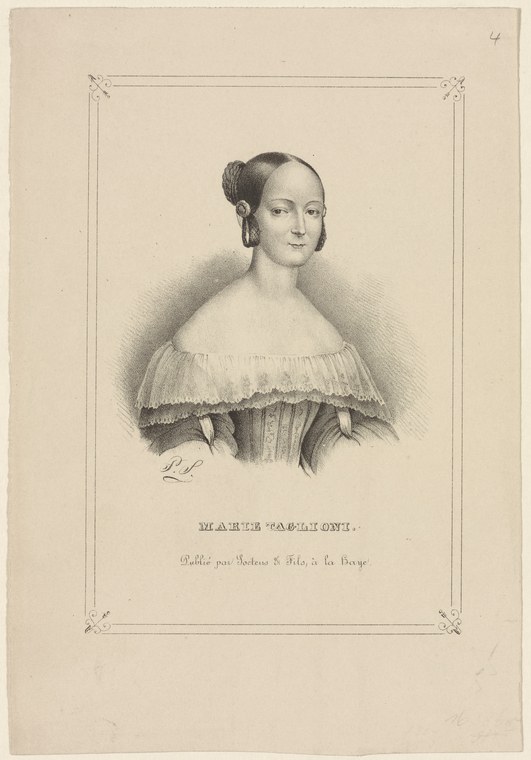
A young woman is presented in a three-quarter portrait bust, her head turned slightly to the right and tilted back gracefully. She wears her dark hair parted in the center and swept up into a low chignon at the nape of her neck. Her shoulders are bare, emerging from a voluminous off-shoulder garment rendered in fine parallel hatching that suggests silk or tulle. The most striking feature is an enormous cape or shawl of gossamer fabric that drapes across both shoulders and upper arms, creating a soft halo of texture around the figure. The rendering technique—fine engraved or etched lines—captures the luminosity of the fabric and the delicate modeling of her neck and décolletage. The background is plain, allowing the figure to occupy the full visual field. The inscription below reads "MARIE TAGLIONI" and credits the publication to "Publiée par Andro & Fils, à la Bauge" [*sic*], indicating this is a published print rather than a unique work.
The dancing
The figure is stationary and posed rather than captured mid-movement. Her weight is balanced; her shoulders are relaxed and symmetrical. The head carriage is notable—held high and tilted back slightly in a posture that combines dignity with a romantic quality typical of early nineteenth-century portraiture. The arms are not visible, subsumed into the drapery. This is a formal presentation portrait, not a study of a dancer in action.
The dance depicted
Marie Taglioni (1804–1884) was the most celebrated ballet dancer of the Romantic era and the first great exponent of the pointe technique that became central to classical ballet. This is a portrait of the woman, not a document of her dancing. Yet the costume elements—the off-shoulder neckline and the diaphanous shawl—reflect the Romantic ballet aesthetic she embodied and popularized, particularly through her performances in works like *La Sylphide* (1832). The image shows Taglioni in street or social dress rather than theatrical costume, and thus does not directly depict a specific dance or movement.
How it was made
This is an engraving or lithograph printed from a prepared plate or stone, as evidenced by the regular parallel hatching lines and the character of the line work throughout. The technique allowed for the mass production and wide circulation of celebrity portraits in the nineteenth century, making Taglioni's image available to print collectors, theater patrons, and the general public across Europe. The inscription and publication credit indicate this was a commercial print, likely sold individually or as part of a series of theatrical celebrity portraits. The fineness of the line work and the careful modeling of tone suggest a skilled practitioner and an expensive production.
About this work
This is a celebrity portrait print of Marie Taglioni, the dominant figure in Romantic ballet and an international star of the 1830s–1840s. The print dates from the height or aftermath of her fame and was published as a mass-produced engraving for the theater-going public. While the image does not depict Taglioni dancing, it documents her public image and the aesthetic values of Romantic femininity—ethereal, graceful, distinguished—that she embodied on stage and that ballet dancers still reference today.
The work belongs in a dance collection not as a performance document but as evidence of how dancers were celebrated, consumed, and imagined by their audiences. Portrait prints of celebrated dancers are artifacts of dance history in their own right, recording how contemporaries saw and remembered the great performers.
How to look at it
Attend to the carriage of Taglioni's head and the delicacy of her neck and shoulders—these convey both physical refinement and a quality of gentle reverie. The drapery is not incidental decoration but a formal device: its weightlessness and volume suggest the gossamer fabrics that defined Romantic ballet costume and the ethereal aesthetic she pioneered. The three-quarter pose and the slight upward tilt of the head are conventions of early nineteenth-century portraiture designed to convey both accessibility and idealization. Notice how the engraver has used line to suggest texture and luminosity rather than to create sharp definition—a technique that complements the Romantic aesthetic.
The artist
The artist is not recorded. The publication credit to "Andro & Fils, à la Bauge" suggests a Parisian publisher and printmaker, likely working in the 1830s–1850s when Taglioni's fame was at its height and the market for theatrical celebrity prints was booming. The technical quality and the care in the rendering suggest a professional hand accustomed to fashion and society portraiture.
The period
This print dates from the Romantic era in ballet, when the art form was undergoing a fundamental transformation. The rise of pointe work, the emphasis on ethereal and otherworldly female characters (sylphs, spirits, sprites), and the emergence of a cult of personality around individual dancers all coincide with Taglioni's career. She was the first ballerina to achieve true international stardom and to command audiences through a combination of technical virtuosity and dramatic presence. In the visual arts, Romantic portraiture moved toward capturing an idealized inner character and emotional interiority rather than mere likeness—evident here in the dreamy quality of her expression and the softly rendered drapery.
Where it lives
This print is held in the New York Public Library's collection of prints depicting dance. It is a published print, likely one of many editions, and represents a commercial artwork intended for mass circulation rather than a unique museum object.
Dance in this work
Questions about this work
Who was Marie Taglioni?
Marie Taglioni (1804–1884) was a Swedish-Italian ballerina and the most celebrated dancer of the Romantic era. She revolutionized ballet technique by perfecting pointe work and created an entirely new aesthetic for the art form, emphasizing lightness, grace, and the illusion of weightlessness. She was the first ballet dancer to achieve international celebrity status, and her performances in works like *La Sylphide* defined what Romantic ballet became.
Is this a picture of Taglioni dancing?
No. This is a formal portrait in social dress, not a stage image. It records how Taglioni appeared to the public in everyday settings and how she was imagined by audiences beyond the theater. Portrait prints like this were extremely popular in the nineteenth century and served as souvenirs, fan images, and cultural artifacts.
What is the gossamer fabric draped across her shoulders?
This is likely a shawl or stole, a fashionable accessory of the period. The engraver has rendered it with exceptional delicacy to emphasize the ethereal quality associated with Taglioni's stage persona. The diaphanous quality also echoes the tulle skirts and veils that defined Romantic ballet costume.
Why is this print in a dance collection?
Celebrity portraits document how dancers were seen, valued, and remembered by their contemporaries. They are primary sources for understanding the cultural importance of dancers and the aesthetics of their era. This print of Taglioni is an artifact of Romantic ballet history and a record of one of dance's most transformative figures.
More dance artwork





