49 works in this view — arrow keys or swipe to move between them.
Dance in Art
L'opera
Unknown artist
- Collection:
- Prints depicting dance
- Source:
- New York Public Library
- Rights:
- Public domain — free to use, share and adapt.
- Recorded as:
- Public Domain
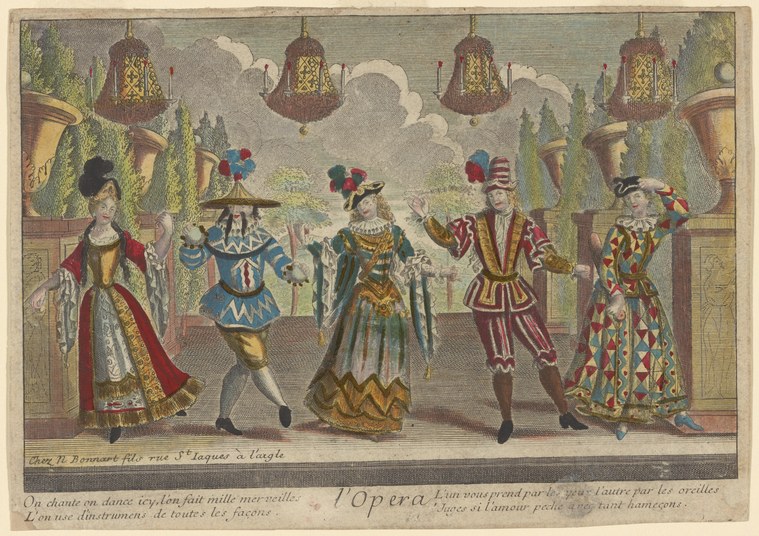
This print documents the visual and material conditions of operatic performance before the dominance of ballet, showing how dance functioned within a broader theatrical and musical framework. For dance historians, such images reveal how bodies were dressed, positioned, and presented in theatrical space, and how performance genres mixed music, spectacle, and movement in ways very different from later concert dance.
What you are looking at
This is a hand-colored engraving depicting a theatrical opera or court entertainment, likely from the 17th or 18th century. Five figures in elaborate costumes occupy a stage framed by ornate architectural elements—fluted columns, decorative capitals, and swags of drapery. Suspended above are four hanging lanterns with intricate geometric patterns, casting theatrical light. The backdrop shows stylized trees and clouds rendered in soft greens and grays. The figures wear richly detailed costumes in jewel tones: one woman in a crimson-lined gown with gold embroidery (left), a man in bright blue with gold trim, a central female figure in gold and white with patterned hems, and two men in red and white striped and colorful patterned clothing. The composition is frontal and relatively static, with figures arranged across the stage in a presentation rather than narrative moment. The engraving style is precise, with fine line work hand-tinted in watercolor or gouache.
The dancing
The five figures stand in scattered positions across the stage, none in immediate contact. The leftmost woman adopts a formal pose with one hand extended. The central female figure holds what appears to be a staff or wand. The two rightmost men strike theatrical attitudes with arms extended. None appear to be executing a specific dance hold or formation; instead, they present themselves to the viewer as costumed characters in a static theatrical arrangement. The postures suggest formal decorum and character display rather than kinetic dance.
The dance depicted
This is not a dance scene in the modern sense but rather a theatrical intermezzi or divertissement—an operatic character presentation or interlude common in European court entertainment of the 17th–18th centuries. Opera in this period included sung and danced passages, but the primary emphasis here is on costume, character, and spectacle. The figures' lack of contact and their frontal presentation suggests this captures a moment of theatrical display or a formal procession rather than an active dance sequence. The title 'L'opera' and the French text below indicate this documents a specific performance tradition.
How it was made
This is a hand-colored engraving: a composition created by incising lines into a metal plate (likely copper), inked, and printed onto paper, then tinted by hand with watercolors or gouache in each impression. The fine parallel lines visible in the background and architectural details are characteristic of engraved line work. The technique allowed for precise reproduction of costume detail and theatrical design, making these images valuable documents of performance practice. Such prints were sold to a broad educated audience as records of celebrated entertainments, particularly court spectacles and opera productions.
About this work
This engraving documents a moment from European operatic theater, likely from the court spectacles that dominated entertainment in the 17th and 18th centuries. The image preserves a record of theatrical costume, staging, and the integration of dance, music, and visual spectacle that defined opera as an art form. While the figures do not actively dance in the image, they represent the performer-characters who would have sung, moved, and entertained in these elaborate productions. The work belongs in a dance gallery because it shows the theatrical context in which dance existed and functioned—not as an isolated art but as one element within a multimedia spectacular designed to display skill, beauty, and courtly refinement.
How to look at it
Observe the frozen theatrical moment: how each figure presents a distinct character or role through costume and posture, yet no two are in physical dialogue. The architectural frame and hanging lights anchor the scene as a stage, not a ballroom or natural setting. Notice the extreme precision of the costume detail—the textile patterns, trims, and embroidery rendered in the engraving and hand-coloring—which signals that this is a record of actual spectacle, not invention. The static quality is key: this is a moment of presentation, not action, showing how theatrical display functioned alongside or instead of active dance.
The period
Opera emerged in Italy around 1600 and rapidly spread to France, where it became a vehicle for court spectacle and royal display. In the 17th and 18th centuries, opera incorporated elaborate intermezzos, entrées, and divertissements—danced and sung passages that showcased costly costumes, scenery, and performers. These spectacles served both as entertainment and as expressions of dynastic power. The engraving tradition of documenting such events was well established by this period; prints circulated among the educated elite and created a visual record of performances that were otherwise ephemeral. By the time this print was made, the integration of professional dance into opera was already underway, though the relative weight of music, spectacle, and dance varied considerably.
Where it lives
This print is held in the New York Public Library's collection of prints depicting dance. It is part of a broader archival effort to document performance history through visual material, particularly prints and engravings that record theatrical spectacles and entertainment practices before photography.
Dance in this work
Questions about this work
Is this actually a dance?
Not in the sense of a choreographed sequence. It is a moment from operatic theater, which included both danced and non-danced entertainment. The print captures a theatrical presentation scene—a moment of spectacle, costume, and character display. These scenes often included music and movement, but this particular image shows figures in static or formal poses rather than active dance execution.
What was 'L'opera' and when was it performed?
The title 'L'opera' likely refers to a specific opera or operatic entertainment, but without identifying marks or inscriptions beyond the title, the exact work cannot be determined from the image alone. The style of costume, engraving technique, and theatrical conventions suggest a European (probably French or Italian) production of the 17th or early 18th century, but the date remains uncertain.
Why are these people standing so still?
Theatrical performance traditions of this era included many moments of formal presentation, musical solo, or character introduction where movement was minimal or purely gestural. The engraver chose to capture such a moment—likely one of high costume visibility and clear character identification—rather than an active dance passage. This was typical of how such spectacles were documented.
How do I know this is an engraving?
The fine parallel lines (hatching) visible in the background, the precise linear definition of forms, and the shallow picture plane are all characteristic of engraved technique. The hand-applied color in discrete areas is typical of how these prints were finished for sale to wealthy collectors. Engravings allowed for mass production while maintaining the fine detail essential to documenting costume and spectacle.
More dance artwork





