49 works in this view — arrow keys or swipe to move between them.
Dance in Art
Boliero
Unknown artist
- Collection:
- Prints depicting dance
- Source:
- New York Public Library
- Rights:
- Public domain — free to use, share and adapt.
- Recorded as:
- Public Domain
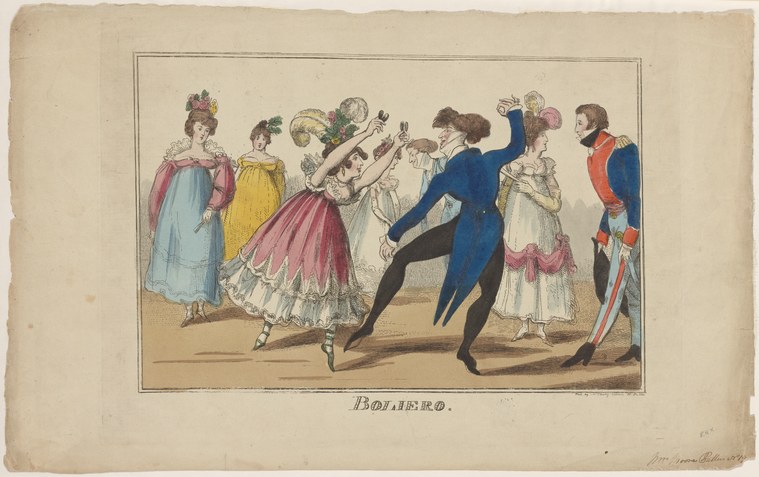
This image preserves direct visual evidence of how the bolero was actually performed and dressed for in European ballrooms, not in Spain or the Americas but in the refined social world depicted in novels by Jane Austen and Georgette Heyer. It documents the moment when Spanish and Latin American dance forms entered metropolitan European society and were integrated into the language of fashionable courtship and display.
What you are looking at
A lively ballroom or social dance scene in which a central couple performs while observed by four onlookers arranged around them. The woman at center wears a high-waisted Regency gown in pink with white underslip and a decorative bonnet or headdress; the man opposite her is dressed in dark blue coat with black breeches and stockings. The couple are captured mid-movement, their bodies angled toward each other in a sprightly, engaged posture. Three additional women in high-waisted gowns in yellow and white stand to the left; a gentleman in blue coat with red and white trim stands to the right, holding his hands near his face. The composition suggests a moment of active performance watched by interested spectators, typical of Regency-era social dancing.
The dancing
The central couple is positioned facing each other across a small space, with the man's body weight forward and his right arm raised expressively. The woman appears to be moving or turning, her skirts caught in a swirl around her legs. The man's raised arm and the woman's engaged position suggest a sprightly, interactive dance rather than a formal close hold. The four spectators surround the action, some with hands raised in gestures of attention or response.
The dance depicted
The title *Boliero* identifies this as bolero, though the Regency dress and social setting suggest this may depict a European interpretation or adaptation of the dance current in early 19th-century ballrooms. The dance was fashionable in British and European society during the 1810s–1820s, adopted from Spanish sources. The energetic, expressive posture of the central couple and the presence of attentive onlookers reflects how such dances were performed as entertainments at social gatherings, with the dancing couple as performers for the group.
How it was made
This is a hand-colored engraving or aquatint, characteristic of Regency-era popular prints. The line work is clean and precise, with careful attention to the folds of fabric and the articulation of limbs. The color is applied in discrete washes—the woman's pink skirt, the gentleman's blue coat—over a printed outline. This technique was economical and allowed for mass production, making such prints widely available and affordable to the middle-class audiences who frequented dancing assemblies and sought images of fashionable social life.
About this work
This is a contemporary record of the bolero as danced in European ballrooms during the Regency period, captured in a hand-colored engraving intended for popular circulation. The work documents both the costume conventions and the physical character of early 19th-century social dance: the high-waisted gowns, the energetic and expressive movement, and the social function of dance as a performance for one's peers. It belongs to a substantial genre of Regency and later-Georgian prints depicting fashionable dances and social customs, produced for domestic and commercial audiences.
How to look at it
Observe the specific moment the engraver chose: the couple is captured mid-action, their bodies engaged and animated rather than still. The woman's skirts are caught mid-swirl, and the man's raised arm conveys rhythm and liveliness. The four spectators are alert and turned toward the dancers—note their postures and gestures, which tell you that this is a social performance, not a private moment. The precision of the line work in the fabrics reveals how much the engraver cared about recording the exact texture and construction of Regency dress.
The period
The bolero achieved fashionable status in European ballrooms in the early 19th century, imported by Spanish sources and refined through the lens of Regency taste. Simultaneously, the tradition of engraving and hand-coloring social scenes was at its height: print publishers in London and the continent produced thousands of images of fashionable life—assemblies, promenades, dances—both as documentation and as aspirational imagery for the rising middle class. Dance prints of this kind served as both entertainment and instruction, allowing people without access to dancing masters to observe correct dress and deportment.
Where it lives
This print is held in the New York Public Library's collection of prints depicting dance, which documents the visual culture of dancing across centuries and geographies. It is one of many such Regency-era social prints produced for middle-class audiences.
Dance in this work
Questions about this work
Is this bolero the same as flamenco bolero?
No. The bolero danced in European ballrooms in the early 19th century was a couple dance adapted from Spanish popular forms but refined to suit ballroom conventions. It is distinct from flamenco, which remained a regional Spanish form, and from the Cuban bolero, which developed later.
What was the bolero actually like to dance?
From prints and descriptions of the period, the bolero was a moderately paced, rhythmic dance for couples, characterized by expressive arm and hand movements and a turning or gliding motion. This print shows the liveliness and engagement expected of the dancers, with the raised arm and animated posture conveying both technical skill and social polish.
Why are there spectators watching?
In Regency ballrooms, dancing was both participation and performance. Couples would often dance while others watched, especially during cotillions or more elaborate dances where the figures were complex. It was an important way to display grace, fashion sense, and social status.
More dance artwork





