49 works in this view — arrow keys or swipe to move between them.
Dance in Art
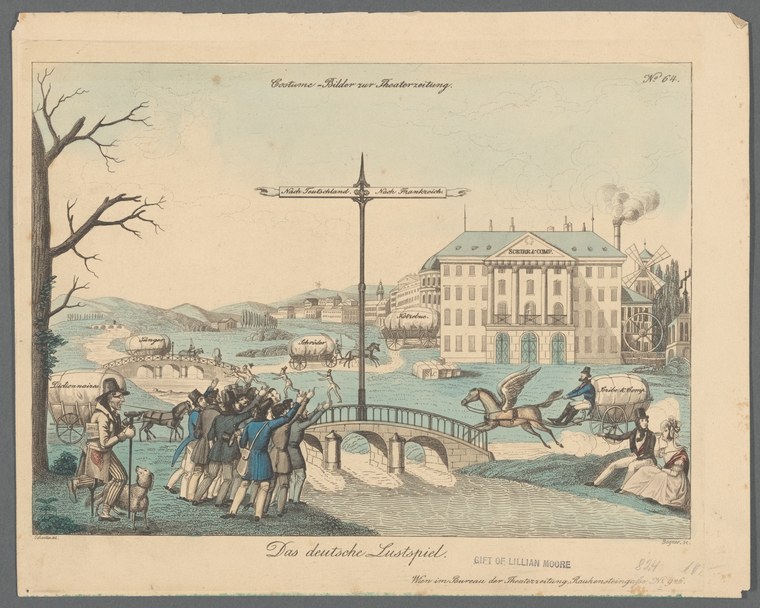
Das deutsche Lustspiel
Unknown artist
- Collection:
- Prints depicting dance
- Source:
- New York Public Library
- Rights:
- Public domain — free to use, share and adapt.
- Recorded as:
- Public Domain
For dance historians, this engraving provides visual evidence of the social context and physical conduct of 18th-century German folk dancing, a tradition largely documented through description rather than image. It also demonstrates how dance was represented in popular print culture for audiences who may never have witnessed such scenes themselves, blending ethnographic interest with satirical or affectionate humor.
What you are looking at
A lively German countryside scene rendered in hand-colored engraving, showing a village festival or merrymaking along a waterside with a substantial building—likely an inn or manor house—dominating the right side of the composition. The foreground depicts multiple groups of figures in 18th-century dress: some couples and groups appear to be dancing or moving together on the grass near a wooden bridge; others stand in clusters, engage in conversation, or drive carts and horses. The scene is crowded with activity across multiple spatial planes—closer figures in the immediate foreground, middle-ground groups on and around the bridge, and distant boats and buildings along the riverbank. A bare tree on the left frames the composition. The hand-coloring is delicate, with blues, flesh tones, and pale yellows creating a sunny, festive atmosphere. The German inscription at top reads "Saxkrone—Skitse zur Illustration" (or similar), identifying this as an illustration plate.
The dancing
The figures are rendered in the slight stylization typical of 18th-century popular prints: bodies are upright and formal rather than fluid, with minimal articulation of joints or weight shift. Several couples appear to be in a closed or near-closed embrace, standing or stepping together, though the resolution and engraving technique do not allow clear reading of footwork or frame. Groups stand in conversational postures. The horses and carts suggest rural labor alongside festivity. No pointe work, turnout, or technical balletic positioning is evident; the bodies and their relationships suggest social, communal dancing rather than theatrical or virtuosic forms.
The dance depicted
This appears to depict German folk or social dancing of the 18th century, likely Ländler or a related German country dance tradition. The groupings—couples moving together with others standing nearby, the rural outdoor setting, the mixed-gender sociability—align with the village festival dances that were central to German and Alpine folk culture. The engraving's title, *Das deutsche Lustspiel* (The German Comedy or Amusement), suggests the work is ethnographically or satirically documenting German rural merrymaking and its characteristic dances. No specific technical detail visible in the engraving allows identification of a particular named dance, but the scene clearly captures the social function and communal character of early modern German folk dancing.
How it was made
This is a hand-colored engraving, a reproductive print technology widely distributed in 18th-century German-speaking territories. Engraving allowed fine linear detail and could be hand-colored in the workshop after printing, making each impression somewhat unique while remaining affordable for popular consumption. The technique's reliance on line over tonal modeling suits the decorative, illustrative purpose—documenting a scene and its figures rather than capturing movement or shadow. The quality and style suggest this was a commercial or semi-commercial print, likely part of a series or publication on German life and customs, distributed to a domestic middle-class or educated audience.
About this work
This hand-colored engraving documents German rural festivity and social dancing in the 18th century, capturing a moment of village merrymaking centered on couples and groups moving together in the foreground while community activity continues around them. The work sits within a tradition of ethnographic or satirical popular prints that documented national character and rural customs for urban audiences. It belongs in a gallery of dance in art because it records not the techniques of codified dance but its social practice—the role of dancing in communal gathering, courtship, and the seasonal or festive life of the rural German-speaking world.
How to look at it
Attend to the multiple social groups and their spacing: the print captures not a synchronized formation or spectacle but the scattered, overlapping nature of festive dancing, with some couples absorbed in movement while others pause, converse, or attend to horses and carts. The composition emphasizes breadth and detail over dramatic moment, inviting the viewer to scan across the scene and read its social texture. The archival and illustrative purpose means the artist prioritized legibility of costume and behavior over the capture of dynamic movement, so the still, frontal poses and clear outlines should be read as vehicles for documenting what people wore and how they arranged themselves, not as evidence that movement was absent or unimportant.
The period
The 18th century saw a flourishing of popular prints documenting national types and rural life, both as satire and as genuine antiquarian interest. German and Alpine folk dances—Ländler, Schottischer, and country dances—were increasingly observed and recorded by urban audiences, and prints like this mediated that fascination. Simultaneously, ballroom dance was becoming codified in cities and courts, making folk and country dances appear quaint or rustic. This print likely dates to the latter 18th century, when such ethnographic subjects became common in popular visual culture.
Where it lives
The work is held in the New York Public Library's collection of prints depicting dance. It is catalogued with minimal metadata, suggesting it was part of a larger collection acquired for its subject matter rather than as a work of established art-historical significance. The holding collection's focus on dance imagery indicates curators recognized its value as evidence of dance practice and representation.
Dance in this work
Questions about this work
Is this a dance scene or a general village scene?
Both. The print is titled to emphasize German character and amusement, but dancing—visible in the foreground couples and groups moving together—is a central feature of the merrymaking. It documents the social context of dance as much as the dance itself.
What dance are they doing?
The print does not show enough technical detail to identify a specific named dance. The rural setting, mixed couples, and communal arrangement suggest German folk dances of the Ländler family, but the engraving's purpose was illustration and documentation rather than technical precision.
When was this made?
The catalogue record does not provide a date. The style, dress, and engraving technique suggest the latter 18th century, but without inscription or provenance data, the date remains uncertain.
Why is this in a dance collection?
It documents how social dancing was practiced, represented, and understood in everyday life outside the theater or ballroom. For dance historians, such images are primary sources on vernacular and folk dance that survive largely through visual record rather than written description.
More dance artwork





