49 works in this view — arrow keys or swipe to move between them.
Dance in Art
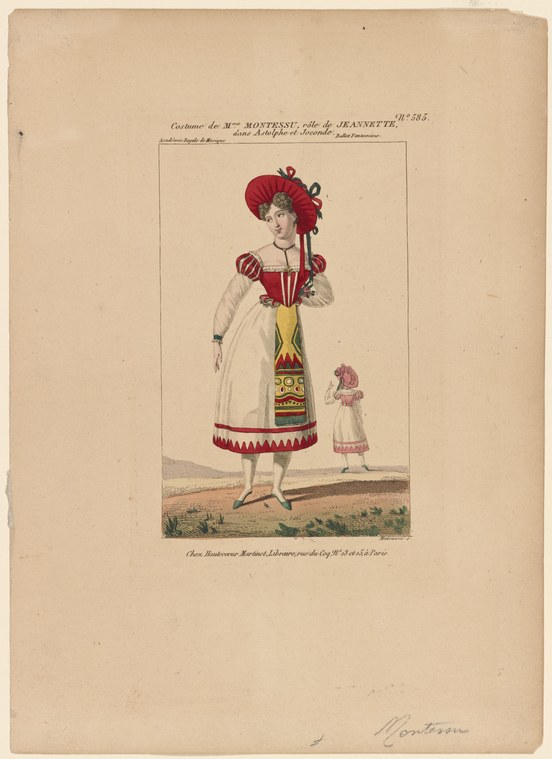
Costume de Mme. Montessu, rôle de Jeannette, dans Astolphe et Joconde, ballet pantomime, Académie royale du musique
Unknown artist
- Collection:
- Prints depicting dance
- Source:
- New York Public Library
- Rights:
- Public domain — free to use, share and adapt.
- Recorded as:
- Public Domain
The image provides direct evidence of how a named role in a specific ballet pantomime was costumed and presented to the body in the late 18th century, a period for which visual records are sparse. It documents the extraordinary prominence of the headdress in creating theatrical character, a priority very different from later ballet aesthetics. The work is also valuable as a record of print practice—the circulation of theatrical costume images as a form of theatrical publicity and artistic documentation.
What you are looking at
A young woman in theatrical costume stands against a plain landscape background, depicted in the three-quarter pose typical of costume studies. She wears a high-waisted white muslin gown with a decorative border at the hem in red and gold, the skirt gathered at the sides with knots of red ribbon. Over this sits a short red velvet jacket or bodice, fitted and adorned with gold trim and red bows at the shoulders. Her headdress is the dominant visual element: an enormous construction of red velvet or silk, elaborately shaped and gathered, rising high above her head with trailing ribbons and a decorative plume or cockade. She holds what appears to be a feathered fan or plumed ornament in her right hand. Her pose is dignified but not actively dancing—she stands upright, gazing to the viewer's left, presenting herself as a named character in costume rather than in the midst of movement. To her lower right, a small figure, possibly a child, wears a similar though simpler costume. The whole is rendered in hand-colored engraving or aquatint, with careful attention to the texture and fall of fabrics and the intricate details of the headdress.
The dancing
The primary figure stands in a relaxed contrapposto pose, weight balanced on both feet, the body upright and the head held high. There is no active dance movement or balletic frame evident—the arms hang naturally, with the right hand holding a fan or accessory. The posture and presentation are those of a performer presenting her costume to an audience rather than demonstrating a dance technique or step. The stance suggests social or theatrical ease rather than technical execution.
The dance depicted
This is a costume study from a ballet pantomime, and the inscription identifies the character as Jeannette from *Astolphe et Joconde*, a work staged at the Académie royale de musique (Opéra, Paris). The image documents theatrical dress rather than capturing dance in action. The late 18th-century date suggested by the style and the theatrical context indicates this is from the era of Romantic ballet's precursors, when pantomime and elaborate spectacle were central to operatic entertainment. The work belongs to the documentation of French court and operatic dance costume rather than to a specific dance style.
How it was made
This is a hand-colored engraving or aquatint print, a medium well suited to the precise rendering of costume detail and the wide circulation of theatrical designs. The coloring is applied by hand after printing, visible in the careful brushwork of the red velvet and gold trim. Such prints were made for the theatrical press and for collectors interested in fashion and stage design—they functioned as a record of a specific performance costume and as advertisement for the spectacle itself. The technique allowed for fine detail work on the headdress and embroidery while maintaining the clarity necessary for reproduction and sale.
About this work
This is a costume study documenting the dress of a named character in a late 18th-century French ballet pantomime. It records not a moment of dancing but a carefully composed presentation of theatrical costume, centered on the extravagant headdress that would have been the primary visual spectacle of the role. The work belongs to a rich tradition of theatrical documentation through engraved costume plates, a genre that flourished in Paris from mid-century onward and served both archival and promotional purposes. It sits at the intersection of fashion history, theatrical design, and the documentation of dance practice, capturing the visual world of operatic spectacle at a moment when costume was as much a subject of aesthetic attention as movement itself.
How to look at it
Attend to the headdress first—it is the largest and most visually complex element and would have been the dominant visual feature from the audience. Notice the careful layering of the white muslin gown beneath the red jacket, a silhouette typical of late 18th-century fashion. The pose is formally composed for the print, not a capture of action; the figure faces the viewer in a way designed to display the costume from all its significant angles. The small figure beside her (possibly another dancer or a child performer) provides scale and suggests the theatrical context, reminding viewers that this is a designed image, not a naturalistic scene.
The period
The work dates to the 1780s–1790s, the period of the French operatic tradition at its height and just before the Romantic ballet revolution. At the Académie royale de musique, ballet pantomime was a central theatrical form, typically embedded within operas, featuring elaborate costumes, narrative spectacle, and social dance rather than technical virtuosity. French theatrical engraving was at its peak as both an art form and a commercial enterprise, with prints of costume, scenery, and famous performers selling widely to a public fascinated by Paris opera. This was before pointe work became standard, before the tutu dominated ballet dress, and when the headdress and the richness of the fabric and ornament were the primary vehicles for creating character and spectacle on stage.
Where it lives
The work is held in the New York Public Library's collection of prints depicting dance. It is part of a substantial archive of French theatrical costume engravings from the period, many of which documented specific roles and performances at the Paris Opéra.
Dance in this work
Questions about this work
What ballet is this costume from?
*Astolphe et Joconde*, a ballet pantomime performed at the Académie royale de musique (Paris Opéra) in the 1780s. The character is named Jeannette, as stated in the inscription. Very little else is known about this work; this costume study is one of the few surviving records of it.
Why is the headdress so large?
In late 18th-century operatic ballet, the headdress was the primary means of establishing character and creating visual spectacle from the audience. The size and elaboration of the decoration—feathers, ribbons, ornaments—communicated status, personality, and narrative role. Dancers would be seen from a distance in a large theater, so the headpiece needed to be visually commanding.
Is the figure dancing?
No. The figure is posed for the costume print, not captured mid-movement. This was standard practice for theatrical costume documentation; the goal was to show the dress clearly and in its full formal presentation, not to capture action.
What does the small figure on the right represent?
It may be another character in the ballet, a child performer, or simply a scale figure to emphasize the size and importance of the main costume. Many 18th-century theatrical engravings included secondary figures for context or proportion.
More dance artwork





