49 works in this view — arrow keys or swipe to move between them.
Dance in Art
Les noces
Unknown artist
- Collection:
- Prints depicting dance
- Source:
- New York Public Library
- Rights:
- Public domain — free to use, share and adapt.
- Recorded as:
- Public Domain
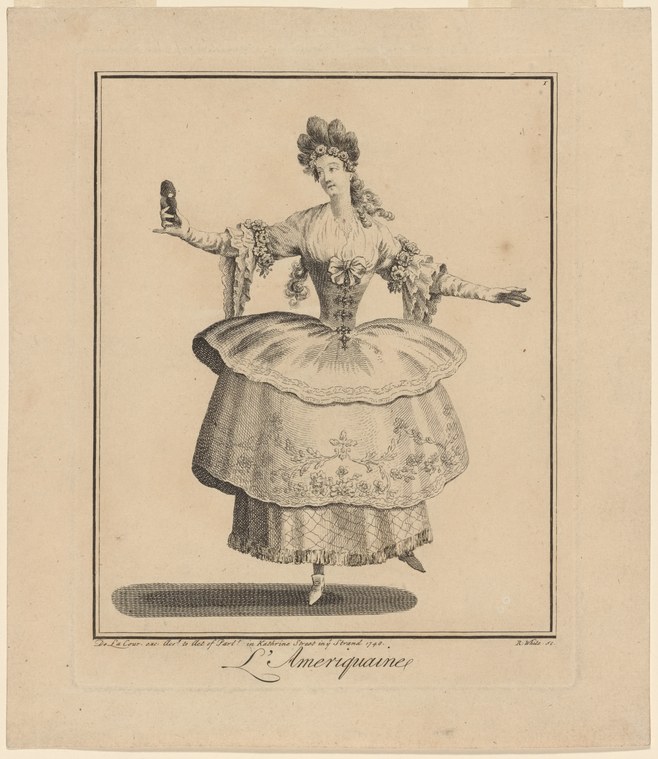
This engraving is crucial evidence of how solo theatrical dance was performed and understood in the 18th century—a moment when the vocabulary of modern ballet was being codified but when pantomime, character gesture, and ornament played as large a role as pure movement technique. The image shows us not only what dancers wore but how they held and moved their bodies, and it documents a specific role or character that was significant enough to be engraved and circulated, suggesting this was a celebrated performer of her time.
What you are looking at
A single female dancer is shown in an exuberant pose against a plain background, her body lifted and energized. She wears an ornate, heavily embellished jacket or corsage densely decorated with what appear to be jewels, sequins, or metallic ornaments, worn over a voluminous skirt with a deep ruffle or flounce at the hem. Her hair is elaborately dressed and adorned with feathers or plumes. Her left arm is extended upward and outward, hand raised as if holding or presenting an object (possibly a fan or small prop), while her right arm extends to the side. Her posture suggests mid-motion—the body appears light and buoyant, with weight shifted upward and forward. The engraving captures a moment of theatrical display and elegance, with the dancer rendered in fine detail showing the textures of fabric and ornamentation.
The dancing
A single dancer occupies the composition, posed in a dynamic vertical alignment with the weight lifted through the body. The extended left arm reaches upward diagonally, the hand elevated and open; the right arm extends horizontally or slightly downward. The torso is upright but animated, suggesting the body is in flight or at the apex of a jump or leap. The posture is open and presentational rather than in a closed ballroom hold; the dancer faces the viewer directly, engaging the audience. The costume—particularly the stiff, heavily ornamented skirt and fitted bodice—suggests the dress of 18th-century theater or court spectacle, not social dance.
The dance depicted
This appears to be a theatrical solo, most likely a pantomime or character dance from the 18th-century stage, possibly French given the style and the title 'Les noces' (The Wedding). The elevated, buoyant posture and the emphasis on ornamental display suggest a dancer trained in the theatrical conventions of the period—neither the structured formality of a minuet nor the ballroom partnering of social dance. The dynamic arm gestures and the moment chosen (the body lifted, the pose theatrical) suggest a performer demonstrating technical skill and character expressiveness rather than participating in social choreography. The work appears to document a specific performed role or character type.
How it was made
This is an engraving, a printmaking technique that produces fine linear detail and tone through incised lines on a copper plate. The artist has captured intricate textures—the faceting of jeweled ornaments, the pattern of the skirt's ruffle, the wisp of feathers—through careful parallel and cross-hatching. The technique allowed precise rendering of costume detail and facial expression, and the medium's portability and reproducibility meant such prints circulated widely as documentation of celebrated performers and roles, as well as fashion and theatrical reference. The formal border and presentation suggest this was issued as a single print or part of a series.
About this work
This engraving documents a female dancer in theatrical dress, posed mid-performance in a moment of dynamic elevation and display. The work captures the conventions of 18th-century theatrical dance, in which a solo dancer (almost certainly a woman) demonstrated both technical accomplishment and interpretive character through ornate costume, expressive gesture, and dynamic body control. The title 'Les noces' suggests the dancer was portraying a character or role associated with weddings—possibly a bride, a wedding guest, or an allegorical figure. Such prints were essential documentation of celebrated performers and roles, circulating through European cities as records of specific theatrical moments and as fashion reference. The work sits at the intersection of theatrical documentation, fashion print, and dance history.
How to look at it
Attend to the moment the artist chose: the dancer is captured at the peak of a leap or lift, body weightless and open, not in a held position. This choice emphasizes the performer's technical command and the buoyancy of her execution. Notice the relationship between the elaborate costume and the body beneath it—the ornament is not merely decorative but part of the spectacle of the performance, catching light and drawing attention to every gesture. The direct gaze toward the viewer was a convention of theatrical portraiture of the period, asserting the performer's status and inviting admiration. The careful rendering of fabric and jewels reflects the importance of costume as both character and status marker in 18th-century theater.
The period
This engraving dates from the mid-to-late 18th century, when European theater—especially in France—was undergoing significant change. The late Baroque and early Rococo period saw the rise of elaborate theatrical spectacle, in which dance, pantomime, and costume were increasingly interwoven. Female dancers were becoming celebrated as soloists rather than merely ornamental presences in ensemble scenes. The ornamental, jeweled style of dress and the emphasis on facial expression and character gesture reflect the theatrical idioms of the period, when performers were expected to convey narrative and emotion through a combination of formalized movement and interpretive mime. Engravings of celebrated performers were a primary means of circulating knowledge of fashion, technique, and theatrical fashion across Europe.
Where it lives
The work is held in the New York Public Library's collection of prints depicting dance. It is catalogued with a French title and no artist attribution, suggesting it was a commercially circulated print rather than a unique work, and that the title may be inscribed on the plate or mounting. The sparse catalogue record reflects the state of many prints in institutional collections: widely available and visually significant, but often incompletely documented.
Dance in this work
Questions about this work
What dance style is this?
This is theatrical dance from the 18th-century stage—most likely a pantomime or character dance rather than a ballroom or court dance. The pose, costume, and presentation all suggest a solo performer in a theatrical role, not a social dancer. The title 'Les noces' (The Wedding) indicates she is portraying a wedding-related character.
Who was the dancer?
The engraving does not identify the performer by name in the available catalogue record. However, the fact that she was deemed significant enough to be engraved and circulated suggests she was a celebrated performer of her era. Such prints were often made of famous dancers and actors to circulate knowledge of their roles and appeal.
Why is the costume so elaborate?
The jeweled, ornate dress was both historically accurate to 18th-century theatrical fashion and a marker of status and character. Elaborate costume signaled importance and allowed the performer to shimmer and catch the eye as she moved. The ornament was integral to the theatrical spectacle, not separate from it.
What does the pose tell us?
The elevated, open-armed pose suggests the performer was trained to move with lightness and dynamism, not the measured, grounded posture of a minuet. The extended arms and buoyant carriage indicate a dancer capable of expressive gesture and dramatic presence, qualities essential to theatrical roles that required both movement skill and pantomime.
More dance artwork





