49 works in this view — arrow keys or swipe to move between them.
Dance in Art
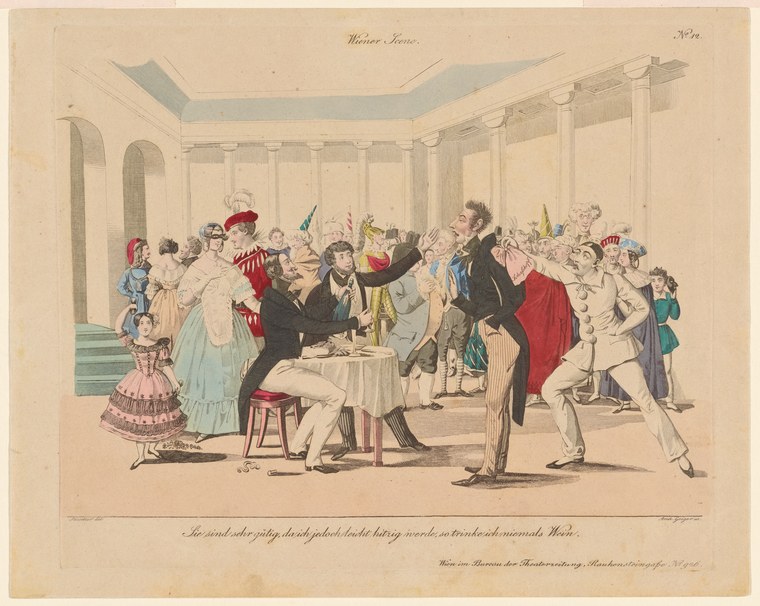
Sie sind sehr gütig, da ich jedoch leicht hitzig werde, so trinke ich niemals Wein
Unknown artist
- Collection:
- Prints depicting dance
- Source:
- New York Public Library
- Rights:
- Public domain — free to use, share and adapt.
- Recorded as:
- Public Domain
This print offers rare documentary evidence of how early-nineteenth-century ballroom dancers understood and managed their own bodies—specifically, the deliberate avoidance of wine and heat to maintain the composure and physical readiness required for dancing. The scene illustrates the bodily discipline and self-awareness that genteel dancing demanded, beyond the formal steps and figures. For historians of social dance and of the body, the work shows how dancing intersected with larger codes of conduct, temperance, and masculine self-control in Regency society.
What you are looking at
A grand columned hall hosts a crowded social gathering in which a man seated at a small table in the foreground declines a glass of wine with an emphatic gesture. The scene is rendered in colored hand engraving, with figures distributed across the space in clusters—some conversing, others dancing or taking refreshment. The architecture is neoclassical: tall fluted columns rise to a coffered ceiling, and a shallow flight of steps visible at left suggests this is an interior of some consequence. The palette is restrained—pale washes of blue-gray for the vault, cream and pale ochre for the walls and figures, touches of red in the women's dresses and a man's coat, and strategic use of black for definition. The lighting is even and cool, characteristic of indoor scenes rendered in this print medium. The crowd's energy centers on the background, where figures mingle in the conversational crush of an evening assembly.
The dancing
The figures are rendered with characteristic early-nineteenth-century elongation and refined posture. The central seated figure—clearly the subject of the scene—holds one arm raised in emphatic refusal, the other resting on the table before him. Around him, standing figures lean in with expressions of social engagement; several women wear high-waisted gowns with puffed sleeves typical of the Regency period, and men are dressed in dark coats and breeches. The grouping suggests conversation and social interaction rather than formal dance positions, though background figures appear to be engaged in minuet-like movements characteristic of the era's ballroom protocol.
The dance depicted
This is a scene from genteel Regency social life rather than a dedicated dance representation, though the setting and some background figures suggest the context is a formal ball or assembly. The title, which translates to 'You are very kind, but since I become heated easily, I never drink wine,' suggests a comedic scene about social etiquette and bodily management—a gentleman's reasoned refusal of wine to maintain composure during dancing. The background activity suggests minuet or contradance formations typical of early-nineteenth-century ballroom dancing, but the principal subject is social interaction and conversation rather than choreographed movement. This is a scene about the *social management* of dance rather than the dance itself.
How it was made
This is a hand-colored engraving, as evidenced by the fine linear detailing characteristic of copper engraving and the careful application of transparent color washes across the composition. The print is clearly European in production and likely German or Austrian, given the German inscription. The technique of hand coloring—applied after printing—allowed for the delicate gradations of tone visible in the architectural elements and the subtle rendering of fabric. This medium implied circulation among educated, affluent audiences who could afford finished colored prints, suggesting the scene had social or satirical relevance to its contemporary viewers. The engraving technique's precision allowed the artist to capture the fashionable dress and refined composure essential to the comedy of the scene.
About this work
This is a colored engraving depicting an episode of social comedy from an early-nineteenth-century ball or assembly. The scene shows a gentleman declining wine at a formal gathering, a moment that speaks to the physical and social demands placed on dancers in Regency society—the need to remain composed, unburdened, and ready for exertion on the dance floor. The work sits within the tradition of social satire in print culture, using the ballroom as a setting to comment on manners and bodily discipline. While dancers appear in the background and the setting is explicitly a place of dancing, the work's primary interest is in the comedy of social convention rather than in dance itself.
How to look at it
Attend first to the compositional wit: the seated figure's emphatic refusal anchors the foreground, while the dancing and social life of the assembly continues casually behind him. This is a freeze-frame of social decision-making in a moment of potential embarrassment. Notice the careful rendering of dress—the women's high-waisted gowns and the men's dark coats—which dates the scene precisely. Look at the architectural setting, which elevates this to a formal occasion of consequence rather than a casual gathering. Finally, observe how the artist has rendered the background dancers in a state of refined motion, suggesting the ongoing ballroom activity that frames the central figure's choice.
The artist
The artist is not recorded in the catalogue. The print bears a publisher's mark (visible at lower right) suggesting a German or Austrian commercial print house, likely Vienna, active in the early nineteenth century. The refined draftsmanship and satirical intent are consistent with the German-language social comedy prints that circulated widely in Central Europe during this period. Such works were typically produced for middle-class and genteel audiences by commercial publishing houses rather than commissioned by individual patrons.
The period
The early nineteenth century was the height of the Regency and Romantic periods in European social dance, when the minuet gave way to more vigorous country dances, quadrilles, and the emerging waltz. Social dancing was central to genteel life, and the ballroom was a primary site of courtship, reputation-making, and social display. Simultaneously, prints satirizing social etiquette and bodily comportment were extremely popular; they offered middle-class audiences a humorous perspective on fashionable life. The focus in this print on bodily management—heat, sobriety, composure—reflects period anxieties about the physical demands of dancing and the gentleman's ability to master his own body in public.
Where it lives
The print is held in the New York Public Library's collection of prints depicting dance. It is catalogued as a hand-colored engraving, date and artist unknown, from the holdings of a German or Austrian publisher active in the early nineteenth century.
Dance in this work
Questions about this work
Why would a dancer refuse wine?
In Regency society, dancing was vigorous and prolonged, and the body needed to be managed carefully. Heat, exertion, and alcohol were thought to produce unbecoming physical effects—sweating, flushing, loss of composure. A gentleman's refusal of wine was a deliberate strategy to maintain bodily control and social propriety during the evening's dancing. The print satirizes this disciplined self-management, suggesting both its necessity and its potential comedy.
What kind of dancing is shown here?
The background figures appear to be engaged in the formal social dances of the Regency ballroom: minuets, country dances, or quadrilles. These were structured, partnered dances that required sustained attention and bodily restraint. The print does not depict specific choreography but rather the social and physical context in which such dances took place.
Is this a real scene or a fictional one?
The print is almost certainly satirical rather than a documentary record of a specific event. However, it draws on real social practices and anxieties of the period—the genuine concern about bodily composure in the ballroom, the actual etiquette of declining refreshment, and the real physical demands of Regency dancing. It is a heightened, comic version of an authentic social situation.
More dance artwork





