49 works in this view — arrow keys or swipe to move between them.
Dance in Art
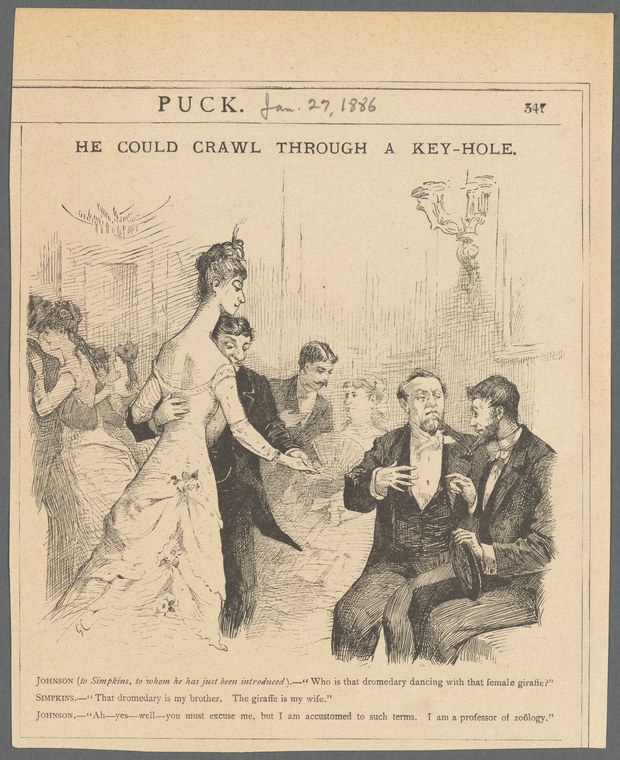
He could crawl through a key-hole
Unknown artist
- Collection:
- Prints depicting dance
- Source:
- New York Public Library
- Rights:
- Public domain — free to use, share and adapt.
- Recorded as:
- Public Domain
The image captures a liminal moment in the history of bodily performance: the female body rendered as flexible spectacle, the domestic interior as theater, and the illustrated periodical as the medium through which such social moments were circulated and satirized. It testifies to the existence of contortion and extreme flexibility as a form of parlor entertainment and social performance in the 19th century, a practice that has largely vanished from historical record.
What you are looking at
A satirical Victorian engraving depicting a parlor scene in which a woman in an elaborate light gown performs an acrobatic feat for an assembled company. She has inserted her body through a keyhole in a door, demonstrating extreme flexibility by threading her torso and limbs through the narrow opening while her head and shoulders remain visible on the far side. Three men in evening dress sit or stand in the foreground, engaged in conversation; one gestures with apparent skepticism or amusement. Two further figures appear in the background on the left, observing the feat. The woman's body is rendered in graceful line work, emphasized by cross-hatching that suggests the texture of her dress. The domestic interior is indicated by simple perspective lines suggesting a doorway and walls. The engraving's caption introduces the scene as a wager or demonstration of unusual bodily capability.
The dancing
The central female figure demonstrates an extreme contortion pose: her spine is sharply arched in a backward bend as she threads through the keyhole, her limbs extended and flexed to pass through the narrow aperture. Her weight is distributed across the frame of the door itself rather than the floor. The three gentlemen in the foreground adopt casual poses of social repose—seated, leaning, conversing—creating a stark contrast between their stillness and her athletic display. There is no partnered hold; instead, the woman's frame is isolated and geometric, locked into an impossible configuration against the architectural element.
The dance depicted
This is not a depiction of ballroom or theatrical dance, but rather of an acrobatic feat performed for social entertainment in a parlor setting. The extreme spinal flexibility, architectural framing, and the nature of the "trick" align with contortion or extreme flexibility performance rather than any codified dance style. The scene satirizes Victorian parlor entertainment and the fashionable display of female physicality and accomplishment. The caption's tone suggests this is offered as marvel or curiosity rather than as art, marking the boundary between performance, athleticism, and spectacle.
How it was made
This is a wood or steel engraving, identifiable by the precise parallel line work (hatching and cross-hatching) that builds tone and texture without relying on wash or watercolor. The technique was well-suited to reproductive circulation—engravings could be printed in high numbers and distributed in periodicals, which is consistent with the Puck magazine attribution and date. The linear precision required of engraving is particularly suited to the sharp, geometric articulation of the woman's body compressed through the rectilinear keyhole frame.
About this work
This is a satirical engraving from the Victorian periodical Puck, illustrating a parlor entertainment in which a woman demonstrates extreme spinal flexibility by passing her body through a keyhole. The work belongs to a tradition of illustrated social commentary and spectacle that occupied the space between fine art, journalism, and popular entertainment. It documents not ballroom dance but the broader culture of physical performance and bodily display that characterized Victorian parlor society, where female accomplishment was often rendered as curiosity or marvel for male consumption.
How to look at it
Attend to the geometric relationship between the woman's body and the rectangular keyhole: the artist has chosen the moment of maximum compression, when the body is most impossibly folded. The stillness and casual posture of the male observers contrasts sharply with the contorted intensity of her pose, inviting the viewer to oscillate between regarding her feat as impressive and regarding it as absurd. The title's pun—ability to "crawl through a key-hole"—frames the performance as a curious anomaly rather than a skill.
The artist
The work is attributed to Puck, the American humor and satire magazine founded in 1877, but the individual artist is not recorded. Puck specialized in illustrated social and political satire, employing skilled engravers to render scenes of contemporary life. The magazine's illustrators were often anonymous or credited collectively, reflecting the industrial production model of periodical illustration.
The period
The 1880s were a period of expanding opportunities for female bodily display in entertainment—music halls, variety shows, and parlor performances all offered venues for women to demonstrate physical skills and flexibility. At the same time, the female body remained heavily corseted and constrained in everyday dress, making any display of physical flexibility or unusual capability a matter of social curiosity and satire. The engraving sits at the intersection of Victorian propriety and the hunger for spectacle.
Where it lives
This print is part of the New York Public Library's collection of prints depicting dance and performance. It comes from the Puck archive, the weekly humor magazine that documented American social and political life from 1877 onward.
Dance in this work
Questions about this work
Is this actually a dance?
No. This depicts contortion or extreme flexibility performance, a form of bodily spectacle that was practiced in Victorian parlor entertainment, music halls, and variety shows. It belongs to the broader culture of physical performance rather than to dance as such, though both draw on bodily virtuosity and display.
What is Puck, and why does it matter for dance history?
Puck was an illustrated weekly magazine founded in 1877 that specialized in social and political satire. Its images of contemporary life, including dance, theatrical performance, and physical spectacle, offer a valuable record of what Americans actually did—and what they found funny about—in the decades after the Civil War.
Why would a woman perform this feat, and for whom?
In Victorian society, female accomplishment was often displayed in parlor settings for the entertainment of one's social circle. The extreme flexibility required would have marked the performer as unusual or remarkable. The satirical tone of the engraving suggests that such displays were regarded as both marvelous and mildly ridiculous—a tension that much Victorian satire exploits.
More dance artwork





