49 works in this view — arrow keys or swipe to move between them.
Dance in Art
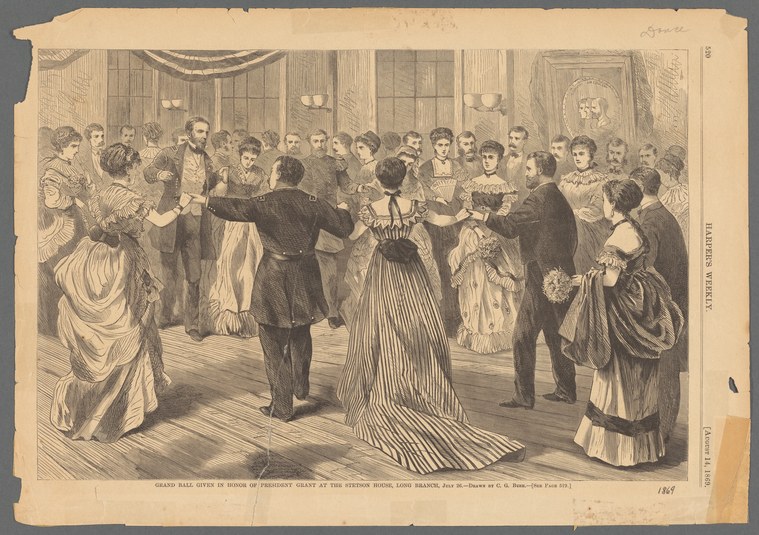
Grand ball given in honor of President Grant at the Stetson House, Long Branch, July 26
Unknown artist
- Collection:
- Prints depicting dance
- Source:
- New York Public Library
- Rights:
- Public domain — free to use, share and adapt.
- Recorded as:
- Public Domain
This engraving is valuable documentation of actual ballroom practice and dress in the Gilded Age—not an idealized or theatrical rendering, but a contemporary journalistic record of a high-profile social event. It shows how ballroom dancing functioned as a social institution and marks the costume, setting, and formality conventions of the period. For dancers and historians, it provides primary-source evidence of what ballroom attire looked like in motion and how such events were understood and represented in the press.
What you are looking at
A formal ballroom reception in full swing, crowded with elegantly dressed guests in mid-Victorian formal wear. The room is grand and symmetrical, with tall windows and ornamental ceiling details visible behind the gathered crowd. In the center-left foreground, a couple stands prominently: the woman wears a striking vertical-pleated skirt with a fitted bodice, her dress extending in a long train; the man beside her wears a dark formal coat and stands at an angle to her. Around them, numerous other couples and guests mill about in clusters—some in conversation, others watching the dancers, creating the social atmosphere of a high-society event. The lighting is even and bright, suggesting daytime or well-lit interior space. The engraving captures the moment as a snapshot of social activity rather than climactic movement, with multiple simultaneous interactions across the composition.
The dancing
The central couple appears to be in a formal ballroom frame, though the woman's body angle and the spacing between partners suggests they are pausing or in transition rather than executing an active figure. Most other figures stand in conversational groups; several women have their arms linked or held at the elbow by partners. The dress—especially the women's voluminous skirts with tight bodices and the men's uniform dark coats—creates a uniform silhouette across the room. The overall posture is upright and formal, with little visible flexion or dynamic weight transfer; this is social standing rather than active dancing.
The dance depicted
This is a Gilded Age formal reception where ballroom dancing is the primary social activity, though most figures are not actively dancing at the moment captured. The dress and setting place this firmly in the 1870s–1880s American upper class. The women's pleated skirts and tight bodices, paired with the men's evening coats, indicate the period's standard ballroom costume. The dance styles in use at such an event would have been the waltz, polka, and quadrille—the dominant ballroom forms of the era—but the engraving shows the social framework rather than a specific dance technique. The central couple may be performing a waltz or preparing to, but the composition emphasizes the reception as a social institution rather than choreographic detail.
How it was made
This is a wood engraving or steel engraving, evidenced by the fine parallel-line hatching used to create tone and the delicate line work throughout. The technique allowed for mass reproduction in periodicals and newspapers—this appears to be a contemporary illustration for a news publication documenting a notable social event. The fineness of detail and the careful composition suggest this was made from a sketch or photograph taken at or shortly after the event. Engravings of this quality were a primary means of visual journalism in the 1870s–80s, circulating widely among middle- and upper-class readers of illustrated weeklies.
About this work
This engraved illustration documents a formal ball held in honor of President Ulysses S. Grant at the Stetson House in Long Branch, New Jersey, on July 26. It captures not a single choreographic moment but the social spectacle of Gilded Age ballroom culture—the crowded, formal reception in which dancing was embedded as a mark of status and refinement. The image is a record of who attended, how they dressed, and what such an event looked like at its height. It belongs in a dance archive because ballroom dancing was the central social technology of this era, and this image shows its setting, costume, and social meaning. The work demonstrates how dance history is documented through visual journalism and social portraiture, not only through dance notation or theatrical records.
How to look at it
Look first at the arrangement of figures: the artist has chosen a moment of social pause or transition rather than active dancing, emphasizing the social gathering over the choreography. Note the formal dress code—the uniformity of the men's dark coats and the voluminous, decorative skirts of the women—which was as much a rule of ballroom culture as the dance steps themselves. Observe the central couple, whose positioning and spacing suggest the formal, restrained hold of period ballroom dance. Finally, attend to the crowded, symmetric composition: the engraver has rendered the ballroom as a stage for social display, with multiple simultaneous social interactions suggesting the event as a whole rather than a single climactic moment.
The period
In the 1870s–80s, ballroom dancing in America was dominated by the waltz, the polka, and the quadrille—all couple dances performed in formal evening dress. The Gilded Age elevated ballroom dancing to a marker of social status and respectability; such events were covered in illustrated newspapers as major social news. Long Branch, New Jersey, was a fashionable resort for the wealthy and a seasonal retreat for presidents and political figures. The period also saw the rise of the illustrated weekly magazine, which made such events visually accessible to a broad readership. This engraving reflects both the social importance of ballroom dancing and the role of the press in documenting and circulating images of elite leisure.
Where it lives
This engraving is held in the New York Public Library's collection of prints depicting dance. It was published as a contemporary illustration documenting a significant social event; the catalogue record identifies it as documenting a ball given in honor of President Grant, held July 26 at the Stetson House in Long Branch.
Dance in this work
Questions about this work
What dances were performed at this ball?
The engraving does not depict a specific moment of active dancing, so the dance forms cannot be identified from the image alone. However, balls of this period and status typically featured waltzes, polkas, and quadrilles—the dominant ballroom dances of the 1870s–80s. The formal dress and setting are consistent with such events.
Why are most people standing rather than dancing?
Formal balls of this era typically alternated between active dances and periods of social gathering, conversation, and promenade. The engraver has captured the social aspect rather than a moment of active choreography, emphasizing the ball as a social institution and gathering of the elite.
What does the central woman's dress tell us?
Her vertical-pleated skirt, fitted bodice, and long train are characteristic of 1870s–80s formal ballroom dress. The elaborate skirt was essential to ballroom aesthetics and had to accommodate the movement of waltzes and polkas while remaining decorative and modest. Her attire marks her as a member of the social elite.
How was this image made and distributed?
This is a wood or steel engraving, a technique that allowed for fine detail and mass reproduction. It was likely published in an illustrated weekly newspaper or magazine to document the event for a broad, middle- and upper-class readership. Such engravings were the primary means of visual journalism in the 1870s–80s.
More dance artwork





