49 works in this view — arrow keys or swipe to move between them.
Dance in Art
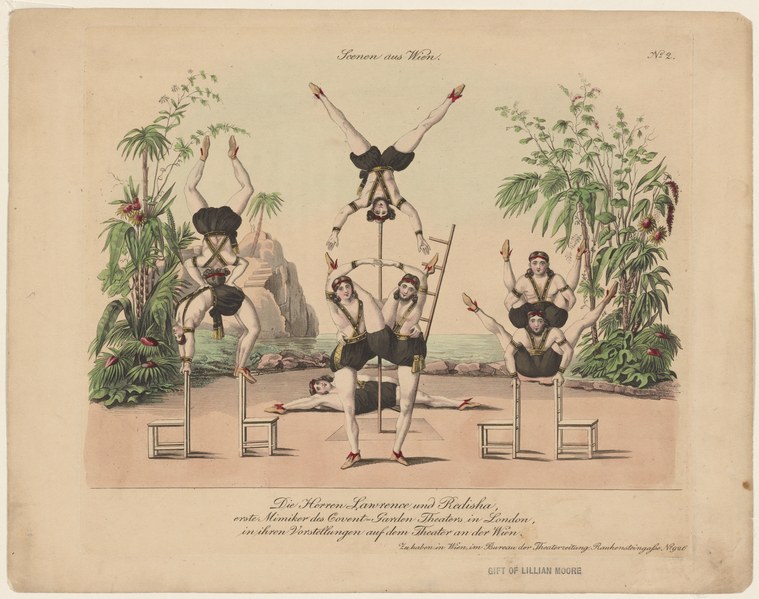
Die Herren Lawrence und Redisha: erste Mimiker des Covent-Garden Theaters in London, in ihren Vorstellungen auf dem Theater an der Wien
Unknown artist
- Collection:
- Prints depicting dance
- Source:
- New York Public Library
- Rights:
- Public domain — free to use, share and adapt.
- Recorded as:
- Public Domain
This print is rare visual evidence of how acrobatic performance was presented and advertised in late-18th-century theater, and of the touring entertainers who moved between London and continental Europe. It shows an early form of partner acrobatics that would eventually develop into modern circus adagio, and it demonstrates that 'dance' on the theatrical stage encompassed a far wider range of physical practice than formal dance history often acknowledges.
What you are looking at
A hand-colored engraving depicts two male acrobatic performers in a theatrical setting, likely from an 18th-century Vienna venue (the Theater an der Wien). The central figure stands upright in dark breeches and a light shirt, his body inverted as a second performer balances horizontally across his shoulders and extended arms in a dramatic supported position. A third figure, also in period dress, stands to the right in a complementary pose. The stage is framed by lush tropical vegetation—tall flowering plants with detailed foliage flank both sides—creating an exotic backdrop. The foreground shows the wooden stage floor with simple rectangular geometric props or blocks. The composition emphasizes the extraordinary strength and control required: the central performer's legs are splayed for stability while his arms hold the suspended figure at full extension, a position that demands considerable athletic skill. The print's warm cream tone and careful hand-coloring suggest this was a promotion for a specific performance or a souvenir of a notable act.
The dancing
Three male performers work in close physical contact and apparent coordination. The central standing figure distributes weight through a wide stance while his arms—extended to the sides at shoulder height or higher—support the weight of a horizontal body across his shoulders and upper back. The suspended performer holds a fully inverted position with limbs extended, requiring complete trust and precision. The third figure mirrors a similar configuration. The performers wear fitted breeches and light-colored shirts with minimal costume, allowing the musculature and control of the body to be visible. There is no balletic turnout or the refined carriage of theatrical dance; instead, the bodies are functional, the limbs extended for spectacle rather than aesthetic line.
The dance depicted
This is acrobatic performance rather than dance in the theatrical sense of the period. The print documents the act of Lawrence and Redisha, identified in the German title as "first mimic performers of the Covent Garden Theatre in London" performing at the Theater an der Wien in Vienna. These were traveling acrobatic entertainers, not dancers. The image shows partner acrobatics or adagio—a form of circus performance where one strong performer (the 'base') supports another in increasingly difficult positions. The reliance on strength, geometric precision, and visual spectacle over movement flow or narrative marks this as circus acrobatics performed in a theatrical venue. The title's reference to "Vorstellungen" (performances/representations) and the exotic stage dressing suggest these were celebrated guest acts attracting paying audiences.
How it was made
This is a hand-colored engraving, likely stipple engraving or a related technique given the fine detail in the background foliage and anatomical precision of the figures. The careful parallel lines building tone in the bodies and the detailed botanical rendering suggest work by a skilled practitioner. Hand-coloring in watercolor or gouache has been applied over the printed surface, with particular attention to the skin tones, the green foliage, and the contrast between costumes and flesh. As a colored print, this would have been relatively expensive and circulated among affluent audiences who could afford theatrical entertainment or souvenirs of celebrated performances. The survival of the print with its original coloring intact is significant; such objects were often kept in theatrical scrapbooks or collected as records of memorable acts.
About this work
This hand-colored engraving documents a specific acrobatic performance by Lawrence and Redisha, English entertainers who performed at Vienna's Theater an der Wien in the late 18th century. The print captures an act of partner acrobatics (adagio) that relied on one performer's ability to support another in inverted and unsupported positions—spectacular demonstrations of human strength and control rather than trained dance in the contemporary sense. Yet the work belongs in dance history because acrobatics and partner performance were then integrated into theatrical entertainments and because the image documents how bodies could be deployed for spectacle in the period.
How to look at it
Attend to the precision of the weight distribution: the base performer's wide stance, the placement of arms, and the alignment of the suspended performer's body all demonstrate that this is not a momentary gesture but a held and controlled position. The artist has frozen the image at the moment of display rather than in the flow of movement—the bodies are extended for visual impact. The tropical vegetation, while decorative, indicates that acrobatic acts were often presented within elaborate theatrical scenarios rather than in a bare circus ring. Notice the absence of pointe shoes, tutus, or any of the costume vocabulary of theatrical dance: these are athletes, not dancers in the period sense.
The period
The late 18th century saw a boom in theatrical acrobatics and gymnastic performance across Europe. The Theater an der Wien opened in 1801, but acrobatic acts were touring and performing in Vienna and other major cities throughout the 1790s. The print's reference to the Covent Garden Theatre in London reflects the mobility of such performers: entertainment acts traveled regularly between major theatrical centers. At this period, the boundary between dance, pantomime, acrobatics, and circus was porous; all were presented on theatrical stages and catered to mixed audiences. The exotic botanical setting suggests the print may have marketed the act as part of a larger theatrical production with narrative or decorative themes.
Where it lives
The print is held in the New York Public Library's collection of prints depicting dance. The notation 'Gift of Lillian Moore' indicates it entered the collection through the donation of a major dance history collector, suggesting its recognition as significant to the history of theatrical performance.
Dance in this work
Questions about this work
What is the difference between acrobatics and dance in this period?
Dance in the late 18th century typically referred to codified movement trained from childhood—ballet, social dances, pantomime. Acrobatics were acts of strength and control, often performed by touring entertainers who trained in different traditions. Both appeared on theatrical stages, but acrobatics were celebrated for their apparent impossibility, while dance was valued for refinement and grace. The boundary shifted over time.
Who were Lawrence and Redisha?
They are identified in the print as performers from London's Covent Garden Theatre who appeared at Vienna's Theater an der Wien. Beyond this attribution and the image itself, little is documented. They appear to have been part of the circuit of traveling acrobatic acts that moved between major European cities in the late 1700s.
How was this printed and colored?
This is an engraving—a line image printed from an incised metal plate—that was then colored by hand using watercolor or similar pigments. Hand-coloring made each print unique and more costly. The skill of the engraver in rendering anatomical detail and botanical precision is visible in the fineness of the line work, particularly in the foliage.
More dance artwork





