49 works in this view — arrow keys or swipe to move between them.
Dance in Art
Dance cartoons
Unknown artist
- Collection:
- Prints depicting dance
- Source:
- New York Public Library
- Rights:
- Public domain — free to use, share and adapt.
- Recorded as:
- Public Domain
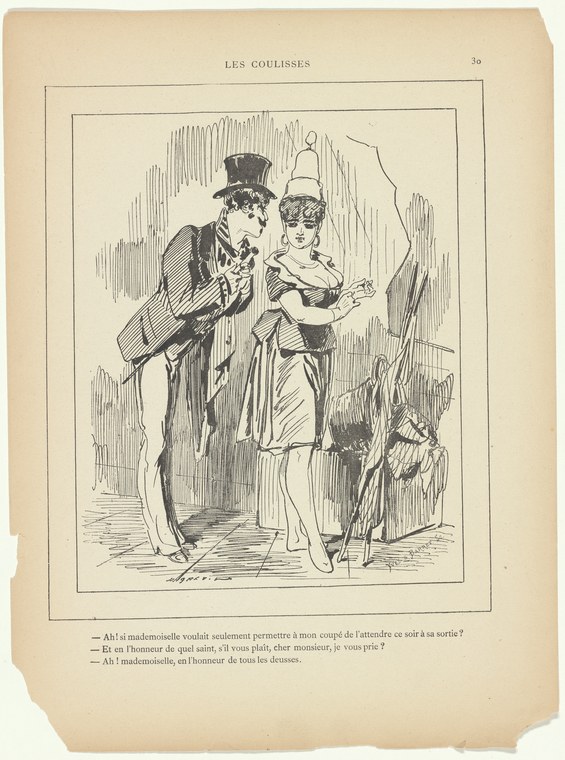
This image documents the visual culture of 19th-century social dance in its most everyday form—not the theatrical stage but the drawing room. It captures not the perfection of formal technique but the animated social interaction that defined ballroom dancing for the middle classes, offering insight into how contemporary viewers understood the relationship between dance, courtship, and social propriety.
What you are looking at
A gentleman in a tall top hat and dark tailcoat bends forward attentively toward a woman in a white Empire-waist dress with a tall feathered headdress. The woman stands with her weight shifted, one arm extended as if gesturing or dancing. The setting is a shallow interior with vertical hatching suggesting curtains or drapery behind them. A small child in a dress stands to the right, watching the pair. The line work is sharp and deliberate, with strong contrasts between the figures and background typical of 19th-century satirical prints. The mood is one of social interaction, possibly flirtation or instruction in dance, captured at a moment of apparent animation.
The dancing
The woman's posture shows an open, expressive upper body with her torso turned slightly away from her partner and one arm lifted in a gesture that reads as simultaneously demonstrative and elegant. The man leans in with a courteous bow, his body angled toward her with his top hat held at a slight angle—a pose suggesting deference and social attentiveness. Neither figure shows the rigid formal positioning of classical ballet; instead, both display the looser, more naturalistic bearing of social dance. The child's presence as an observer adds a narrative dimension: she may be a younger sibling or pupil watching a courtship or a dance lesson.
The dance depicted
This appears to depict a moment of social dancing or flirtation in a 19th-century bourgeois setting, most likely a quadrille, cotillion, or other ballroom social dance of the 1840s–1860s. The woman's costume—white dress with high waistline, plumed headdress—and the man's formal tailcoat are consistent with the ballroom dress of the Regency and Victorian eras. The gestural language is that of social ballroom dance rather than theatrical performance: the woman's arm extension and the man's deferential lean suggest the kind of polite, flirtatious interaction that characterized the social dances of the period. The French caption and satirical context suggest this may be commenting on courtship rituals or dance etiquette of the time.
How it was made
This is a wood engraving or steel engraving, executed with the fine parallel lines and precise cross-hatching characteristic of 19th-century print culture. The technique allowed for sharp detail and fine gradation of tone, and the print medium enabled wide distribution to a reading public. The style and technique suggest publication in a satirical or humorous periodical—the kind of work that would have appeared in popular illustrated magazines. Such prints were cheap to produce and distribute, making them a primary form of visual commentary on contemporary manners and social behavior.
About this work
This is a satirical or genre print from the 19th century (likely 1840s–1860s based on dress and style) depicting a moment of social courtship or dance instruction in a bourgeois interior. The two main figures—a fashionably dressed couple—interact with the kind of gestural animation associated with social ballroom dance of the period. The woman's plumed headdress, white dress, and expressive arm position, combined with the man's attentive lean and formal tailcoat, locate this squarely in the world of Regency or Victorian social dancing. The work belongs in a gallery of dance in art both for its depiction of actual ballroom practice and for its satirical commentary on gender roles and courtship rituals of the era.
How to look at it
Observe the woman's arm gesture and the tilt of her torso—the artist has frozen a moment of animation that reads as lively and engaged rather than stiff or formal. Notice how the man's deferential bow and the direction of his gaze are directed entirely toward her, establishing a dynamic of courtship or flirtation. The small child at right serves as a witness and adds a narrative layer; she may be learning by observation, or her presence may be the satirical point. The vertical hatching of the background, which creates the effect of curtains or drapery, frames the figures intimately and keeps the focus on the social interaction.
The artist
The work is attributed to an unknown artist within a collection of dance-related satirical prints. The style, technique, and subject matter are consistent with the output of 19th-century printmakers working for satirical and literary periodicals, particularly French publications. The hand-signed initials or mark visible at the bottom of the composition suggest a professional engraver, likely someone whose work appeared regularly in illustrated journals.
The period
This print dates to an era when social ballroom dancing was at the height of its popularity among the European and American bourgeoisie. The quadrille, cotillion, and other set dances were not merely entertainment but a central mechanism of social interaction, courtship, and the performance of class status. In the 1840s–1860s, illustrated periodicals and satirical prints frequently commented on the manners and follies of ballroom culture, using dance and courtship as vehicles for social satire. The feathered headdress, high-waisted white gown, and formal tailcoat place this squarely in the early-to-mid Victorian period.
Where it lives
This print is part of a collection of dance-related prints held by the New York Public Library, catalogued under the heading 'Prints depicting dance.' The collection appears to comprise primarily 19th-century satirical and genre prints, many of French origin, that document social and theatrical dance practices of the era.
Dance in this work
Questions about this work
What dance are these people doing?
The print does not depict a specific named dance step or movement but rather a moment of social ballroom interaction—likely during a quadrille, cotillion, or waltz. The woman's gesture and posture are consistent with the kind of animated, courteous interaction that characterized 19th-century social dancing among the bourgeoisie. The focus is on the social and flirtatious dimension of dance rather than technical execution.
Why is there a child in the picture?
The child's presence serves a narrative function. She may be observing a dance lesson, learning proper ballroom conduct by watching her elders, or the inclusion may be satirical—commenting on the child's understanding (or misunderstanding) of adult courtship rituals. In 19th-century genre and satirical prints, the presence of observers and bystanders often added layers of social commentary.
Is this a theatrical scene or a social scene?
This is a social, not theatrical scene. The dress, setting, and body language are those of a private ballroom or drawing room, not a theatrical stage. The man and woman are engaged in the kind of everyday social dancing that would have occurred at balls, assemblies, and private parties among the middle and upper classes.
What does the French caption say?
The caption reads (roughly): 'Ah! if Mademoiselle would only permit me to see her exit—and on evening out, would you be willing, dear admirer, to grant me this favor? Ah! Mademoiselle, in homage of all the ladies.' The caption is characteristic of 19th-century satirical print humor, playing on the courteous and somewhat overwrought language of ballroom flirtation.
More dance artwork





