49 works in this view — arrow keys or swipe to move between them.
Dance in Art
Dance cartoons
Unknown artist
- Collection:
- Prints depicting dance
- Source:
- New York Public Library
- Rights:
- Public domain — free to use, share and adapt.
- Recorded as:
- Public Domain
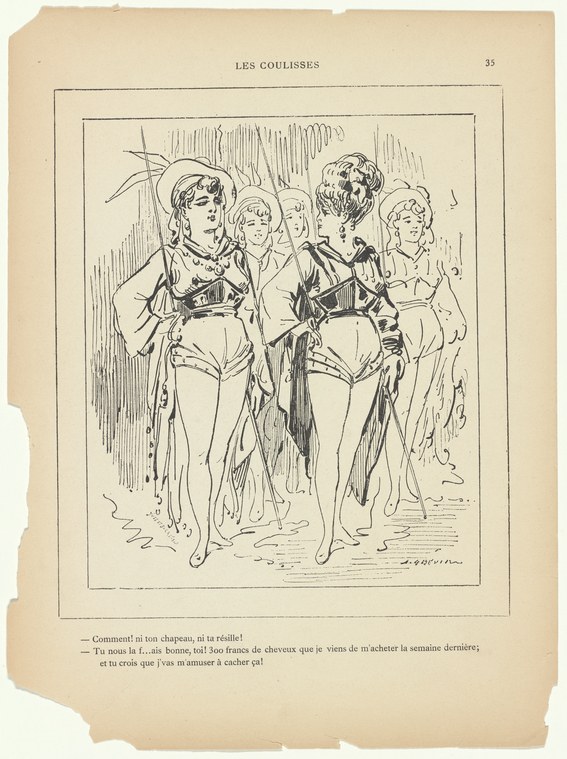
This cartoon documents the cultural anxieties and satirical treatment of commercial dance and female entertainers in the modern city. It shows how dancers were represented not as artists but as objects of mockery and moral suspicion, a perspective that shaped both the social position of dancers and the ways they were imagined in visual culture.
What you are looking at
A satirical line of four young women stands against a curtained backdrop, each wearing a fitted jacket or corset top with abbreviated shorts—a costume that reads as theatrical or performance wear rather than everyday dress. The figures are arranged in profile or three-quarter view, their poses stiff and almost mechanical. The leftmost figure wears a hat with an upright feather; the others have their hair up or styled elaborately. The line is static and frontal, like a chorus arrayed for display rather than in the midst of movement. The drawing style is swift and caricatural, with hatching used to suggest the curtain behind them. The overall tone is one of mockery: the abbreviated costume and the awkward, posed arrangement suggest these are entertainers or dancers of some kind, and the caption below makes clear the satire is directed at their profession and perhaps their morality.
The dancing
The four figures stand upright with minimal weight shift, their legs straight and parallel or slightly turned out. Their arms hang at their sides or rest on their hips; there is no sense of extension or grace, only of bodies displayed. The postures are rigid and unnatural, almost doll-like—the opposite of fluid dance movement. Their faces are turned toward the viewer with direct gazes, emphasizing display over participation in an action. This is not a depiction of dancers in motion but of young women arranged as objects.
The dance depicted
This is not a depiction of actual dance technique or performance. Instead, it is a satirical cartoon that uses the figure of the dancer or performer—identifiable by the abbreviated costume and the lineup format common in theatrical chorus or review shows—as a vehicle for social commentary. The style and tone suggest French or European popular satire from the late 19th or early 20th century, when such critiques of cabaret, music-hall, and theatrical entertainment were common. The dance tradition being mocked is likely the commercial, sensational theater of the period: cancans, revues, or other popular entertainment forms that were targets of conservative disapproval.
How it was made
This is a pen or ink drawing, likely a print (engraving or lithograph reproduction of a drawing). The technique is linear and economical—the artist uses simple outline and selective hatching rather than tonal modeling. The signature at lower right suggests this was a professional illustration, probably produced for a periodical or book. The swift, caricatural style and the subject matter—contemporary fashion and entertainment—point to this being journalistic or editorial illustration, a common form of visual satire in 19th-century print culture.
About this work
This is a satirical cartoon depicting four performers or dancers in abbreviated theatrical costume, arranged in a static, doll-like lineup. The drawing ridicules the women and their profession through exaggeration and unflattering formal treatment. It belongs in a gallery about dance not because it celebrates dance or shows dancers in action, but because it uses the figure of the dancer and the conventions of theatrical performance costume as its subject matter. It is evidence of how dancers and entertainment were perceived and caricatured in popular culture, and how visual satire weaponized the female dancer as a symbol of moral anxiety.
How to look at it
Look at the absolute stiffness of these bodies—the artist has deliberately erased any suggestion of movement or grace in order to make the subjects appear ridiculous. Notice that they are arranged as a line-up or display, not as participants in a narrative or action. The abbreviated costume is emphasized through heavy outline and clear silhouette, making it the primary target of the satire. The caption below will make the specific point of the mockery clear; read the text and image together to understand what social behavior or professional reality is being attacked.
The artist
The signature appears to read "Grellon" or similar, but it cannot be securely identified. The style and subject matter are consistent with French fin-de-siècle illustration and caricature, a tradition that included prolific contributors to periodicals like *La Vie parisienne*, *Le Rire*, and *L'Assiette au beurre*. The rapid, witty line and the focus on contemporary entertainment and gender dynamics are characteristic of the period's newspaper and magazine illustration.
The period
The late 19th and early 20th centuries saw an explosion of commercial entertainment in European cities—music halls, cabarets, and revues—where women performed in increasingly scanty and sensational costumes. This provoked both fascination and moral panic, particularly from conservative critics and satirists. The same period saw the rise of the modern illustrated press and the profession of caricaturist-illustrators who mocked contemporary mores. Simultaneously, serious theatrical forms like ballet were consolidating their prestige and artistic legitimacy, creating a sharp divide between the 'high' dance of the opera house and the 'low' dance of the popular stage.
Where it lives
This work is part of the New York Public Library's collection of prints depicting dance. It is catalogued minimally, with no artist securely identified and no date assigned. The collection designation "Les Coulisses" (The Wings/Backstage) and page number 35 suggest it may come from a published periodical or a compilation of theatrical satire.
Dance in this work
Questions about this work
Are these dancers actually performing a specific dance?
No. This is satirical illustration, not a record of actual dance performance. The artist has used the generic figure of the theatrical dancer or performer as a vehicle for social mockery. The poses are deliberately stiff and unnatural—the opposite of trained dance technique.
What does the costume tell us about the performance form being mocked?
The abbreviated costume (short jacket and very short shorts or skirt) was typical of music-hall, cabaret, or revue performers in the late 19th and early 20th centuries. This style of entertainment was popular but controversial, often condemned as immoral. The costume makes the women's bodies the primary visual focus, which is exactly what the satirist is criticizing.
Why is this in a gallery about dance if it's not depicting dance?
Because it uses dancers and theatrical performance as its subject, and because it documents how dancers were represented, perceived, and ridiculed in popular visual culture. Understanding how dancers were caricatured tells us as much about the history of dance as celebrating their artistry does.
More dance artwork





