49 works in this view — arrow keys or swipe to move between them.
Dance in Art
La leçon de danse
Unknown artist
- Collection:
- Prints depicting dance
- Source:
- New York Public Library
- Rights:
- Public domain — free to use, share and adapt.
- Recorded as:
- Public Domain
This print is rare evidence of how dance pedagogy actually happened in the nineteenth century—not on the stage, but in private lessons where technique was transmitted through observation and correction. It shows dance as a skill embedded in female education and social accomplishment, and the presence of multiple pupils of different ages reveals the commercial and domestic structures that sustained dance training outside the theater. For historians of pedagogy and the body, this image documents the gendered spaces and teaching methods that shaped centuries of dance practice.
What you are looking at
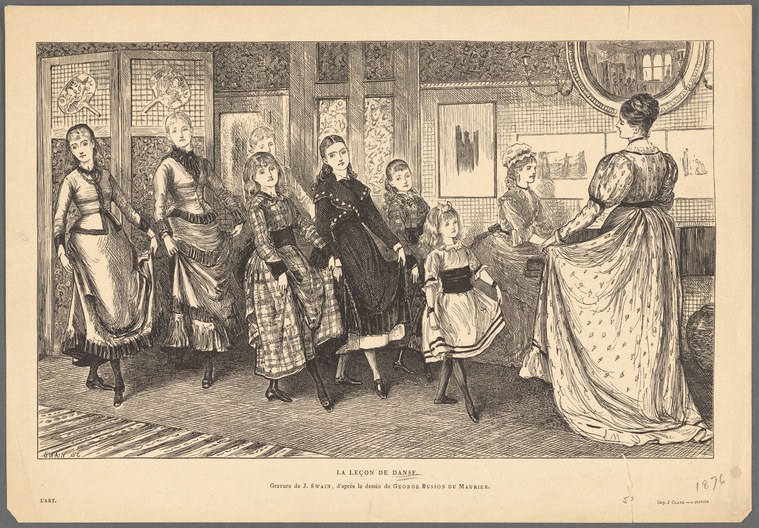
An interior domestic or studio space where a dance lesson is underway. An adult woman (likely an instructor) stands at right, dressed in a long white gown with patterned sleeves and a draped shawl, observing a group of younger pupils arranged before her. The group includes roughly eight children and young people, all female, wearing various period dresses in darker fabrics—checked patterns, solid blacks, and striped materials. The setting is detailed with latticed windows in the background, framed wall panels, decorative items on shelves, and a patterned floor runner. The lighting is warm and even, typical of interior daytime illumination. The instructor's posture is attentive and authoritative; the pupils cluster together with varying degrees of engagement, some facing the instructor, others at angles, suggesting a moment captured mid-lesson rather than a formal demonstration.
The dancing
The instructor stands in profile at right, her weight centered in a composed stance, arms open in a teaching gesture. The pupils show mixed orientations and postures—some have arms at their sides, others gesture expressively, and the arrangement suggests informal instruction rather than strict alignment. The children's bodies show age-appropriate bearing and the varied energy levels typical of a group lesson. The closest pupil stands in relatively formal position; others behind her are less formally arranged, some slightly turned, creating depth and naturalistic spacing rather than the rigid lines of ballet training.
The dance depicted
This depicts a dance lesson of the nineteenth century, most likely from the 1850s–1880s based on dress, and represents instruction in social or theatrical dance for young women of means. The setting and grouping suggest a private or semi-private lesson in deportment and movement—likely covering elements of ballet technique (suggested by the formal dress and indoor studio), social dancing, or both. The presence of multiple young pupils of varying ages under a single instructor points to a pedagogical model common in European domestic education, where dance was part of refined accomplishment for young ladies. The specific style cannot be determined from technique alone, but the formal interior and emphasis on posture align with Classical ballet pedagogy of the period.
How it was made
This is a wood engraving or steel engraving on paper, executed in fine black line with skilled cross-hatching to create tone and texture. The technique allows precise rendering of fabric folds, facial expression, and interior detail, and suggests this was a reproduction print for wide distribution rather than a unique artwork. The print quality and composition indicate it was created for publication—likely as an illustration for a journal, periodical, or book on dance, education, or domestic life. The care lavished on the teacher's drapery and the pupils' varied expressions suggests both artistic ambition and an educated audience familiar with the conventions of mid-nineteenth-century academic engraving.
About this work
This print documents a private dance lesson, probably French or European in origin, from the mid-nineteenth century. It is a pedagogical image—a record of how dance was taught to young women of the professional or upper-middle classes, combining elements of formal training with the domestic sphere. The work sits at the intersection of art instruction, social history, and the material culture of dance training in the industrial era. It belongs in a dance gallery because it shows not a performance or a finished choreography, but the teaching moment itself, the relationship between instructor and learner, and the embodied knowledge that was transmitted within the drawing room.
How to look at it
Attend first to the posture and expression of the instructor—her composed stance and observant gaze establish her authority and her pedagogical role. Then notice the contrast between the pupil nearest the viewer (relatively formal in bearing) and those behind her (more natural, less trained). The artist has captured the moment just after an instruction or demonstration, when the pupils are settling into position—not a performance, but a working lesson. The layering of the group in space, with some pupils partly hidden behind others, gives a sense of depth and documentary realism rather than formal arrangement. The inclusion of specific details—the girl's checked dress, the instructor's draped shawl, the latticed windows—grounds the scene in a particular place and time, making it a record rather than a generic allegory.
The artist
The artist is not recorded. The engraving bears the signature or mark 'J. Sarg.' or similar at lower left, and a credit line indicating it is after a design by J. Evard (or similar name), 'après le dessin de Mademoiselle Evard ou Maubeuf.' This suggests the print was made by a professional engraver from a drawing or painting by another hand—a common practice in mid-nineteenth-century print production. The quality of execution indicates a skilled professional workshop, likely French based on the language of the credit and the style of the interior.
The period
The 1850s–1880s were the height of Romanticism in ballet and a period of intense codification of ballet technique. However, this image does not show professional ballet training; rather, it documents the broader market for dance instruction that had grown enormously in nineteenth-century cities. Dance was essential to middle-class female education, marketed alongside music and drawing as essential accomplishments. At the same time, the Romantic ballet was reaching wider audiences through prints, journals, and illustrated newspapers. This print sits at the intersection: it shows the unglamorous reality of how the technique seen on stage was actually taught to amateur pupils in drawing rooms and private studios.
Where it lives
This print comes from the NYPL's Prints depicting dance collection. It is catalogued as a print (likely engraving or steel engraving) from an unknown date and unknown artist. The inscription at lower margin in French, 'La leçon de danse' (The Dance Lesson), and the credit line reference Evard or Maubeuf suggest a French origin or context.
Dance in this work
Questions about this work
Is this a ballet lesson?
It appears to show instruction in formal movement and deportment for young women, likely including elements of ballet technique, but the setting and informality suggest it may combine social dancing, theater training, and etiquette. Without clearer evidence of pointe work or specific ballet vocabulary, it is best described as a nineteenth-century dance lesson in a private or semi-private context.
Who was the teacher and where was this lesson held?
The artist and the specific instructor are unknown. The interior suggests a well-appointed studio or drawing room, the kind typically found in European cities where professional or semi-professional dance teachers offered private instruction to daughters of the middle and upper classes.
When was this print made?
The dress, interior furnishings, and engraving technique suggest a date between 1850 and 1890, likely closer to the 1870s–1880s. The catalogue record lists the date as unknown, but the style is consistent with mid-to-late Victorian periodicals and illustrated books.
Why is a dance lesson the subject of a print?
Dance instruction for young women was a fashionable and marketable topic in the nineteenth century, and illustrated newspapers and journals regularly featured such scenes. This print may have been published as an illustration in a periodical, or as part of a book on education, etiquette, or domestic life, reaching an audience interested in both dance and the accomplishments expected of young ladies.
More dance artwork





