49 works in this view — arrow keys or swipe to move between them.
Dance in Art
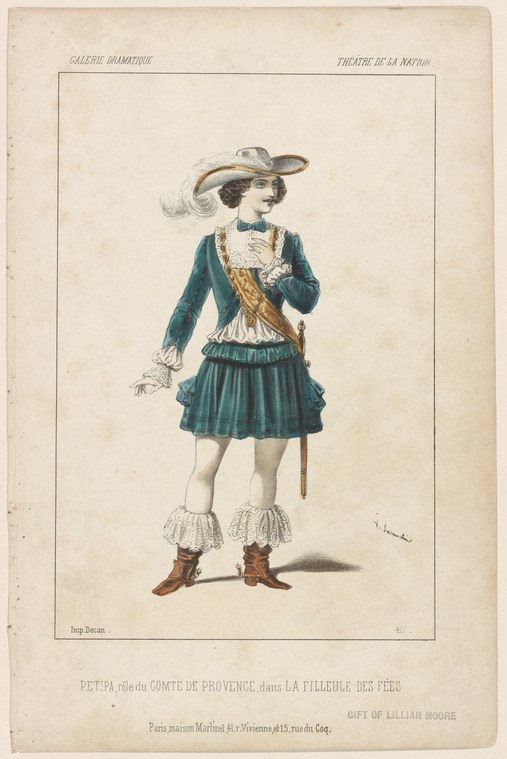
Théâtre de la Nation. Petipa, rôle du comte de Provence, dans La filleule des fées
Unknown artist
- Collection:
- Prints depicting dance
- Source:
- New York Public Library
- Rights:
- Public domain — free to use, share and adapt.
- Recorded as:
- Public Domain
Costume prints are among the richest surviving documents of how 18th-century theatrical dancers actually moved and carried themselves, because unlike paintings they were made for direct circulation and regular use by performers learning roles. This print preserves both the material culture of stage dress and the postural conventions of the period—evidence that is almost never available from other sources. For historians of dance, theater, and French culture, such prints form a crucial visual archive of performance practice before the age of photography.
What you are looking at
A young male dancer in theatrical costume stands in a three-quarter pose against a plain background, weight shifted slightly onto his left leg. He wears a dark teal or forest-green jacket with a white lace jabot at the neck and a contrasting gold-trimmed waistcoat. A pleated skirt in the same teal hangs to mid-thigh, beneath which white ruffled cuffs frame his calves above brown leather heeled boots. A tricorn hat with a white plume sits at a jaunty angle on his powdered or light-colored hair. His right arm hangs naturally; his left hand rests on or near his hip in a gesture suggesting ease and authority. The figure occupies the center of the composition with considerable white space around it, a common convention for theatrical costume prints meant for documentation and circulation among performers and theater professionals.
The dancing
A single standing figure in a relaxed contrapposto stance, with the weight set on the back leg and the opposite hip slightly raised. The pose suggests a moment between movement or a held presentational stance rather than active dancing. The arm positions—one at rest, one near the hip—do not suggest an energetic leap or turn. The silhouette, proportions, and bearing are consistent with the upright frame and turnout expected of trained theatrical dancers of the period, though the figure is shown in stillness rather than action.
The dance depicted
This is a costume plate for a male dancer performing the role of the Comte de Provence in *La Filleule des Fées* (*The Fairy's Goddaughter*) at the Théâtre de la Nation. The inscription attributes the role to Petipa, likely referring to Jean-Antoine-Mérante Petipa, a prominent French dancer and choreographer of the late 18th century. The pose and presentation suggest a character role in a narrative ballet or mixed theatrical piece rather than pure ballet technique. The costume—a variant of 18th-century courtly dress—indicates a social drama or fairy-tale narrative, typical of the féerie (magical spectacle) genre popular in French theater of this period. Without access to the scenario or performance records, the specific choreographic vocabulary cannot be determined from the image alone, but the context indicates a theatrical work blending dance with dramatic narrative.
How it was made
This is a hand-colored engraving or lithograph, a standard format for theatrical costume documentation in the 18th and early 19th centuries. The line work is delicate and precise, with careful attention to textile details—the pleating of the skirt, the ruffles at the wrist, the trim on the waistcoat—rendered through cross-hatching and fine strokes. Color has been applied in flat washes, with particular care on the deep teal of the jacket and skirt, the warm brown of the boots, and the gilt of the waistcoat trim. This combination of technique and finish suggests production by a commercial theatrical print shop, designed for wide circulation among performers, patrons, and theater libraries. The print commemorates both a specific costume design and a particular dancer's interpretation of a role.
About this work
This is a costume documentation print for a male dancer in a named role from a French theatrical production, executed in the standard format used to circulate information about costume design and performance practice in the 18th–early 19th century theater world. The figure is presented in a formal, presentational stance that shows off the costume's construction and ornamentation rather than capturing action. As a documentary artifact, it records not only what was worn but also the dancer's posture, bearing, and physical presence—the visible authority and grace expected of a trained performer in a major role.
The work belongs to a large and important category of theatrical ephemera whose primary purpose was practical: to communicate to other performers, costume makers, and patrons what a role looked like, how it moved, and what status it carried. Yet because it preserves both the physical reality of costume and the dancer's interpretation of character through posture and gesture, it is also a historical record of embodied performance—how a dancer named Petipa stood, held his arms, and presented himself in a particular story at a particular venue.
How to look at it
Observe the dancer's posture carefully: the distribution of weight, the slight lift of the rib cage, the angle of the head. The artist has chosen a moment of stillness—not a leap or turn—which emphasizes how the dancer holds his body in repose and in character. Notice too the precision of the costume details: the way light falls on the waistcoat trim, the construction of the skirt, the heel of the boot. These details tell you that this was a costume of some expense and status, designed to make the wearer look authoritative and graceful. The blank background focuses all attention on the figure's line and presence, a convention of the period that makes the dancer's own body the primary text.
The artist
The artist is not recorded. The print was published by the Parisian house Martinet, rue du Coq, a major producer of theatrical costume engravings and prints in this period. Martinet's shop was known for rapid, accurate, hand-colored prints documenting new roles and performers; such prints were sold to the theater-going public and to performers themselves as reference materials. The signature or mark visible in the lower margin may be that of the engraver or the shop's house mark, but without archival research this cannot be confirmed.
The period
This print dates to the late 18th or early 19th century, a period of significant transformation in French theatrical dance. The Théâtre de la Nation (renamed from the Comédie-Italienne) was a major venue for mixed theatrical forms—plays, ballets, pantomimes, and féeries. The costume style here—tricorn hat, tailored jacket, and pleated skirt—is consistent with late ancien régime or early Napoleonic courtly dress vocabulary, adapted for theatrical character roles. The work of choreographers like Noverre and Dauberval was emphasizing expressiveness and narrative coherence in ballet, moving away from pure technical display toward integrated dramatic performance. A role such as the Comte de Provence would have required both technical dancing ability and dramatic characterization—exactly the double competence that new theatrical ballet demanded.
Where it lives
This print is held by the New York Public Library in its collection of dance-related prints and photographs. It is one of many theatrical costume documentation prints produced by Parisian publishers in this period, surviving in libraries and museums across Europe and North America because of their documentary value and their appeal to collectors of theatrical history.
Dance in this work
Questions about this work
Who was Petipa and why is his name on this print?
The name Petipa most likely refers to Jean-Antoine-Mérante Petipa (1787–1855), a French dancer and choreographer who performed in major Paris theaters in the late 18th and early 19th centuries. His name appears on the print because it documented his performance in this specific role—such prints were often issued with the performer's name to mark a particular interpretation of a character or to acknowledge a dancer's reputation.
What is a costume plate and why were these prints made?
A costume plate was a hand-colored engraving documenting a theatrical costume, usually showing a single figure in a standing pose. These prints served multiple purposes: they were used by costume makers and performers as reference materials, sold to theater patrons as souvenirs, and kept in the archives of theaters and performance companies as records of how roles were dressed and performed. They were practical documents first, artistic prints second.
What can we learn about 18th-century dance from a print like this?
Costume prints show us posture, bearing, weight distribution, and how dancers held themselves in character. They record what was worn—the materials, construction, and ornamentation—which tells us about the status and nature of a role. They also show us which roles involved dancing and which were primarily dramatic, and they preserve evidence of performance practice from an era before photography.
Is this a ballet or a play with dancing?
It is most likely a mixed theatrical work—a féerie or a play with substantial dancing roles. The costume is courtly dress adapted for theater, and the role (a count) suggests a narrative drama. The fact that a trained dancer named Petipa performed it indicates it included significant choreographed movement, but the scenario itself was likely a story of intrigue or magic rather than a pure abstract ballet.
More dance artwork





