49 works in this view — arrow keys or swipe to move between them.
Dance in Art
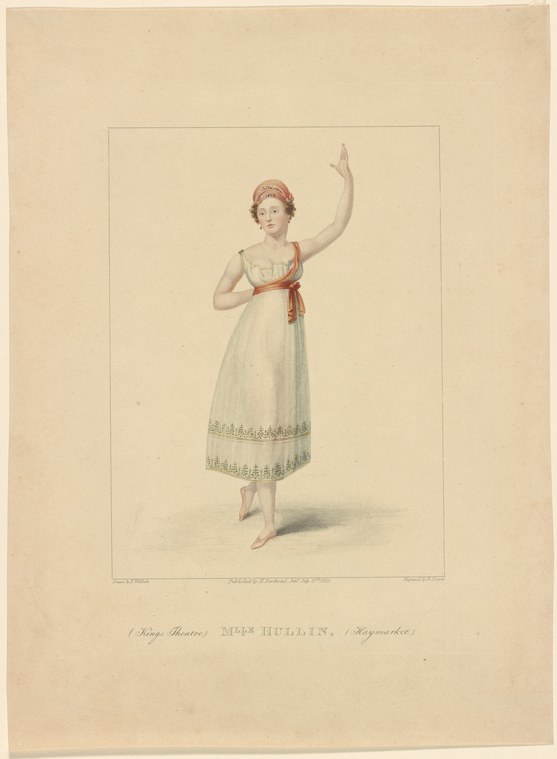
(Kings Theatre) Mlle. Hullin, (Haymarket)
Unknown artist
- Collection:
- Prints depicting dance
- Source:
- New York Public Library
- Rights:
- Public domain — free to use, share and adapt.
- Recorded as:
- Public Domain
Mlle. Hullin's portrait is documentary evidence of how fashionable female dancers presented themselves on the early 19th-century London stage—the costume, the bearing, and the idealization of the body all reflect specific conventions of the Regency period. As one of relatively few colored prints surviving to show a named female performer from this era in a specific theatrical moment, it is a crucial visual source for understanding the aesthetic values and physical culture of Regency dance.
What you are looking at
A single female figure stands in a graceful contrapposto pose against a plain cream background. She wears a high-waisted Empire silhouette dress in pale cream or white muslin, with a broad decorative band or embroidered trim at the hem. A coral-red sash cinches her waist. Her arms are held expressively—the right arm raised to shoulder height with the forearm extended upward in an open, lyrical gesture; the left rests lower. Her head is adorned with a coral or rose-tinted headdress or turban. She stands en relevé or nearly so, with her weight poised forward on the balls of her feet. The figure is rendered in colored lithograph or aquatint with fine hatching and delicate toning, positioned centrally within a rectangular frame.
The dancing
A single dancer occupies the composition. Her body is arranged in an open, balletic frame typical of Regency-era theatrical dance: weight forward, posture upright and elongated, one arm lifted to about shoulder level in an elegant port de bras while the other hangs softly. Her legs appear straight and extended, suggesting a demi-pointe position. The overall bearing is aristocratic and refined, with an emphasis on upper-body grace and arm line.
The dance depicted
This is a theatrical dance portrait from the Regency or early 19th-century stage, likely depicting a fashionable parlor or ballroom style dance of the period. The inscription identifies the figure as Mlle. Hullin, performing at the Kings Theatre or Haymarket—both prestigious London venues. The costume and pose are consistent with the neoclassical revival style of Regency dance: an emphasis on elegant line, the body as an instrument of courtly refinement, and a fusion of balletic deportment with the lighter, less codified movements of social dance. The raised arm and open frame suggest this may capture a moment from a cotillion, country dance, or other Regency-era theatrical social dance rather than strict ballet technique.
How it was made
This is a hand-colored aquatint or lithograph, a popular medium for theatrical portraiture and dance documentation in the 1820s–1840s. The print shows fine tonal gradations achieved through layered inking and careful hand-coloring of flesh tones, fabrics, and the coral accents. The technique allowed for wide distribution of theatrical imagery to London audiences hungry for souvenirs of celebrated performers, and the surviving hand-coloring suggests this was a higher-end impression, possibly sold in theater foyers or print shops.
About this work
This is a theatrical portrait print of Mlle. Hullin, a Regency-era dancer at one of London's leading playhouses. It documents the visual language of early 19th-century stage dance: the neoclassical dress, the emphasis on elegant line and lifted port de bras, and the synthesis of balletic deportment with the lighter social forms that dominated London stages after the Napoleonic Wars. The inscription situates her within a known theatrical context, though little else about her career is now recorded. The work exemplifies the ephemeral celebrity of the Regency stage and the role of printed theater portraiture in preserving the visual memory of celebrated performers.
How to look at it
Observe how the artist has captured the dancer in a moment of poised repose rather than dynamism—the raised arm is not in motion but held in a defined position, suggesting the kind of controlled elegance valued in Regency stage presentation. The bare or nearly bare arms and the high waistline emphasize the elongated line of the body, which was the paramount ideal. The stance en relevé and the forward tilt of the torso convey lightness and elevation without explicit ballet codification—this is theatrical dancing of a social kind, refined and fashionable but not yet fully committed to the technical vocabulary of classical ballet that would emerge in the 1830s and beyond.
The artist
The artist is not recorded, but the quality of draftsmanship and hand-coloring suggests a professional theater print publisher or printmaker working for one of the London theaters or print shops catering to theater-goers. Regency-era dance and theatrical portraiture was a thriving commercial genre, with prints sold as souvenirs and collectibles; many such prints were issued unsigned or under the publisher's name rather than the artist's.
The period
This portrait dates to the height of Regency neoclassicism in English culture (c. 1811–1820), when the stage was dominated by a fashion for elegant, attenuated bodies, Empire-line dress, and the fusion of ballet technique with lighter social dance forms. The theaters of London—including the King's Theatre in the Haymarket—were centers of fashionable entertainment, and their dancers were celebrities. Female performers appeared in a repertoire that mixed pantomime, dance interludes, comic opera, and the lighter operatic dances that had superseded the heavier Baroque and 18th-century styles. The neoclassical aesthetic in dance paralleled developments in visual art and fashion, with an emphasis on the beauty of line, proportion, and the illusion of effortless grace.
Where it lives
The work is held in the New York Public Library's collection of prints depicting dance. It carries no date or artist attribution in the surviving record, but the inscription and stylistic evidence place it securely in the Regency or early 1820s.
Dance in this work
Questions about this work
Was Mlle. Hullin a ballet dancer?
Not in the modern sense. She was a theatrical dancer of the Regency era, when the distinction between ballet, social dance, and pantomime was not sharply drawn. Her costume and the informality of her pose suggest she performed in the lighter, more fashionable dances of the London stage—cotillions, country dances, and similar forms—alongside dramatic or comic roles. Classical ballet technique was only beginning to be codified in England during this period.
Why is her arm raised like that?
The raised arm was a fundamental gesture of elegance in Regency dance, derived from court dance vocabulary but refined through neoclassical aesthetics. It served both practical and aesthetic purposes: it balanced the body, created a continuous line from hip to fingertips, and signaled grace and cultivation. This particular position—with the arm at roughly shoulder height and the forearm extended—was a standard port de bras for Regency theatrical dancing.
What do the clothes tell us?
The high-waisted Empire gown, bare arms, and coral sash are quintessentially Regency. The light muslin and restrained ornament reflect both neoclassical fashion and the practical demands of stage dancing, which required freedom of movement. The coral headdress and sash add color and a hint of exoticism, possibly suggesting a character role or the theatrical convention of slight costume fantasy.
More dance artwork





