49 works in this view — arrow keys or swipe to move between them.
Dance in Art
L'ouverture d'un bal
Unknown artist
- Collection:
- Prints depicting dance
- Source:
- New York Public Library
- Rights:
- Public domain — free to use, share and adapt.
- Recorded as:
- Public Domain
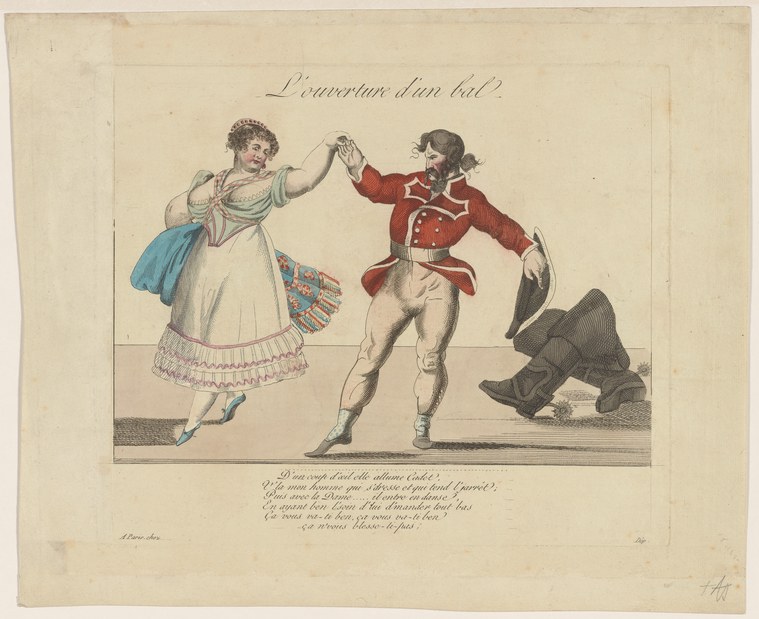
The image is essential evidence for how the opening of a ball was staged as social theater, and how the gesture of invitation and acceptance was codified in movement and deportment. For historians of dance, it shows the moment before the dance began—the courtship and negotiation that framed every social dance of the period.
What you are looking at
A hand-colored engraving depicting the opening moment of a formal ball. A young woman in an elegant Empire-waist white gown with a pink-trimmed hem and a blue silk shawl draped over her arm stands at the center-left, her posture upright and her gaze directed toward her partner. A man in a red military-style coat with white facings and breeches faces her, leaning slightly forward with his arm extended toward hers in an inviting gesture. His stance is dynamic and his bearing suggests the gallant courtesy of a military officer. In the background, a third figure in dark clothing stands partially visible, suggesting the setting is an indoor ballroom. The composition is spare and formal, with the figures arranged against a plain background that emphasizes their dress and demeanor. The title at the top, "L'ouverture d'un bal" (The Opening of a Ball), signals that this is the formal moment when partners meet to begin the dance.
The dancing
The man extends his right arm upward and outward in a classical invitation to dance, his body angled toward his partner. The woman responds with raised arm, her hand meeting his in a gesture of acceptance. Both figures stand upright with the formal posture expected of social dance of the period. The woman's stance is poised but passive, waiting to be led; the man's is active and proprietary. Neither figure shows bent knees or weight shift, suggesting this is the ceremonial moment before movement begins rather than mid-dance.
The dance depicted
This is a depiction of the opening courtesy of a formal Regency-era ball, most likely a Quadrille or English Country Dance, where the recognition and partnering of dancers was as ritualized as the figures themselves. The image documents not the dance in motion but the social protocol that preceded it—the bow, the offered hand, the moment of commitment between partners. The man's military dress suggests officer rank, and such scenes of formal partnership were common in ballroom imagery of the early 19th century. The engraving records the etiquette of courtship as much as the dance.
How it was made
This is a hand-colored engraving, likely from the early 19th century, evidenced by the fine line work in the figures and the delicate application of watercolor or gouache over the printed impression. The technique allowed for wide circulation as a commercial print, making such works accessible to the literate and aspiring middle classes who wanted to study correct deportment and fashion. The hand-coloring suggests this was a luxury version, intended for collectors or those seeking an especially refined object.
About this work
This engraving documents a moment of significant social ritual: the opening of a formal ball in the Regency period, frozen at the moment when a man and woman meet to dance. The work is primarily a record of courtship protocol and fashion—the woman's empire waist and the man's military coat are as important as their poses—but it also preserves the physical language of formal partnering in early 19th-century ballroom dance. The composition's restraint and clarity make it a teaching tool as well as a souvenir of fashionable life.
How to look at it
Notice the careful symmetry of the two figures and the way they frame the space between them—the hand-clasp is the focal point of the composition, and everything else (the woman's dress, the man's coat, their upright posture) serves to emphasize this moment of connection. The artist has chosen not to show movement but rather the formal pause before movement, a choice that emphasizes the social contract being enacted. The background figure and the sparse setting direct all attention to the ritual being performed by the pair.
The period
The early 19th century saw an explosion of print culture devoted to fashion, manners, and social dancing. The Regency period (1811–1820) and the years immediately following were marked by an obsession with correct comportment, especially in mixed-sex social settings. Formal balls were the primary venue for courtship and the display of rank, and prints such as this served as guides to aspiring dancers and as mementos for those who attended such events. The figure of the military officer was particularly fetishized in ballroom imagery of this period, reflecting the Napoleonic Wars and the cultural prestige of the military.
Where it lives
The work is held in the Prints depicting dance collection at the New York Public Library. It is a commercial engraving, likely sold individually or as part of a series documenting fashionable life and ballroom etiquette.
Dance in this work
Questions about this work
What dance are they about to dance?
The print does not specify. The formal opening portrayed here was common to most ballroom dances of the period—Quadrilles, Cotillions, and English Country Dances all began with a similar moment of introduction and invitation. The composition records the protocol rather than the specific dance.
Why is the man in a military coat?
Military dress was a mark of status and prestige in the early 19th century, especially in Regency England. The coat identifies him as an officer, which would have elevated his social standing and made him a desirable partner at a formal ball.
Is this a real moment or an idealized one?
It is both. The composition is stylized and formal, presenting an ideal of courtesy and restraint. However, the ritual depicted—the invitation to dance, the formal hand-clasp, the upright posture—was practiced and understood by all dancers of the period. It is a real social moment, represented according to contemporary conventions of print-making and manners.
More dance artwork





