49 works in this view — arrow keys or swipe to move between them.
Dance in Art
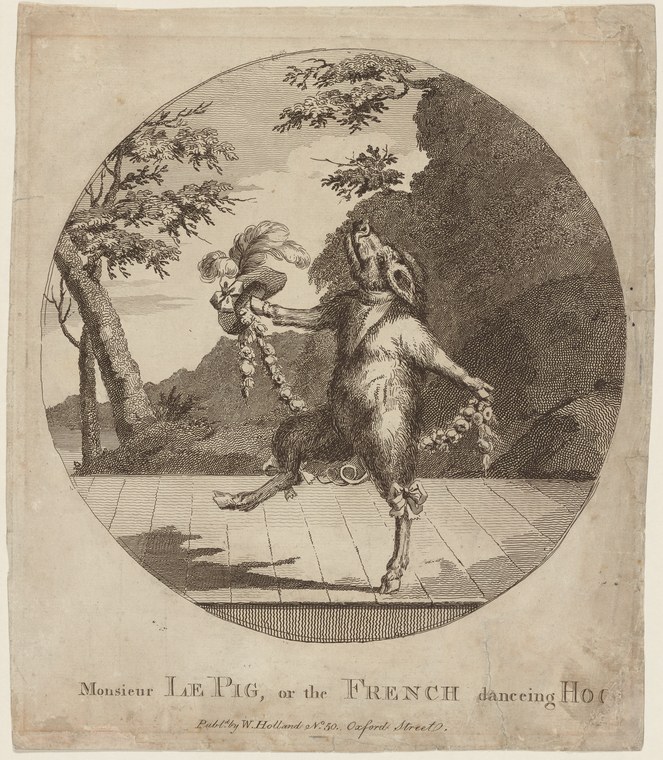
Monsieur Le Pig, or the French danceing Hog
Unknown artist
- Collection:
- Prints depicting dance
- Source:
- New York Public Library
- Rights:
- Public domain — free to use, share and adapt.
- Recorded as:
- Public Domain
This print documents how dance posture functioned as a visual language for social satire in the 18th century, and reveals the power of the minuet and similar Baroque dances as symbols of aristocratic identity that could be mocked by displacement onto an animal. It is one of few images that treats dance as a subject worthy of ridicule rather than celebration, showing that dance was not above criticism or parody in the popular imagination.
What you are looking at
A portly pig stands upright on its hind legs in the center of a circular composition, positioned as if mid-dance. The animal wears a decorative collar or beaded necklace and appears to be gesturing with its front legs raised, one arm bent as if offering a hand or acknowledging a partner. The pig's posture and raised leg suggest active movement. The setting is minimal: a flat wooden stage or floor rendered with hatching lines, a large dark boulder or rock formation behind, and a spreading tree with leafy branches overhead to the left. The background is open and light. The entire scene is contained within a circular frame typical of 18th-century satirical prints. The title at the base identifies the subject as "Monsieur Le Pig, or the FRENCH danceing Hog."
This is an engraving executed with fine hatching and line work, characteristic of satirical animal prints from the Georgian period. The technique shows careful attention to tonal modeling through parallel lines, particularly in the rendering of the rock and the pig's body. The print is rendered in black ink on cream paper, now aged to a warm tan. The composition is both grotesque and theatrical—the pig is treated with the solemnity and framing usually reserved for human dancers, a deliberate absurdity.
The dancing
The pig is a solitary anthropomorphized figure, standing fully upright on hind legs in an unstable posture that reads as active and momentary rather than static. One front leg is bent and raised at the elbow, roughly chest-height, as if offering a hand or gesturing in salutation; the other extends lower. The head tilts slightly, and the overall weight distribution suggests forward motion or an exaggerated curtsy. The posture parodies the formal politeness and elongated limbs of a human courtly dancer.
The dance depicted
This is a satirical print, not a record of actual dance. It uses animal caricature to mock French aristocratic manners and the fashion for sophisticated court dances—likely the minuet or other Baroque social dances that required exaggerated courtesy and precise, artificial postures. The "French" designation in the title suggests the target is French court culture and its affected deportment. The pig, a creature of mud and appetite, is shown adopting the most refined and absurd poses of Enlightenment ballroom society, which is the joke. No actual dance instruction can be drawn from this; rather, it satirizes the very idea of civility and grace by applying it to an inappropriate animal.
How it was made
This is an engraving, most likely a hand-colored or black-and-white satirical print intended for wide circulation. The publication line reads "Publi'd by W. Holland No. 50 Oxford Street," indicating a London-based commercial print publisher active in the late 18th century. Engraving allowed for fine detail and tonal control through parallel hatching, making it ideal for both portraiture and caricature. The circular frame and modest scale suggest this was produced as a single-sheet satirical print or broadside, affordable and collectable by a broad urban middle-class audience. Such prints were the vehicles for political and social satire in this period.
About this work
This is a Georgian-era satirical engraving that uses animal caricature to mock the artificial postures and pretensions of French court dance, particularly the refined manners of Baroque ballroom culture. The print shows a pig standing upright and posed as if dancing a courtly minuet, complete with affected gesture and courtly bearing. It belongs in a gallery of dance imagery not because it documents any real dance practice, but because it reveals how dance—specifically the minuet and its attendant codes of civility—functioned in 18th-century visual culture as a symbol of aristocratic refinement and, to satirists, excessive artificiality. The work testifies to the power of dance posture as shorthand for social class and national identity during the Enlightenment.
The print is also a window onto the politics of Franco-British cultural relations at a moment when French taste dominated European fashion, and when English satirical prints often directed their wit at French pretension. The dancing pig reduces all that elevated courtliness to absurdity, and the joke lands precisely because the viewer recognizes the conventional poses of the minuet.
How to look at it
Attend to the posture: the pig adopts the elongated, upright stance and raised arm position that any educated viewer of the 1780s would instantly recognize as the pose of a courtly dancer, probably in mid-minuet or in the act of offering a hand or curtsy. The artist has captured the exaggerated refinement of the dance by rendering the pig in full upright posture, creating a visual joke through incongruity. Notice the framing: the circular composition and the formal staging (stage floor, backdrop, tree) treat the pig as seriously as one would treat a portrait of a human dancer. It is this formal respect applied to an absurd subject that makes the satire work. The technical skill in the engraving—the careful hatching, the modeling of form—also matters: this is not crude or careless work, but rather a skilled print made with care enough that the satire lands with precision rather than sledgehammer force.
The artist
The engraver is not attributed in the catalogue record. The print was published by W. Holland, a prominent London satirical print seller active from the 1770s onward at 50 Oxford Street, a significant address in the trade. Holland published work by notable caricaturists of the era but also issued many prints by anonymous engravers. The style and subject are consistent with the mainstream of London satirical animal prints from this period—works like those of James Gillray and his contemporaries, though the quality and line work here are solid if not exceptional.
The period
The late 18th century was the age of the minuet and the formal cotillion in European ballroom culture, especially in aristocratic French and British circles. Dance was a required accomplishment for genteel society, taught by dancing masters and performed at assemblies and balls. At the same time, Enlightenment satire was increasingly aimed at the artificiality of aristocratic manners and the gap between natural behavior and courtly refinement. This print sits at that intersection: it takes the most mannered and codified of all social dances—the minuet, with its turned-out positions, formal bows, and precise geometric pathways—and applies it to a pig, the least refined of domestic animals. The absurdity is the point. This period also saw the rise of the London satirical print industry as a mass medium for social commentary, with prints like this sold cheaply and in large numbers.
Where it lives
The print is held in the New York Public Library's collection of prints depicting dance. The publication line identifies it as published by W. Holland, a major London satirical print seller, suggesting original distribution as a commercial single-sheet satirical print in Britain.
Dance in this work
Questions about this work
Is this meant to be a real dancing pig, or is it a joke?
It is entirely satirical. No such pig existed; the print uses animal caricature to mock the artificial postures and pretensions of French aristocratic dance, especially the minuet. By showing a pig adopting the refined poses of court society, the artist ridicules both the dance and the culture that performed it.
What dance is the pig doing?
Most likely a minuet, the most formal and codified of Baroque social dances, characterized by turned-out positions, precise hand-work, bows, and exaggerated courtesy. The raised arm and upright posture are typical of minuet deportment. The satire works because the minuet was the emblem of aristocratic refinement.
Why is it called 'French'?
The minuet originated in France and was the dominant form of court dance in French aristocratic society. Calling the pig 'Monsieur Le Pig' (French title, French name) and labeling it a 'French' dancer is part of the satire—the print mocks French taste and French pretension, which were frequent targets of English satirical prints in this period.
Who made this print?
The engraver is not recorded. The print was published by W. Holland, a London-based satirical print seller operating from 50 Oxford Street in the late 18th century. Holland issued many satirical prints of this type, though this particular one is by an anonymous engraver.
More dance artwork





