49 works in this view — arrow keys or swipe to move between them.
Dance in Art
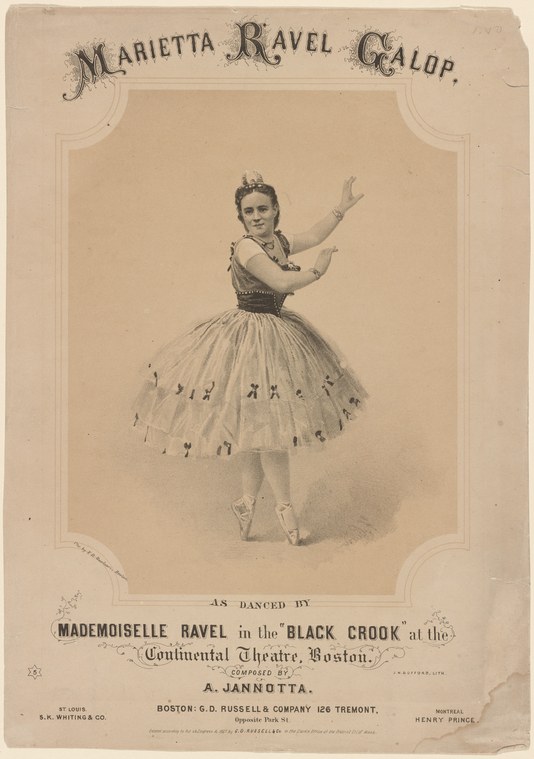
Marietta Ravel galop: as danced by Mademoiselle Ravel in The black crook at the Continental Theatre, Boston. Composed by A. Jannotta
Unknown artist
- Collection:
- Prints depicting dance
- Source:
- New York Public Library
- Rights:
- Public domain — free to use, share and adapt.
- Recorded as:
- Public Domain
This print documents the fusion of ballroom dance and theatrical ballet that defined mid-19th-century popular entertainment, and it preserves the image of a working professional dancer at a moment when such documentation was rare and valuable. For historians of theatrical dance, it provides visual evidence of how the galop was adapted, costumed, and presented in a landmark American theatrical production, and it shows the technical demands placed on dancers in commercial theatre of this period.
What you are looking at
A young female dancer stands alone against a neutral background in a three-quarter pose, facing the viewer with her body turned slightly to the left. She wears a fitted dark bodice with a decorative waistband and a voluminous tulle skirt that extends to mid-calf, the skirt printed or embroidered with what appears to be text or decorative patterns across its surface. Her right arm is raised to shoulder height with the elbow bent, her left arm extended downward in a graceful line. She stands en pointe in pink ballet slippers, her weight balanced on her left foot while her right leg appears slightly bent. Her posture is upright and elegant, with her head held high and a composed expression. The composition is formal and theatrical, framed by an ornamental border typical of mid-19th-century theatrical prints. The figure is rendered in a tonal lithographic or engraved style with careful shading that gives dimension to the folds of the skirt and the musculature of her legs.
The dancing
The dancer presents a classical theatrical stance with the body turned in an open, frontal position. Her raised right arm curves gracefully with the forearm at approximately right angles, suggesting an ornamental port de bras; her extended left arm is long and softly curved. She stands fully on pointe, a technical requirement that demands strength and balance, with her supporting leg straight and her free leg bent with foot pointed. The pose conveys both control and lightness—the dancer's frame is elongated and her shoulders are held back, demonstrating the upright carriage of mid-19th-century theatrical dance. The gesture is frozen at a moment of apparent repose or transition rather than dynamic movement.
The dance depicted
This is a theatrical dance print documenting a galop as performed by Mademoiselle Ravel in *The Black Crook* at the Continental Theatre in Boston. The galop was a fast, energetic couple's dance popular in the mid-19th century, typically performed in 2/4 time with a characteristic hopping, prancing quality. However, this image shows Ravel in a solo theatrical variation—the ornamental, virtuosic version of the galop adapted for the stage as a feature dance rather than a social ballroom step. The pose suggests a moment between or within rapid, traveling movements; the tutu with its distinctive pattern (possibly listing steps or decorative text) indicates this was a featured solo within the operatic spectacle of *The Black Crook*, a major American theatrical production. The artist has chosen to present her at a moment of grace rather than maximum velocity, emphasizing her technical accomplishment and balletic training.
How it was made
This is a lithographic print or engraving, likely hand-colored or printed in tone, a common format for theatrical publicity and souvenirs in the 1870s–1880s. The technique allowed for relatively affordable multiple copies to be distributed to audiences, making this a document of theatrical celebrity and popular taste as well as dance history. The fine detail in the rendering of the tulle skirt and the precise delineation of the dancer's musculature suggest a skilled theatrical lithographer working from a stage sketch or photograph. The ornamental border and the printed text crediting composer A. Jannotta and identifying the performer and theatre locate this within the commercial dance print tradition—works made for sale to theatregoers and collectors rather than for archival purposes.
About this work
This is a theatrical souvenir print documenting a galop variation performed by the celebrated dancer Mademoiselle Ravel in the Boston production of *The Black Crook*, one of the most popular theatrical spectacles of its era. The print captures a single moment from a featured solo, showing Ravel en pointe in balletic pose within a voluminous tulle skirt. It is both a record of a specific performance and a piece of theatrical publicity designed to immortalize and market a celebrated dancer to her audience. The image reveals how 19th-century theatrical dances—even the social, bouncy galop—were transformed into showcases for balletic technique and visual spectacle when performed on the professional stage.
How to look at it
Look closely at the tulle skirt: it appears to bear printed text or notation, which may be decorative or may document steps of the galop itself—a fascinating possibility that invites comparison with dance notation and theatrical documentation of the period. Notice the precise control required by the pose: the dancer stands en pointe on one leg while maintaining an elegant, lifted frame, a technical demand that shows how ballroom dances were transformed by classical training for theatrical performance. The artist has chosen an elegant, posed moment rather than a dynamic mid-step position, which tells us that the goal was to produce a beautiful, collectible image for theatrical promotion rather than a documentary record of the galop's characteristic hopping motion. Compare the upright, balletic posture here with contemporary images of the galop as danced socially: the theatrical version emphasizes verticality, balance, and visual spectacle over the sideways, traveling energy of the ballroom original.
The artist
The artist is not recorded. The print is credited to A. Jannotta as composer of the piece and is marked as published by G.D. Russell & Company in Boston and H. Prang in London and Montreal. The printmaker's signature or name does not appear to be legible in the surviving copy. The work was likely created by a theatrical lithographer working in the Boston printing trade, a profession that produced thousands of such commemorative dance and theatrical prints in the mid-to-late 19th century.
The period
The Black Crook premiered in New York in 1866 and became the longest-running theatrical production of the 19th century, spawning numerous touring companies and performances across North America. It was a foundational work in American musical theatre and spectacle, combining opera, pantomime, ballet, and acrobatic acts. The 1870s–1880s were a period of rapid professionalization in theatrical dance; dancers like Mademoiselle Ravel achieved celebrity status and their images were widely circulated on prints, cartes de visite, and in theatrical programs. The galop itself was declining as a fashionable ballroom dance in Europe by this period but flourished on the theatrical stage as a vehicle for virtuosic display. The ornate, full-skirted costumes visible here reflect the aesthetic of Second Empire and Gilded Age theatre design.
Where it lives
This print is held by the New York Public Library as part of its collection of dance-related prints and theatrical ephemera. It is catalogued as a souvenir or promotional print from a professional theatrical production, a common form of material culture that has survived in significant numbers in institutional collections.
Dance in this work
Questions about this work
What is *The Black Crook* and why is it important?
*The Black Crook* was an 1866 musical spectacle that became the longest-running theatrical production of the 19th century. It blended opera, ballet, pantomime, and acrobatics into a new form of popular entertainment and is considered a foundational work in American musical theatre. The work toured extensively, and dancers who performed in it, like Mademoiselle Ravel, became celebrities whose images were widely circulated.
What is a galop and how was it different in theatre versus ballroom?
The galop was a fast, energetic couple's dance in 2/4 time, popular in ballrooms of the mid-19th century. It was characterized by quick, hopping steps and was danced at speed. When adapted for theatrical performance, as shown here, the galop became a solo featuring a single virtuosic dancer who combined the galop's characteristic steps with classical balletic technique—pointe work, elongated lines, and elegant port de bras—creating a hybrid form that showcased both theatrical spectacle and technical accomplishment.
Why is the dancer standing on pointe?
By the 1870s–1880s, pointe technique had become an essential part of theatrical dance training and performance, even for dancers performing non-classical dances like the galop. Standing en pointe enhanced the ethereal, weightless quality of theatrical spectacle and demonstrated the dancer's technical training and physical control. It was also visually distinctive and immediately signaled to the audience that this was a professional, trained performer.
What is the text or pattern on the skirt?
The printed or embroidered pattern on the tulle skirt is not entirely legible in the reproduction. It may be purely decorative, or it may be a form of dance notation or step-listing—a practice that occasionally appeared in 19th-century theatrical costume design. Without a clearer or original example, its exact purpose cannot be determined, but it adds to the documentary interest of the image.
More dance artwork





