49 works in this view — arrow keys or swipe to move between them.
Dance in Art
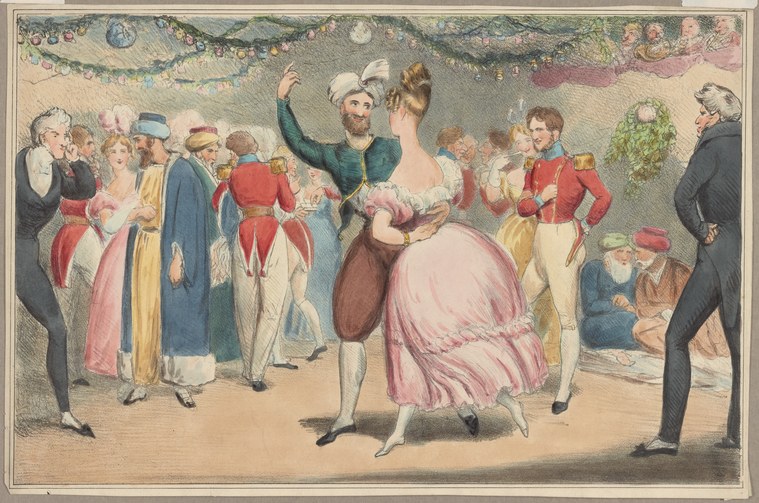
Costume ball
Unknown artist
- Collection:
- Prints depicting dance
- Source:
- New York Public Library
- Rights:
- Public domain — free to use, share and adapt.
- Recorded as:
- Public Domain
The waltz was revolutionary in its time: it brought couples into an unprecedented physical closeness in public, and artistic depictions like this one recorded both the attraction and the anxiety it provoked. A dancer or historian studying the adoption of the waltz into Western ballrooms, or the visual language of formal social dance, will find in this image evidence of how the form was understood, celebrated, and made exotic through costume and spectacle.
What you are looking at
A formal costume ball in an interior space decorated with garland and greenery, rendered in hand-colored engraving. The composition centers on a woman in a pink silk gown with a voluminous skirt, caught mid-turn, her arm raised in animation. She faces a man in a dark coat and plumed turban—a costume suggesting Ottoman or North African dress. Around them, onlookers in evening clothes and period costume stand in conversational clusters; men in tailcoats and women in Empire-waist gowns create a backdrop of spectators and dancers. The lighting is even and clear, typical of interior scenes, with warm tones in the garments and architectural detail suggesting a ballroom or assembly room. The artist has arranged figures across the depth of the space to suggest both the action and the social hierarchies of the event—some engaged, others observing.
The dancing
The central woman's posture shows weight forward and to one side, her raised arm and turning torso indicating rotational movement—a waltz or similar turning couple dance. The man in the turban faces her with his arm extended in a formal hold. The surrounding figures stand mostly upright, watching; no other couples appear to be dancing at this moment. The woman's high-waisted gown and bare shoulders are characteristic of Regency and early 19th-century formal dress, allowing free movement of the arms and upper body. The composition privileges the central pair and their interaction over ensemble formation or line dancing.
The dance depicted
This appears to depict a Regency or early Gilded Age social dance, most likely a waltz or cotillion, given the turning posture, the closed-hold position, and the formal ballroom setting with spectators. The waltz was relatively novel in Western European ballrooms in the early 19th century and remained controversial; artistic depictions often emphasized the novelty and intimacy of the hold. The woman's animated expression and the man's formal costume suggest the social transgression or exoticism the waltz represented—the plumed turban may be a masquerade accessory heightening the element of playful costume and role-play central to such events. This is a social dance of the ballroom, not a theatrical or folk performance.
How it was made
This is a hand-colored engraving or possibly a colored lithograph, recognizable by the fine lines of the engraved plate, the even application of color by hand (visible in the slight variations and pooling in the garments), and the pale, almost translucent quality of the inks. The technique allowed for wide circulation of fashionable scenes; such prints were collected as records of social life and sold as prints in London and other European capitals. The hand coloring adds specificity to fabrics and social status—the pink silk, the gold trim, the fine detail of jewelry—making the work a document of both fashion and social convention.
About this work
A formal costume ball in the Regency or early 19th-century style, captured in a hand-colored engraving. The work documents a moment of social dance—a waltz or cotillion—in which a woman and man in formal evening dress and exotic costume enact the novel and slightly scandalous waltz hold in front of a gathering of onlookers. The composition balances the central dancing pair with the social framework of the ballroom: spectators, musicians (implied), and the architectural setting define the occasion. The work belongs to a genre of social-scene prints that recorded fashionable leisure and the evolution of ballroom dance in the early 19th century, serving as both a mirror of contemporary fashion and a document of changing attitudes toward the body, touch, and movement in polite society.
How to look at it
Notice the woman's weight and the line of her body: she is caught mid-turn, her upper body twisting, her arm raised to shoulder height or above, suggesting the upright frame and rotational movement of the waltz as opposed to the processional or stepping patterns of earlier country dances. The man's formal posture and extended arm suggest the closed hold in which his left hand clasps her right, and his right arm encircles her waist—a gesture that was itself the subject of intense social commentary. Observe, too, the spectators: their eyes are on the dancing pair, and their stillness and formal arrangement contrast sharply with the energy and motion at the center. The artist has chosen the moment of greatest visual and social interest—not a stately processional, but an intimate turning movement witnessed by an assembled crowd.
The period
The early 19th century saw the rapid adoption of the waltz across European ballrooms, despite strong resistance from moralists and older generations who found the closed hold and rapid turning unseemly. Artistic depictions of ballroom scenes became a staple of fashionable print culture, distributed through London, Paris, and Vienna to audiences eager to see and emulate the latest styles and dances. At the same time, masquerade and costume balls were popular social events that blurred the lines between everyday identity and performance, allowing attendees to adopt exotic or fantastical personas—hence the plumed turban. The print medium democratized access to images of these exclusive events, making them available to a middle-class audience who might not have attended such balls.
Where it lives
The work is held in the Prints Depicting Dance collection at the New York Public Library. It is a print, likely a hand-colored engraving or lithograph, produced for commercial distribution and popular circulation in the early 19th century.
Dance in this work
Questions about this work
What is the plumed turban and why is the man wearing it?
The turban is a costume accessory typical of masquerade balls, where attendees wore fancy dress or exotic costumes to blur their social identity and allow for playful role-play. The turban may suggest Ottoman or North African dress, making it part of the 'orientalist' aesthetic popular in European high society. It does not indicate that the man is actually from the Ottoman Empire, but rather that he has adopted a costume for the occasion.
Is this couple actually dancing, or are they just posing?
The woman's rotational posture, the line of her body, and her raised arm all suggest active movement—this is a waltz in progress, not a formal pose. The engraver has chosen to capture the moment mid-turn, when the couple's movement is most visible. The surrounding figures are stationary, watching, which heightens the sense of the dancing pair in motion.
What was so controversial about the waltz?
The waltz brought the dancer's bodies into a closed hold (man's arm around woman's waist, hands clasped in front) for the first time in Western ballroom dancing. Earlier country dances involved minimal contact and were often performed in lines or circles. The waltz's intimacy and the rapid spinning motion alarmed older generations and moralists, who saw it as indecent. Prints like this one both documented and helped normalize the dance by showing it performed in respectable company.
Who made this print and when?
The artist is not recorded in the catalogue. The style and subject matter suggest it was produced in the early 19th century, likely in London or Paris, as a fashionable print for a middle-class audience interested in current ballroom styles and social life. The hand-coloring and composition are consistent with commercial print production of the Regency and early Romantic periods.
More dance artwork





