49 works in this view — arrow keys or swipe to move between them.
Dance in Art
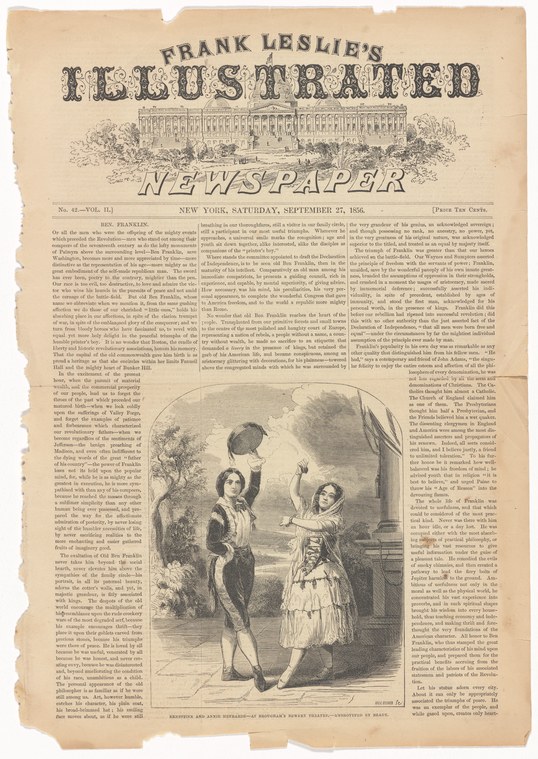
Ernestine and Annie Henrarde: at Brougham's Bowery Theatre
Unknown artist
- Collection:
- Prints depicting dance
- Source:
- New York Public Library
- Rights:
- Public domain — free to use, share and adapt.
- Recorded as:
- Public Domain
This image documents a form of theatrical dance and acrobatics that thrived in the nineteenth-century American theatre but is now largely invisible in dance history. The Henrarde sisters were professional performers whose names and images circulated in the press, yet acrobatic performance by women has been largely written out of theatre and dance history in favor of narrative ballet. The image proves that such performance existed, was celebrated, and was recorded—and raises questions about why it has been forgotten.
What you are looking at
This is a wood-engraved illustration from Frank Leslie's Illustrated Newspaper, September 27, 1856, depicting two young female acrobats, Ernestine and Annie Henrarde, performing at Brougham's Bowery Theatre in New York. The scene shows a theatrical interior with classical architectural details—columns and a colonnade visible in the background. The two dancers are captured mid-performance in a moment of striking physical display: one figure is suspended or elevated, her body extended horizontally or at a diagonal angle, while the other figure below reaches upward toward her in an attitude of support or spotting. Both wear performance costumes typical of mid-nineteenth-century theatrical acrobatics—fitted bodices and skirts that allow visibility of the leg line and movement. The lighting is rendered through fine cross-hatching that emphasizes the drama of the moment and the musculature and extension of the elevated performer's body. The composition draws the eye to the relationship between the two bodies and the extraordinary physical feat being demonstrated.
The dancing
The composition centers on an asymmetrical partnered acrobatic relationship. One performer is lifted or suspended with her body nearly horizontal, legs extended, arms positioned for balance or aesthetic line. The lower performer, anchoring the figure, stands with arms raised and extended upward in a supporting gesture, her posture suggesting controlled strength rather than strain. Both figures display the elongated line and pointed-leg extension valued in nineteenth-century theatrical dance and acrobatics. The spatial relationship between them—vertical stacking with active support—suggests a practiced partnership and trained bodies capable of sustaining difficult positions.
The dance depicted
This depicts acrobatic performance of the type popular in mid-nineteenth-century American theatrical venues. The Henrarde sisters appear to have been professional acrobats whose act combined elements of gymnastic display with theatrical presentation. The image captures a moment of partner acrobatics (adagio work), in which one performer's body is controlled and displayed by another. This was a distinct performance mode from narrative ballet, yet was frequently presented on the same stages and in the same theatrical programs. The composition suggests training in body control and line that draws from both circus acrobatics and theatrical dance traditions of the era.
How it was made
This is a wood engraving, a relief-printing technique in which an image is carved into the end-grain of a wooden block and printed. The fine parallel lines (hatching and cross-hatching) visible throughout are characteristic of wood engraving and allowed for the reproduction of tonal gradation and atmospheric effect. As a page from Frank Leslie's Illustrated Newspaper, a mass-circulation weekly, this image was intended for rapid production and wide distribution to a middle-class American readership. Wood engraving was the dominant technology for newspaper illustration in the 1850s, before photographic reproduction became standard. The technique's requirement for bold, clear linework and high contrast meant that artists working in this medium prioritized legible composition and dramatic gesture over subtle modeling.
About this work
This is a newspaper engraving documenting a specific theatrical performance by two acrobatic dancers in 1856 New York. It belongs in a gallery of dance imagery because it captures not a narrative or allegorical moment, but a real feat of trained physical skill—the kind of performance that existed alongside and sometimes intersected with ballet in the nineteenth-century American theatre. The Henrarde sisters were professional performers whose bodies and techniques deserve recognition as part of the broader history of theatrical dance, even though acrobatics and partner gymnastics are often excluded from that history. The image is evidence of what audiences paid to see and what was newsworthy enough to illustrate in a major newspaper: the female body in controlled, difficult, and visually striking motion.
How to look at it
Attend to the moment of suspension and support: the artist has chosen the instant of maximum extension and difficulty, when the upper performer's body is fully displayed and the lower performer's strength is most visible. Notice the classical architectural setting, which frames the acrobats' bodies against ordered, permanent forms—suggesting that their ephemeral feat is worthy of being recorded in the monumental language of architecture. The fine engraved lines that model the performers' bodies emphasize musculature and the clarity of their line, presenting trained bodies as objects of visual interest and technical mastery. The composition uses the verticality of the figures against the horizontals of the colonnade to create dynamic tension.
The period
In the 1850s, the American theatre was a space of considerable variety. Narrative ballet, in the Romantic tradition, was performed by visiting European companies and resident troupes, but acrobatic performance, pantomime, spectacular dance, and circus-influenced acts were equally popular and often more financially successful. Frank Leslie's Illustrated Newspaper, founded in 1855, was the first American newspaper to employ wood engravers on a large scale, and its theater coverage documented the full range of theatrical entertainments available to urban audiences. The fact that the Henrarde sisters' performance was deemed worthy of illustration indicates that acrobatic dance held significant cultural value and audience appeal. This was also an era before the professionalization and formalization of ballet training in America; many performers trained in multiple movement traditions.
Where it lives
This engraving appeared in Frank Leslie's Illustrated Newspaper on September 27, 1856. The print is held by the New York Public Library in the collection of prints depicting dance. As a page from a major illustrated newspaper, it was mass-produced and distributed to subscribers and newsstand purchasers across America.
Dance in this work
Questions about this work
Who were Ernestine and Annie Henrarde?
The Henrarde sisters were professional acrobatic performers active in mid-nineteenth-century American theatre. Beyond what appears in this newspaper image and the performance billing, little is documented about their lives and careers. They represent a class of skilled performers whose technical abilities were celebrated in their time but whose names have largely disappeared from historical records.
What is the difference between this and ballet?
This is partner acrobatics or adagio work—one performer's body is lifted, controlled, and displayed by another. While ballet also uses partnering, acrobatic performance typically emphasizes the difficulty and strangeness of the human body's extension and suspension, rather than narrative or emotional expression. The training is different, the aesthetic goals are different, and the performance context often overlapped with circus and variety theatre rather than opera houses.
Why is this in a dance collection?
Because it is a performance of trained physical skill set before an audience in a theatrical setting. The distinction between 'dance' and 'acrobatics' is partly historical convention—what mattered to audiences in 1856 was the technical achievement and the spectacle of the human body in motion. Excluding acrobatic performance from dance history means ignoring a significant part of theatrical entertainment and the careers of skilled performers.
How was this image made?
An artist drew or sketched the scene, and a wood engraver then carved the image into the end-grain of a wooden block using fine tools. The block was inked and printed in a printing press, allowing thousands of copies to be produced for distribution in the newspaper. This labor-intensive process was the standard technology for newspaper illustration in the 1850s.
More dance artwork





