49 works in this view — arrow keys or swipe to move between them.
Dance in Art
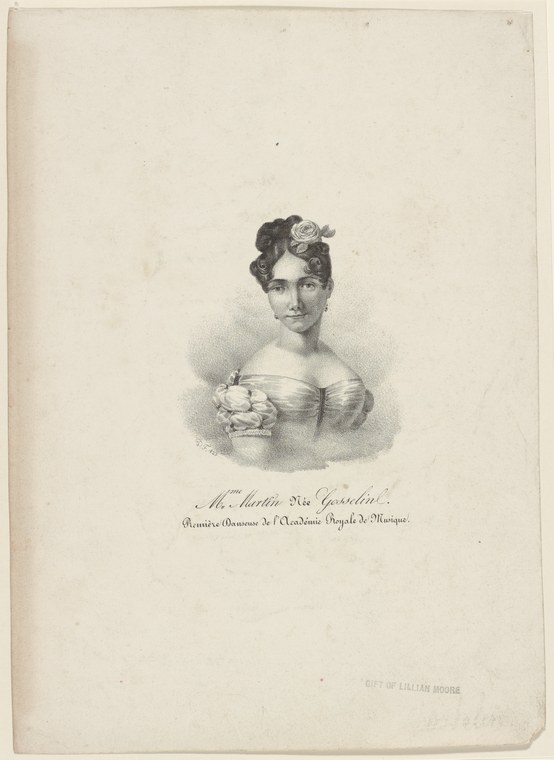
Mme. Martin née Gosselin, première danseuse de l'Académie royale de musique
Unknown artist
- Collection:
- Prints depicting dance
- Source:
- New York Public Library
- Rights:
- Public domain — free to use, share and adapt.
- Recorded as:
- Public Domain
Named female dancers of the 18th century are sparsely documented outside cast lists and memoirs; this engraved portrait is evidence of Mme Martin's professional standing and celebrity. It demonstrates that serious theatrical dancers—particularly women—were subjects of fine-art portraiture and print circulation, marking their value to the culture and the audience's interest in knowing the faces behind famous performances.
What you are looking at
A half-length portrait of a young woman set against a neutral background, rendered in fine engraving with stippled shading that gives volume and subtle modeling to the face and shoulders. She is shown bare-shouldered in the neoclassical manner, her dark hair swept up and adorned with a white feather or plume. She gazes directly outward with a composed, frontal expression. Her right hand is raised and positioned near her torso, holding what appears to be a small bouquet or fan—the object is delicately rendered but somewhat ambiguous in the engraving. The work is signed or inscribed below the image in a flowing cursive script: "Mme Martin née Gosselin, première danseuse de l'Académie royale de musique."
The dancing
The subject is a single female figure in a static, formal pose typical of theatrical portraiture. Her shoulders are relaxed and square to the viewer. The raised right hand and arm suggest a gentle, controlled gesture—possibly the posed moment before or after movement rather than movement itself. There is no indication of active dance posture or dynamic weight shift; this is a formal presentation of the dancer as a person rather than a capture of performance.
The dance depicted
The inscription identifies this as Mme Martin (née Gosselin), a principal dancer (première danseuse) of the Académie royale de musique in Paris. The late 18th-century title and the engraved portrait format suggest this is a commemorative work of a professional stage dancer, likely from the Romantic era or its immediate predecessor. No specific dance style is depicted here—this is a portrait of a dancer rather than a representation of dance itself. The bare shoulders and neoclassical styling reflect the costume conventions of serious theatrical dance of the period, but the pose is entirely formal and non-kinetic.
How it was made
This is a fine engraving, identifiable by the closely spaced parallel lines (hatching and stippling) that build tone and volume, particularly in the face and upper torso. The technique allows for precise detail and a delicate, refined finish suitable for a commemorative portrait. The work demonstrates the high level of skill required for portrait engraving and suggests a significant subject and a circulation among educated audiences—print collections, gift exchanges, theatrical archives. The New York Public Library holds it as part of its collection of prints depicting dance, indicating it was valued as both a portrait and a document of theatrical history.
About this work
This is a formal engraved portrait of Mme Martin née Gosselin, identified as a principal dancer of the Paris Opéra (Académie royale de musique). It documents a named performer from the late 18th century at the height of her professional standing. The work belongs in a gallery about dance not because it represents choreography or movement, but because it is a historical record of an individual dancer's status and celebrity—one of the ways the art form was documented and circulated before photography. Such portraits served as promotional images, gifts, and mementos, and their existence signals that dance was an art practiced by named artists worthy of commemoration.
How to look at it
Attend to the directness of the gaze and the formality of the pose—this is a woman presenting herself as a professional artist, not a character in a narrative. The bare shoulders and classical styling are the costume codes of the serious ballet stage of the era. The delicate engraving technique itself is worth noticing: it was laborious, expensive, and reserved for subjects deemed worthy of permanent documentation. The inscription below the image is as important as the portrait itself—it names her, claims her rank, and anchors her identity to a specific institution.
The artist
The artist is not recorded. The work was produced by a professional engraver working in the late 18th-century theatrical portrait tradition, likely in Paris or for a Parisian audience. The skilled rendering and the care taken with the subject suggest the engraver was accomplished and the commission came from or was intended for a reputable publisher or the dancer's own circle.
The period
In the late 18th century, the Académie royale de musique was the center of French theatrical dance, and its dancers—especially female performers—were celebrities in Parisian society. The Romantic period was beginning to reshape what ballet meant, emphasizing ethereal, weightless movement and emotional expressiveness. Engraved portraits of dancers were a common form of theatrical promotion and celebrity documentation, circulating among audiences, dance enthusiasts, and archives. Women dancers had begun to dominate the ballet stage, though their labor was precarious and their social status complex; this portrait captures a moment of professional recognition.
Where it lives
The work is held in the New York Public Library's collection of prints depicting dance, catalogued as part of a broader archive of theatrical documentation. It is an engraving, a form of print that was made in multiples and circulated among collectors, theaters, and libraries—making it a work of both individual commission and broader cultural reach.
Dance in this work
Questions about this work
Was Mme Martin a famous dancer?
The title 'première danseuse de l'Académie royale de musique' indicates she held the highest rank for a female dancer at the Paris Opéra, the most prestigious institution for theatrical dance in the 18th century. This was a position of considerable status and visibility. Beyond this inscription, few details of her career survive in the historical record, but the fact that she was commemorated in an engraved portrait suggests she was well-known and valued by her audiences.
Why are there no women's names in old dance history?
Women dominated the ballet stage from at least the early 18th century onward, but their careers were rarely documented as thoroughly as those of male choreographers or composers. Portraits like this one are valuable because they name individual women and claim their professional standing. Most evidence of women dancers survives in fragments—cast lists, memoirs, images like this—rather than in sustained written histories that were more often devoted to men's work.
What does 'Académie royale de musique' mean?
This was the official name of the Paris Opéra under the French monarchy. It was a royal institution and the supreme venue for theatrical dance in France. To dance there, and to hold the rank of première danseuse, was to be at the apex of the professional dance world of the period.
More dance artwork





