49 works in this view — arrow keys or swipe to move between them.
Dance in Art
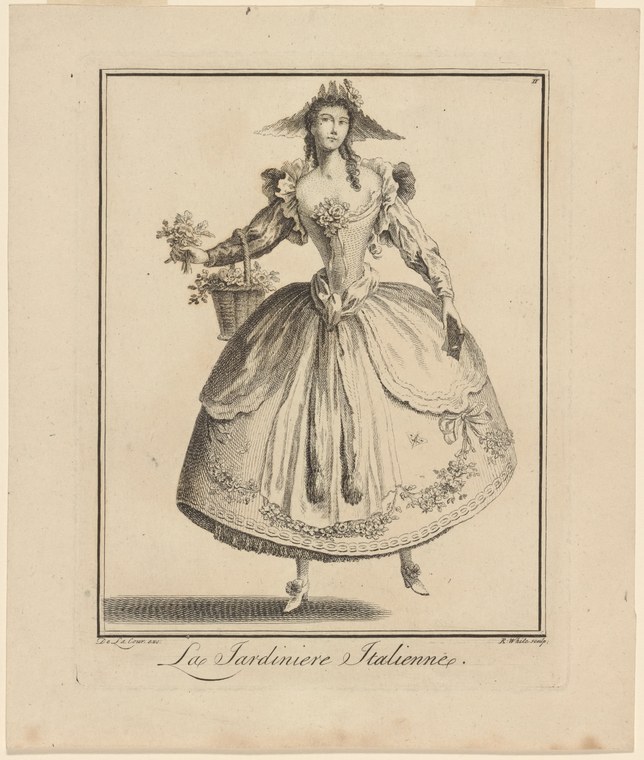
La jardiniere Italienne
Unknown artist
- Collection:
- Prints depicting dance
- Source:
- New York Public Library
- Rights:
- Public domain — free to use, share and adapt.
- Recorded as:
- Public Domain
This image documents a character role and a theatrical tradition that shaped European dance and pantomime for centuries, yet leaves few other records. The engraving is evidence of how pantomime, pastoral comedy, and commedia dell'arte influenced the bodies and vocabularies of theatrical dance, and how costume and character were inseparable in eighteenth-century performance.
What you are looking at
A young woman in eighteenth-century dress stands alone against a plain background, posed as if mid-performance. She wears a fitted bodice with short, puffed sleeves and a voluminous skirt gathered with decorative swags, the hem embellished with what appear to be floral or leaf motifs. On her head sits a wide, flat straw hat adorned with feathers or ribbons. She holds a small basket of flowers in her left hand, extended outward in a graceful gesture. Her right arm is raised, and one leg is extended behind her in a balletic attitude. Her expression is animated and directed toward the viewer, her gaze keen and her mouth slightly open as if caught mid-gesture or mid-speech. The figure floats against the plain ground with no stage furniture or architectural setting—only the engraver's line and the white of the paper. This is a portrait of a theatrical type or character role rather than a narrative scene.
The dancing
The dancer stands alone in an asymmetrical, mobile pose: her weight appears to rest on one leg while the other extends behind her in a line that suggests elevation or the moment just after a jump. Her left arm extends forward and downward, holding the basket; her right arm rises at the elbow, palm open and fingers relaxed. The neck is long, the head tilted, the torso upright but animated. The overall carriage is light and buoyant—the body arranged to suggest motion even in stillness. There is no contact with a partner, no closed frame, no grounded stance; instead, the figure occupies space with the self-consciousness of a solo performer taking an applauded moment.
The dance depicted
The work depicts a character type common to eighteenth-century theater and pantomime—the Italian garden girl or 'jardinière italienne'—rather than a specific dance. The pose, costume, and props (basket of flowers, rustic hat) are those of the pastoral or comic character roles that appeared in commedia dell'arte, opera buffa, and theatrical dance interludes. The balletic pose of the raised leg and the lightness of the carriage suggest the vocabulary of court or theatrical dance was used to render this character, but no specific dance form is identifiable. The figure appears to be a 'costume print' or theatrical character study, the kind circulated to advertise actresses and dancers in their signature roles.
How it was made
This is a line engraving, executed with fine parallel lines (hatching) to model form and suggest fabric texture and shadow. The technique—precise, portable, and reproducible—allowed such prints to circulate widely as theatrical ephemera, souvenir programs, or costume reference. The plate shows no color; the modulation of tone relies entirely on the density and direction of the engraved line. The border frame and the crisp baseline are typical of French and Italian theatrical prints of the period. From the style of engraving, the dress, and the printing conventions, this work appears to date to the mid-to-late eighteenth century, though the catalogue record does not confirm a date.
About this work
This is a theatrical character print documenting a dance or pantomime role—the Italian garden girl—as performed in eighteenth-century European theater. The figure is posed in a moment of display: animated, elevated, and directly engaging the viewer. The engraving captures not a narrative moment but a costume and a type, a frozen instant of performance that would have been recognizable to contemporary audiences as a specific role with a tradition of performance. The work sits at the intersection of dance history, theater history, and the history of costume and character—a record of how bodies were trained and displayed to communicate character and entertainment.
The print belongs to a large tradition of costume and character prints produced throughout Europe from the sixteenth century onward. Such works served as documentation of theatrical practice, advertising for performers, and models for costume-makers and set designers. For dance history, they provide evidence of how dance steps and theatrical movement were integrated into character-driven performance, and how the body was positioned and ornamented to signal social type and dramatic role.
How to look at it
Attend to the pose: the raised leg, the extended arm, the lifted torso. These are borrowed from courtly and balletic movement, but the character is a working girl, a rural figure. The artist has used the vocabulary of refinement to render a comic or sympathetic character—a statement about how theatrical movement worked. Notice too the directness of the gaze and the engagement with the viewer; this is not a narrative scene but a portrait of a performer in role, meant to be recognized and admired. The print format—the frame, the baseline, the signature—signals that this is a document of a known performer or a repeatable type, not a unique moment.
The period
The image dates to an era when theatrical dance was undergoing rapid formalization and codification. The mid-to-late eighteenth century saw the rise of the professional ballet d'action in France and Italy, in which narrative and character were conveyed through both pantomime and dance vocabulary. At the same time, commedia dell'arte and opera buffa remained vital popular forms, often featuring dance interludes and character roles like the one depicted here. The pastoral or 'rustic' character—the garden girl, the peasant, the country maid—was a stock type, often played for comedy and often danced. Such prints were part of a broader culture of theatrical documentation and celebrity, in which celebrated actors and dancers were portrayed in their signature roles and costumes, then circulated as prints for a paying public.
Where it lives
The print is held in the New York Public Library's collection of prints depicting dance. No artist, date, or edition information is recorded in the catalogue, suggesting it may be one of thousands of similar theatrical prints, some of which survive in collections without full attribution or provenance.
Dance in this work
Questions about this work
What is a 'jardinière italienne'?
A stock character type from eighteenth-century Italian and French theater—a rural or working-class girl, often a flower-seller or gardener, who appeared in commedia dell'arte, opera buffa, and theatrical interludes. The character was typically young, witty, and flirtatious, and often performed with song, dance, and mime. The costume shown here—the simple bodice, full skirt, straw hat, and basket of flowers—would have been instantly recognizable to contemporary audiences as this type.
Is this a depiction of a specific dance?
No. This is a character study and costume print. While the pose uses balletic vocabulary (the raised leg, the lifted carriage), it documents a theatrical character role rather than a named dance form. The print records how this character was performed and costumed, but does not teach a dance step or form.
Who was the dancer or performer?
The catalogue record does not identify the artist or the performer, so it is unknown whether this depicts a famous actress or dancer, or a generic type that could be danced by anyone playing the role. Many such prints were issued without the performer's name, or with a name now lost.
Why are there no other figures or scenery?
This is a portrait print of a character in costume, not a scene print. It was designed to be looked at on its own—to show the costume, the pose, and the character type clearly. The absence of stage furniture or other figures keeps the focus on the performer and allows the print to be compact and portable, ideal for circulation as a theatrical souvenir or reference.
More dance artwork





