49 works in this view — arrow keys or swipe to move between them.
Dance in Art
Highest life in London
Unknown artist
- Collection:
- Prints depicting dance
- Source:
- New York Public Library
- Rights:
- Public domain — free to use, share and adapt.
- Recorded as:
- Public Domain
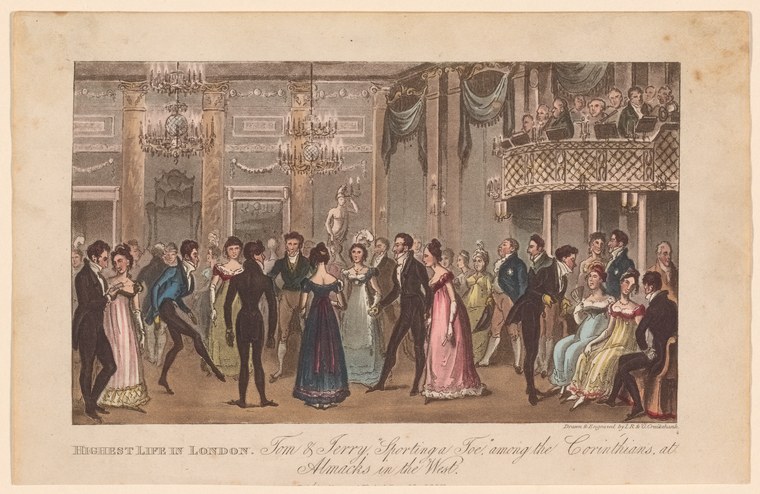
This print is rare evidence of how Regency ballroom dancing actually looked in situ—not idealized through theatrical spectacle or caricature, but recorded as a social fact by a commercial artist. For dance historians, it shows the formal frame, the restraint of the upper-body carriage, the integration of women's long skirts into movement, and the social formations of the period's most fashionable dances. For art historians, it exemplifies the genre of Regency topographical and social prints that documented urban leisure culture for a print-buying public.
What you are looking at
A formal ballroom scene set in an ornate interior with crystal chandeliers, draped fabrics, and a musicians' gallery above. The composition centers on a mixed group of fashionably dressed figures—men in dark tailcoats and women in high-waisted, neoclassical gowns with long trains—arranged across the floor in a social gathering. The lighting is warm and diffuse, characteristic of indoor gaslight or candlelight. In the foreground, several couples are engaged in dance or conversation; in the background, spectators occupy chairs and the gallery. The scene captures the formal sociability of Regency or early Georgian high society, with the figures distributed throughout the space in a choreographed pattern that suggests both structured dance and leisurely promenade.
The dancing
The dancers are arranged in small groups and couples across the floor, many in closed or semi-closed holds appropriate to the period. The women's arms are extended gracefully, bodies upright and composed; the men's posture is formal and attentive. Several figures appear to be moving together in synchronized pairs, while others stand conversing or observing. The high-waisted gowns with long skirts limit leg articulation, so movement is contained and upper-body-led. The spacing and mutual attention between partners suggests structured social dance rather than free movement.
The dance depicted
This appears to depict an evening entertainment in a fashionable London drawing room or assembly room, likely showing social dances of the Regency or early 19th-century ballroom tradition—cotillions, quadrilles, or country dances. The title's reference to 'highest life' and the formal dress confirm this as elite social dancing rather than theatrical performance. The dancers maintain the upright, restrained frame and composed deportment characteristic of Regency ballroom practice. Without clearer detail of individual footwork or formation, the exact dance cannot be narrowed further, but the overall arrangement—couples, lines, and small groups—is consistent with cotillions or quadrilles of the period.
How it was made
This is a hand-colored engraving or aquatint, evidenced by the fine linear detail, the tonal gradation achieved through crosshatching and stippling, and the characteristic palette of period topographical prints. The technique allowed wide distribution as a popular print, likely sold individually or in series to urban audiences. The inscription at the base appears to be printed, consistent with commercial print production. The hand coloring—applied after printing—is visible in the warm tones of the walls, the blues and reds of the clothing, and the golden highlights of the chandeliers. This production method places the work in the tradition of Regency-era social documentation for middle and upper-class consumption.
About this work
This is a hand-colored engraving depicting an evening dance gathering in fashionable Regency London society. It records not a theatrical ballet or performance but the actual social dances—likely cotillions and country dances—that constituted the leisure and courtship rituals of the era's elite. The print is a document of ballroom convention, showing how bodies moved, dressed, and interacted in formal social space. It belongs in a gallery of dance in art because it captures the aesthetic and physical grammar of an entire social practice: the frame, the hold, the geometry of partnership and group formation, and the ritual choreography of high-society evening entertainments.
How to look at it
Observe the repeated postures and arrangements: the men's attentive forward lean, the women's vertical carriage and extended arms, and the spacing that suggests simultaneous movement in pairs or small groups. Notice how the long high-waisted gowns constrain the dancers' lower bodies, forcing movement to be upper-body-led and restrained. The formal architecture and the placement of spectators in the gallery confirm this is a rule-governed social occasion, not improvised movement. The artist chose to capture the moment of active dancing rather than conversation or rest, emphasizing the visual spectacle of the assembled company in motion.
The period
The Regency and early 19th century saw ballroom dancing as the dominant leisure activity and courtship ritual of the British elite. The cotillion, quadrille, and various country dances were formalized, often taught by dancing masters, and governed by strict rules of decorum. The same period saw a boom in topographical and social-scene printmaking in Britain—artists like Thomas Rowlandson and others documented urban society and entertainment as commercial products for middle- and upper-class collectors. This print sits within that tradition of social documentation through color-printed engraving.
Where it lives
This print is held in the New York Public Library's collection of prints depicting dance. It is a hand-colored engraving or aquatint typical of early 19th-century commercial print production in Britain, and would have been sold individually or as part of a series documenting fashionable London society.
Dance in this work
Questions about this work
What dances are being shown here?
The exact dances cannot be determined from the image alone, but they are almost certainly cotillions, quadrilles, or country dances—the social dances of fashionable Regency ballrooms. These were formal, often taught dances with set figures, and the print shows the characteristic frame and spacing of such dances.
Is this what real Regency dancing looked like?
This is a commercial print made for sale to upper- and middle-class audiences, so it is stylized for decorative and commercial purposes. However, it is a documentary record by an artist observing actual social practice, not a theatrical caricature or fantasy. The formal frame, upright posture, and social arrangements shown are consistent with contemporary descriptions and other evidence of ballroom dancing in the period.
Why are the women's skirts so long?
This is the high-waisted, high-hemline style of the Regency era (c. 1811–1820), influenced by neoclassical aesthetics. The long trains constrained the dancers' footwork, making Regency-era dances more restrained and upper-body-focused than earlier or later ballroom styles.
Who is this by?
The artist is not recorded in the catalogue. The style and subject matter are consistent with London commercial print production of the early 19th century, but the maker's name is not known from the surviving information.
More dance artwork





