49 works in this view — arrow keys or swipe to move between them.
Dance in Art
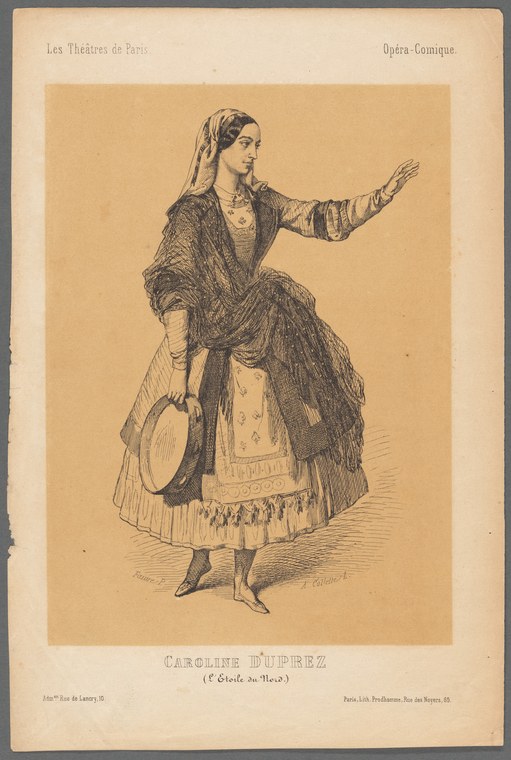
Caroline Duprez (L'Etoile du Nord); Les théâtres de Paris, Opéra-Comique
Unknown artist
- Collection:
- Prints depicting dance
- Source:
- New York Public Library
- Rights:
- Public domain — free to use, share and adapt.
- Recorded as:
- Public Domain
This image documents the intersection of opera and dance in the mid-19th century, a period when theatrical dance in France existed largely within opera and operetta rather than as independent ballet. It preserves the appearance and staging of a specific celebrated performance by a named artist, offering historians insight into how folk and national character types were visualized and promoted in popular theatrical culture.
What you are looking at
A woman in mid-19th-century dress stands in a three-quarter pose against a plain ochre background, her body angled to the left. She wears a dark embroidered jacket or bodice over a full skirt with decorative border and ornamental hem detail; a light chemise is visible at the neck and wrists. A dark headscarf or bonnet frames her face. Her right arm extends outward in a gesture—neither fully raised nor lowered—while her left arm holds what appears to be a tambourine or similar circular object at her side. Her posture is upright but animated; her weight appears to shift slightly, and her gaze directs downward and away. The engraved line work is precise and controlled, creating texture through parallel hatching, particularly in the fabric and hair. The style and execution suggest this is a theatrical costume study or character portrait, likely from a published theatrical series.
The dancing
A single figure, drawn at roughly life scale. The pose reads as neither fully static nor fully dancing—a moment of suspended animation between movements. Her extended right arm and the held tambourine suggest readiness for percussion or rhythmic accompaniment rather than partner dance. The upright frame and modest spacing of the limbs reflects mid-19th-century propriety in theatrical representation. Her weight distribution suggests a standing position with potential forward momentum, not the strong turnout or extreme extension that would characterize ballet of the same period.
The dance depicted
The costume and setting identify this as a theatrical character from a specific opera production. The title inscription—"Caroline Duprez (L'Étoile du Nord)" (The Star of the North)—anchors this to Meyerbeer's 1854 comic opera *L'Étoile du Nord*, in which Duprez was a celebrated performer. The costume suggests a folk or national character rather than a classical dancer; the tambourine and embroidered dress point to a Scandinavian or northern European peasant role. This is not ballet proper but theatrical dance-song—the movement vocabulary of opéra comique, where sung dialogue alternates with rhythmic gesture and folk choreography. The image documents costume and character type rather than technique.
How it was made
This is a wood engraving or steel engraving, identified by the fine parallel lines, precise detail work, and tonal gradation achieved through hatching. The quality of line and the controlled cross-hatching suggest a professional engraver working from a painted or drawn original; the print is hand-coloured with ochre wash, a common practice for theatrical portraiture of the period. The technique allowed rapid, economical reproduction for theatrical programs, souvenir prints, and popular entertainment sheets. Such prints reached a wide urban audience and served both as records of celebrated performances and as promotional images of star performers.
About this work
This is a theatrical costume portrait of the opera singer and dancer Caroline Duprez in her role from Meyerbeer's *L'Étoile du Nord*, a work published as part of *Les Théâtres de Paris*, a series documenting the Paris opera and theatre world of the mid-19th century. It belongs to the broader tradition of theatrical portraiture and character documentation that flourished during the Romantic era, when opera and ballet were the dominant forms of staged entertainment. The work captures not a moment of pure dance but the visual identity of a theatrical role—the costume, props, and carriage that defined a character for audiences of the period.
How to look at it
Attend first to the costume: the embroidered bodice, full skirt with decorative borders, and folk-style headwear establish national or regional character. The tambourine is a signifier of folk dancing and rhythmic accompaniment rather than classical ballet. The pose itself is neither a static fashion plate nor a dynamic balletic attitude; instead it suggests a moment of readiness—the slight forward weight, the extended arm, the held object—that shows how the character moved through the opera. The engraver has chosen to represent Duprez not mid-leap or mid-turn, but as an alert, present figure, which conveys the theatrical presence and character type rather than virtuosity.
The period
In the 1850s, French theatrical dance was dominated by Romantic ballet (often danced by guest stars in opera houses) and by the dance-song of opéra comique, a lighter, more accessible genre mixing spoken dialogue, song, and rhythmic movement. Meyerbeer's *L'Étoile du Nord*, premiered in 1854, exemplifies opéra comique at its height. Caroline Duprez was a celebrated soprano and dancer of the period; she performed extensively across European stages. Theatrical portraiture like this engraving was a standard form of celebrity promotion and souvenir merchandise, distributed through print shops, theatre lobbies, and popular magazines. *Les Théâtres de Paris* was itself a commercial publication documenting the stars and roles that drew audiences to the capital's theatres.
Where it lives
This print is held by the New York Public Library as part of its collection of theatrical prints and imagery. It is one item within *Les Théâtres de Paris*, a commercial publication series that documented the performers and roles associated with Parisian opera and theatre houses during the mid-19th century.
Dance in this work
Questions about this work
Who was Caroline Duprez?
Caroline Duprez (1807–1881) was a French soprano and dancer known for her roles in opéra comique during the Romantic era. She performed regularly at the Opéra-Comique in Paris and achieved celebrity status as a singing actress. She was sister to the famous tenor Gilbert-Louis Duprez and was celebrated for her ability to combine vocal performance with graceful stage presence and dance.
What is *L'Étoile du Nord*?
A comic opera (opéra comique) composed by Giacomo Meyerbeer, with libretto by Eugène Scribe and Jean-Henri Vernoy de Saint-Georges, premiered at the Opéra-Comique in Paris on 16 February 1854. The story is set in Russia and involves a maiden of the north; the role Duprez performed was typically a leading female character, allowing both vocal and physical performance.
What is the difference between this and ballet?
Opéra comique blends sung dialogue, orchestral music, and theatrical movement but does not require the technical virtuosity or aesthetic of classical ballet. The dance vocabulary is simpler, often based on character types, folk gesture, and pantomime. This print shows costume and character rather than the extended limbs, turnout, and pointe-work of ballet proper.
Why does she hold a tambourine?
The tambourine identifies her character as a folk or peasant figure, suggesting she dances or uses rhythm in her role. In opéra comique, such properties signal national or regional identity and allow the performer to integrate percussion and rhythmic gesture into the theatrical storytelling.
More dance artwork





