49 works in this view — arrow keys or swipe to move between them.
Dance in Art
Ballroom dancing on British and American 19th-century music covers
Unknown artist
- Collection:
- Prints depicting dance
- Source:
- New York Public Library
- Rights:
- Public domain — free to use, share and adapt.
- Recorded as:
- Public Domain
The work captures an overlooked moment in ballroom history: the formal ritual that framed competitive waltz performance. Rather than showing the dance in motion, it preserves the social choreography of deference, presentation, and spectatorship that made such events meaningful. For historians of ballroom dance, fashion, and 19th-century social life, it documents the infrastructure—the setting, the observers, the elaborate dress—that surrounded what is usually remembered only as movement.
What you are looking at
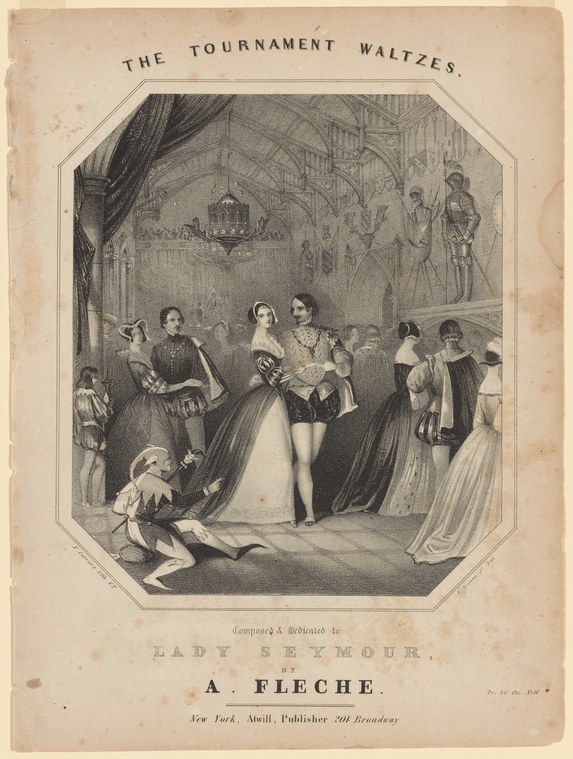
A formal ballroom scene set in a grand hall with a coffered ceiling and hanging lantern. A couple occupies the center of the composition: a woman in a pale gown with an off-shoulder neckline and fitted bodice stands opposite a man in dark formal dress (coat and breeches), who bows or assumes a deferential posture toward her. Their interaction is the focal point, but the scene teems with attendants and onlookers—courtiers and ladies in elaborate gowns line the space, some seated on benches along the walls, others standing in conversation. The lighting is even and formal, rendered through fine cross-hatching that suggests an engraved or finely detailed print. Curtains drape the upper left. The overall impression is of a ceremonial or competitive ballroom event, possibly a tournament or formal presentation, rather than a casual social dance.
The dancing
The central couple are separated and facing each other rather than in a closed or open hold. The man's posture—bent forward from the hips or bowing—suggests deference, reverence, or the opening gesture of a formal dance. The woman stands upright and composed, her body aligned and her gown falling in elegant folds. Neither figure is mid-movement; both are positioned in what appears to be an opening salutation or formal greeting. The spectators—at least a dozen visible—are stationary; this is a displayed or presented dance, observed rather than participatory.
The dance depicted
The title references a tournament of waltzes, which suggests this depicts a competitive or formal waltz event, possibly from 19th-century European ballroom culture. However, the postures and spacing of the central couple do not clearly show the characteristic three-quarter time closed hold and pivoting movement of a waltz in motion. The scene may instead represent the formal opening or presentation moment of such a tournament—the bow and acknowledgment that preceded the dance itself. The elaborate court setting and the presence of multiple observers indicate this was a significant public or semi-public event, not an informal social dance.
How it was made
This is a line engraving or steel engraving, identified by the fine parallel lines (hatching and cross-hatching) used to model form and create tone. The title cartouche and publishing information indicate it is a commercial print, likely created for mass circulation as a keepsake or illustration of a notable event. The octagonal framing device (a common convention in 19th-century popular prints) and the inclusion of publishing details (New York; Abell, Publisher, 5th Broadway) confirm this as a music cover or theatrical illustration intended for a middle-class or professional audience. The precision of the engraving suggests it was executed by a skilled hand, probably after a drawing or design by another artist.
About this work
This is a narrative engraving documenting a formal waltz tournament, likely from the mid-19th century. It depicts not the dance itself in motion but the ceremonial moment of presentation and acknowledgment—the bow and formal greeting that opened such events. The scene is crowded with witnesses, transforming a ballroom into a kind of theater, and the emphasis on costume, setting, and formal posture reflects the cultural significance of competitive ballroom dancing in 19th-century urban society. As a printed music cover, it served both as a commercial product and as a document of fashionable entertainment, circulating among people who attended, played, or simply admired such events.
How to look at it
Observe the separation and formal stance of the central couple—this is not a dance in progress but a moment of formal acknowledgment. The man's bow and the woman's composed posture follow the conventions of ballroom etiquette, where the opening salutation was a codified ritual. Notice how the crowd frames and witnesses this moment; the dance is as much a public spectacle as a private skill. The fine detail of the engraving—the individual folds of gowns, the architecture, the expressions of onlookers—is worth close attention; this level of finish was expensive and indicates the work was commissioned for an educated audience that would appreciate both the social scene and the technical skill of the printmaking.
The artist
The artist is unrecorded; the print was published by Abell in New York. The work is credited to "Lady Seymour," suggesting either that Seymour composed or commissioned the musical work or that she was the subject or dedicatee. The engraving was likely executed by a commercial shop or independent engraver working from a design or original artwork, a common practice in 19th-century print production.
The period
The waltz rose to prominence in European and American ballrooms in the early 19th century, and by mid-century, competitive waltz tournaments were fashionable public entertainments in major cities. The New York publication date and Broadway address place this in the 1850s–1870s, when ballroom dancing was a central leisure activity for the emerging American middle class. The engraving as a medium was ideal for rapid reproduction and mass distribution; music covers in particular were highly collectible items. The formal, almost neoclassical setting shown here reflects both the theatrical presentation of ballroom culture and the architectural aspirations of grand public halls in American cities.
Where it lives
The work is held in the New York Public Library's collection of prints depicting dance. It is catalogued as a music cover or theatrical illustration, published in New York by Abell at 5th Broadway, though the exact date is unrecorded in the available metadata.
Dance in this work
Questions about this work
Is this showing an actual waltz, or something else?
It is showing the formal opening moment of a waltz tournament—the bow and presentation—rather than the waltz in motion. The central couple are posed in a stationary greeting, not in the closed hold or pivoting movement characteristic of waltz dancing itself. The title indicates this is one moment from a competitive ballroom event, probably the beginning or a posed reenactment for the purposes of the illustration.
What does the title 'Tournament Waltzes' mean?
In 19th-century ballroom culture, 'tournaments' or 'competitions' of waltzing were public events in which dancers or couples competed or were formally presented to demonstrate their skill and elegance. The term suggests both a competitive element and a theatrical one—these were not private social dances but public performances witnessed by an audience, as the crowd in this engraving confirms.
Why is this a music cover?
The composition and style are typical of 19th-century sheet music covers. Waltzes were among the most popular musical forms of the era, and publishers commissioned illustrations of ballroom scenes, tournaments, and famous dancers to market the music to amateur pianists and enthusiasts. Owning a printed waltz, complete with an illustration of a famous tournament or event, was both a musical and a social commodity.
More dance artwork





