49 works in this view — arrow keys or swipe to move between them.
Dance in Art
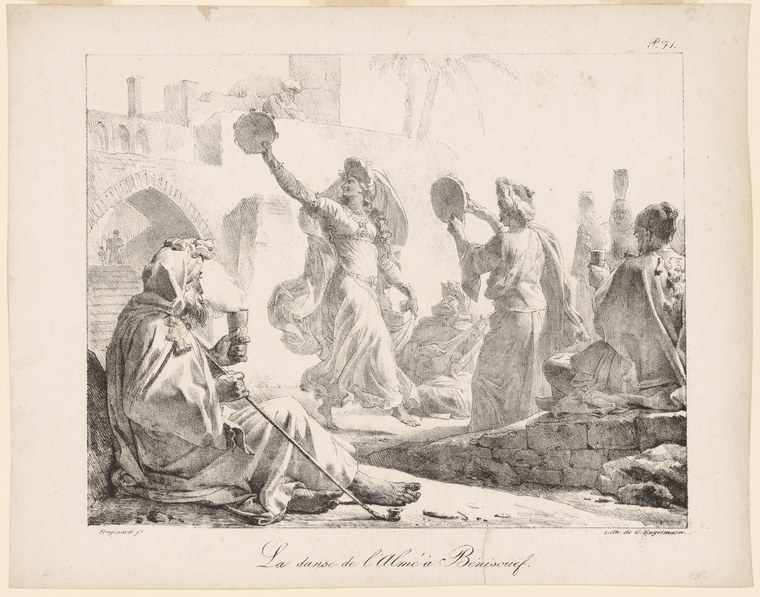
La danse de l'Almé à Bénisouëf
Unknown artist
- Collection:
- Prints depicting dance
- Source:
- New York Public Library
- Rights:
- Public domain — free to use, share and adapt.
- Recorded as:
- Public Domain
The Almeh tradition represents one of the world's oldest documented improvisational dance systems, emphasizing articulation of the spine and hips with a sophistication that predates and influenced modern belly dance. This engraving, despite its colonial framing, preserves a visual record of how these dancers moved and dressed in the early-to-mid 19th century, offering evidence of the continuity (or change) in the tradition over time. The work also illustrates how European artists and audiences consumed and aestheticized non-Western dance, a practice that shaped both the global circulation of Middle Eastern dance and the colonial attitudes toward the bodies of dancers from colonized regions.
What you are looking at
A print depicting a scene of dance in what appears to be North Africa, specifically referencing Bénisouëf (modern Beni Suef, Egypt). The composition shows a seated figure on the left in heavy drapery, observing a group of female dancers in the center and right of the frame. The dancers wear flowing, semi-transparent garments and are captured mid-movement, with raised arms and animated postures suggesting energetic motion. The setting is architectural, with what appears to be stone fortifications or buildings in the background, including a prominent arched structure on the left. The light is rendered through fine engraved lines, creating volume and shadow across the drapery and figures. The overall mood is one of observed spectacle—the dancers are presented for the viewer's gaze, with the seated figure serving as surrogate observer within the composition.
The dancing
Three to four female dancers dominate the center, their bodies in various attitudes of movement with arms raised and extended, suggesting rotational and undulating motions. They wear loosely gathered garments that fall from the shoulders and hips, allowing visibility of limbs and emphasizing the fluidity of movement. The dancers' postures show flexible spinal articulation and hip mobility, with weight frequently shifted and distributed across the balls of the feet. The seated figure on the left, heavily draped and stationary, anchors the composition and provides contrast to the animation of the dancers, establishing this as a scene of performance or entertainment observed by an outsider.
The dance depicted
The title identifies this as 'la danse de l'Almé' (the dance of the Almé), referring to the Almeh or Almehs—professional female entertainers and dancers of Egypt and the broader Middle East. The Almeh were known for their skill in improvised dance that emphasized hip and torso articulation, often performed at private gatherings and celebrations. The image captures the energetic, improvisational quality associated with this tradition, though it is rendered through a European artistic lens. The flowing garments and emphasis on arm extensions and spinal flexibility are consistent with documented accounts of Almeh practice.
How it was made
This is an engraving, identifiable from the fine parallel lines (hatching and cross-hatching) used to build tone, shadow, and texture across all surfaces—drapery, skin, architectural elements, and ground. The technique allows for remarkable detail in rendering the translucency of the dancers' garments and the weight of the seated figure's heavy clothing. Engravings of this type were produced for distribution through prints and in illustrated books, making them accessible to European audiences with limited direct experience of Egyptian or Middle Eastern life. The fineness of the line work and the narrative specificity suggest this was made for a cultivated audience, likely accompanying travel writing or ethnographic documentation.
About this work
This engraving documents a 19th-century European encounter with and representation of Egyptian Almeh dance. It is not a neutral record but a constructed image—the composition places the dancers as objects of display for an external (European) observer, a framing typical of colonial-era visual culture. The work sits at the intersection of documentary intent and orientalist aesthetics: it attempts to represent a living tradition but does so through conventions of spectacle and exoticism. For a dance history focused on lived and performed traditions, the image is valuable precisely because it shows how Egyptian dance was seen, framed, and circulated in European visual culture, even as it necessarily distorts the actual context and meaning of the Almeh's performance.
How to look at it
Focus on the articulation of the dancers' spines and the position of their hips and arms—the engraver has captured a moment that emphasizes the flexibility and controlled isolation of different body parts, which is central to the Almeh tradition. Notice how the flowing garments both reveal and conceal the movement, with the fabric catching and billowing to suggest the energy and speed of the dancers' actions. The composition deliberately frames the dance as spectacle: the seated observer on the left commands attention at first, but your eye is drawn to the dancers' raised arms and animated forms. This compositional choice reflects the European viewer's relationship to the subject—the dance is presented as something exotic and extraordinary, staged for consumption by an outsider gaze.
The period
This print was made during the height of European Orientalism, a period (roughly 1750–1900) in which European artists, writers, and scholars produced vast quantities of images and texts depicting the Islamic world, North Africa, and Asia. Egypt, following the Napoleonic campaigns and later British occupation, was a particular focus of European fascination. Travel literature, illustrated books, and salon paintings brought representations of Egyptian life, dress, and customs to European audiences. Simultaneously, the Almeh were becoming known in European circles, sometimes through direct encounter (travelers to Egypt, Egyptian performers in European cities) and more often through mediated accounts and images. The engraving medium allowed for mass production and distribution of such images, making them a primary vehicle for shaping European ideas about Middle Eastern dance and culture.
Where it lives
Held in the New York Public Library's collection of prints depicting dance. The image is part of a broader body of 19th-century European engravings documenting non-Western dance forms, many produced to illustrate travel narratives, encyclopedic works, or collected as individual prints for display in educated households.
Dance in this work
Questions about this work
What is an Almeh?
An Almeh (plural Almehs or Almiyat) was a professional female entertainer and dancer in Egypt and the Middle East, typically performing at private celebrations, weddings, and gatherings. They were trained in improvised dance that emphasized articulation of the spine, hips, and arms, and were often accomplished musicians as well. The tradition has ancient roots and continues in modified form today; modern belly dance (Raqs Sharqi) is a descendant of Almeh dance, though the contexts and meanings have shifted significantly.
Why does this image look so European if it depicts Egyptian dance?
This is a European engraving, made by a European artist for a European audience. The artistic conventions—the framing, the idealization of the bodies, the romantic drapery, the theatrical lighting—are all European. The scene is rendered through a European lens and reflects European ideas about beauty, exoticism, and the Orient. While the image attempts to document Egyptian dance, it inevitably transforms what it depicts into something legible and appealing to European taste.
Is this an accurate representation of Almeh dance?
It captures something genuine—the emphasis on arm movements, the fluidity of the torso, the improvisational energy—but it is filtered through European artistic conventions and colonial attitudes. The dancers are posed and idealized in ways that serve European aesthetic preferences rather than showing the actual context in which Almeh performed. For a fuller understanding of the tradition, this image should be read alongside written accounts by travelers, accounts by Egyptian and Middle Eastern sources themselves (where available), and continuities visible in modern Egyptian and Middle Eastern dance practices.
When and where was this made?
The catalogue record does not specify a date or place of production. Based on the style of the engraving and the historical context of European Orientalism, it was likely made in the 19th century, probably between 1800 and 1880. The reference to Bénisouëf (a town in Upper Egypt) and the medium of engraving for mass distribution suggest it may have accompanied a travel account or illustrated encyclopedia. Further research into the NYPL's acquisition records would be needed to establish provenance and date.
More dance artwork





