49 works in this view — arrow keys or swipe to move between them.
Dance in Art
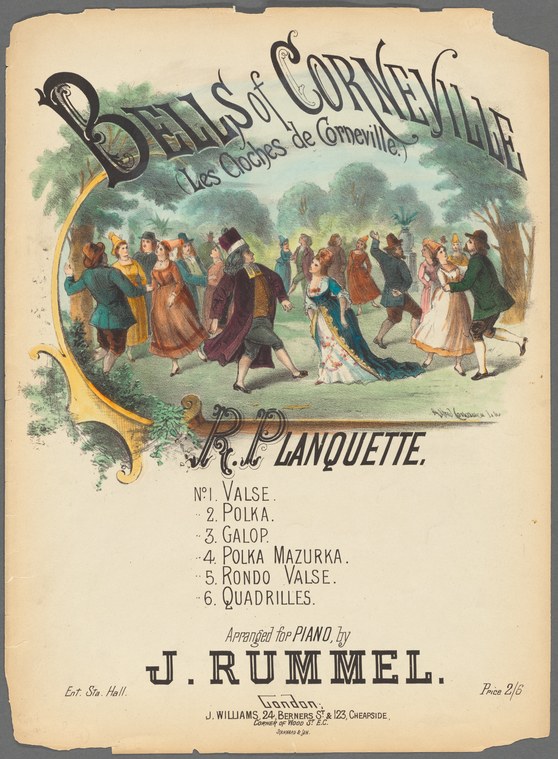
Bells of Corneville (Les cloches de Corneville) ... [composed by] R[obert] Planquette, arranged for piano by J. Rummel
Unknown artist
- Collection:
- Prints depicting dance
- Source:
- New York Public Library
- Rights:
- Public domain — free to use, share and adapt.
- Recorded as:
- Public Domain
This object reveals how opera and operetta drove the popularization of ballroom dance in the 19th century: the composer Planquette made his reputation partly through dance music, and this cover shows how that music circulated not as concert pieces but as domestic entertainment. For dance historians, it documents the typical order and mixture of dances in a fashionable ballroom of the era, and the gendered visual conventions through which that dancing was represented for a mass market.
What you are looking at
This is the cover or title page of a piano arrangement of Planquette's operetta *Les cloches de Corneville* (The Bells of Corneville), arranged by J. Rummel. The central image shows an outdoor garden or parkland scene with a large gathering of dancers in 19th-century formal dress beneath tall trees. The composition is crowded and festive: men in dark suits and women in full-skirted dresses in jewel tones (reds, greens, blues) intermingle in what appears to be a social ball or celebration. Some couples are paired, others stand in small groups; the poses suggest active dancing or the pauses between dances. The scene is rendered in soft watercolor or hand-colored lithography with muted greens for the foliage and warm tones for the figures. Ornamental typography in the art-nouveau style frames the scene, and printed text below lists the six pieces contained in the arrangement: Valse, Polka, Galop, Polka Mazurka, Rondo Valse, and Quadrilles.
The dancing
The figures are depicted in the upright, formal posture of 19th-century ballroom dancers, though the image captures them in varied attitudes—some in closed holds (particularly visible in foreground couples), others turned away or facing inward in conversation. The women's long skirts dominate the visual field, caught in implied motion. Arm positions are restrained and graceful, consistent with the ballroom dances of the era. No individual footwork is discernible at this scale and style; the artist has prioritized the overall social pageantry over anatomical precision.
The dance depicted
This is a ballroom context depicting multiple social dances of the 1870s–1880s operetta period. The title page itself lists six distinct forms: waltz, polka, galop, mazurka, rondo, and quadrilles. The scene almost certainly illustrates a ballroom or garden fête such as might conclude a comic operetta, showing the fashionable couples of the day engaged in the social dancing that dominated European entertainment. The dances themselves—particularly the waltz, polka, and quadrille—were standard features of both operetta plots and real social life, and Planquette's score was famous for its dance numbers.
How it was made
This is a lithographic or hand-colored print, evident from the soft color application, the slight visible texture in the foliage, and the ornamental letterpress typography. The technique allowed wide and affordable reproduction of the sheet-music cover, extending the reach of popular operetta music well beyond concert halls—this would have circulated in homes, music shops, and piano studios across Europe and America. The combination of colored image and printed text on a single sheet was typical of 1870s–1880s music publishing.
About this work
This is a commercial music-publishing artifact—a piano score cover—rather than a fine-art composition, but it is invaluable documentation of how ballroom dancing was understood and marketed in the operetta era. The image conflates the fictional ball in Planquette's plot with the real social dances of the middle and upper classes who would perform this music in their parlors. It captures both a theatrical convention (the grand finale ball) and the material reality of amateur musicianship and dancing that consumed the leisure time of the Victorian bourgeoisie. The six named dance forms on the cover—and their appearance in the garden scene—testify to the standardization and compartmentalization of ballroom dance by the 1870s.
How to look at it
Observe the interplay of movement and stillness in the crowd: some couples are clearly dancing (weight distributed, bodies angled), while others pause between dances or converse. The artist has chosen a moment of social fluidity rather than a single unified dance moment, which is more realistic for a garden ball lasting several hours. Notice how the women's skirts, rendered with fine detail and soft color, carry most of the visual weight and suggest the swirling of waltzes and polkas. The ornamental frame and typography position this as a commercial object meant to appeal to amateur musicians and dancers who would recognize and perform the very dances pictured within.
The artist
Robert Planquette (1848–1903) was a French composer and conductor famous for comic operettas, of which *Les cloches de Corneville* (1875) is among his most celebrated works. J. Rummel is credited as the arranger of this piano version; he is otherwise unknown from the provided information, but piano arrangements were a standard commercial product in the music publishing industry, often created by competent but anonymous musicians. The illustrator of the cover is not credited and remains unknown.
The period
The 1870s and 1880s were the height of the operetta boom, particularly in France and Vienna, and dance was integral to the form. Operettas were comic, spectacular, and designed for middle-class audiences; they showcased social dances (waltz, polka, quadrille) as part of the narrative and spectacle. Simultaneously, these same dances dominated the ballroom life of the era's urban leisure classes. Piano reductions and arrangements of operetta scores were bestsellers—almost as important to publishers as full orchestral materials. The visual conventions here (the garden setting, the formal dress, the mixed-gender socializing) reflect both theatrical fantasy and lived reality.
Where it lives
This is a printed music cover housed in the New York Public Library's Prints collection, identified as depicting dance. The title page would have been bound or pasted into a bound collection of piano music, making it both a functional label and a collectible image.
Dance in this work
Questions about this work
Is this a painting or a print?
This is a lithographic or chromolithographic print, hand-colored or color-printed, typical of 1870s–1880s music publishing. The soft, slightly textured appearance and the integration of printed text with colored image are characteristic of commercial printing rather than fine art.
What is 'Les cloches de Corneville'?
A comic operetta by French composer Robert Planquette, first performed in 1875. It was a popular work of the era, and like most operettas, it featured ballroom dances as part of the plot and spectacle. This is a piano arrangement of the score, made for amateur musicians.
Are all six dances actually shown in the image?
Probably not. The image shows a general ball scene with couples in various attitudes of dancing and socializing, but it does not clearly delineate six distinct dance moments. The list of dances (Valse, Polka, Galop, etc.) describes the contents of the musical score, and the image provides a festive, representative scene rather than a strict literal illustration.
Why was ballroom dancing so central to operetta?
Operetta was entertainment for the urban middle and upper classes, and ballroom dancing was central to their social life. Composers like Planquette knew their audiences practiced these dances in real life, and operetta allowed theaters to stage glamorous versions of the social world their audiences inhabited. Dance numbers also provided relief from recitative and gave performers and audiences a moment of pure visual pleasure.
More dance artwork





