49 works in this view — arrow keys or swipe to move between them.
Dance in Art
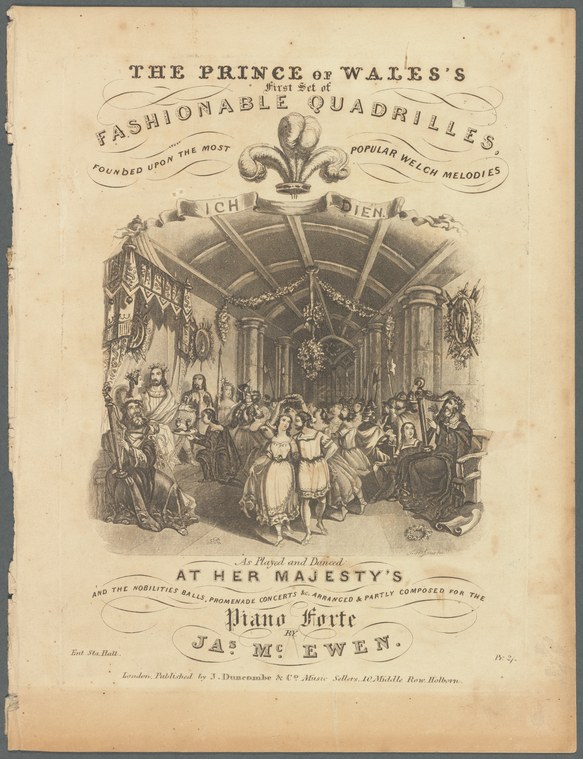
The Prince of Wales's first set of fashionable quadrilles: founded upon the most popular Welch [sic] melodies, as played and danced at Her Majesty's and the nobilities balls, promenade concerts &c
Unknown artist
- Collection:
- Prints depicting dance
- Source:
- New York Public Library
- Rights:
- Public domain — free to use, share and adapt.
- Recorded as:
- Public Domain
This image is a primary document of Victorian ballroom dance practice. It shows the quadrille not as a theoretical pattern but as it was actually performed in the highest circles of British society, with precise documentation of the formation, the dress, and the architecture of the ballroom. For anyone studying the history of social dance in the nineteenth century, this is direct visual evidence of what the dance looked like in motion and how it was taught and circulated—through published music and illustrated instructional prints that were bought by aspiring dancers.
What you are looking at
This is the title page of a printed music score, engraved in the mid-nineteenth century. The composition is dominated by an ornamental illustration occupying the center two-thirds of the page. Within an elegant pavilion or ballroom with columns, draped swags, and a coffered ceiling, a formal dance is in progress. Two dozen figures in evening dress—the women in voluminous skirts with bare shoulders, the men in dark tailcoats—are arranged in the geometrical formation characteristic of the quadrille. They stand and move within the structured lines of the dance, with couples positioned in parallel rows and squares. The women's skirts catch the light and dominate the visual field; the men are rendered more summarily. The architecture of the ballroom is ornate and festive, with hanging garlands visible at the upper corners. The entire scene is rendered in fine engraved line work with careful hatching to suggest form and shadow, giving the image considerable elegance and formality appropriate to its subject—fashionable society dancing at court or a grand ball.
The dancing
The dancers are arranged in the closed, symmetrical formations of the quadrille: couples stand with the woman on the man's right, most in a position of readiness—upright posture, arms at their sides or lightly held, facing forward or toward their partner or the center of their set. The women's arms are bare; their heavy skirts, fitted at the waist and expanding to the floor, are the dominant visual element. A few figures appear to be in motion or turning, their skirts swirling to suggest the rotational movements of the dance. The overall geometry is one of order and precision: four couples to a set, arranged in two parallel lines or in a square, with space between each pair to allow for the side-by-side and face-to-face movements the quadrille required. The male dancers' form is less developed in the engraving but shows them in a supporting position—they face forward and seem to move less elaborately than their partners.
The dance depicted
This is unambiguously a quadrille, the dominant social dance of the mid-nineteenth-century ballroom. The title confirms it explicitly—"The Prince of Wales's first set of fashionable quadrilles." The quadrille was a set dance for four couples arranged in a square, executed to a sequence of five or six figures (changes of formation and promenade) that were repeated throughout the evening. It required no expert training and was danced by fashionable society in ballrooms from the 1820s onward; the reference to performance "at Her Majesty's and the nobilities balls" confirms this as music for the highest circles of British society, almost certainly during the reign of Queen Victoria. The image shows the typical formation—four couples in a square—and the formal, upright carriage the dance required. The quadrille was less athletic than the country dances of the previous generation but far more orderly and rule-bound; the couples move as units within a larger geometric pattern controlled by the caller and the music.
How it was made
This is a wood or steel engraving—fine line work with careful cross-hatching to create tone and shadow. The ornamental title and vignette are characteristic of mid-nineteenth-century printed music covers, which were distributed as single sheets or collected in portfolios. This technique allowed for multiple impressions from a single plate, making the image reproducible and affordable for a broad market of home musicians and dancers. The quality of the engraving and the elaborate ornamentation indicate this was a commercial publication of some standing, likely sold to middle- and upper-class households and music halls. The engraving process allowed the artist to render fine detail—the pleating of the skirts, the folds of fabric, the architectural ornament—that would have been difficult to achieve in lithography or hand coloring.
About this work
This is the title page of a published quadrille score from the mid-nineteenth century, reproduced as an engraved illustration. It documents both the music and the dance itself—showing the formal society quadrille as it was performed in British high society during the Victorian era. The print is a commercial artifact, one of thousands produced to meet the demand for fashionable dance music in ballrooms and drawing rooms. The image combines the ornamental elegance of mid-century graphic design with an historically precise record of the dance formation, dress, and setting of the ballroom. It is valuable both as a visual record of how the quadrille looked and as evidence of the commercial machinery that supported dance in the nineteenth century.
How to look at it
Attend to the strict geometry of the formation: the four couples are arranged as a perfect square, and the dance as shown here is a moment of stillness or formal readiness rather than active motion, though a few skirts suggest movement. The ornamental frame—the columns, the swags, the coffered ceiling—emphasizes the formality and decorum of the event. Notice how the women's skirts dominate the visual field; in the quadrille, the woman's dress and carriage were central to the visual spectacle of the ballroom. The restraint of gesture and the upright posture of all the dancers should be registered against later social dances; the quadrille was conservative and controlled, performed by people who understood themselves to be on display and subject to the judgment of their peers.
The artist
The artist is not recorded. This is a commercial engraving produced for a music publisher, likely by a house engraver whose name was not retained or was not considered important to record. The quality of the work suggests a trained engraver with considerable skill, capable of rendering both ornamental type and complex figural scenes with precision and elegance. Such prints were a major industry in London in the mid-nineteenth century, and hundreds of quadrille scores were published with similar decorated title pages.
The period
The quadrille became the dominant dance of European and British ballrooms in the 1820s and remained fashionable through the Victorian era and into the early twentieth century. It was a democratizing force in ballroom dancing—unlike the elaborate court dances of earlier centuries, the quadrille required no virtuosic training and could be learned by anyone of reasonable coordination. At the same time, it was rigorously formal and orderly, reflecting Victorian values of precision, hierarchy, and controlled movement. The publication of the Prince of Wales's sets (the heir to the throne was a fashion authority) indicates that quadrilles were not merely popular but fashionable at the highest social levels. The rise of published dance music was itself a phenomenon of the period; the quadrille's fixed figures made it possible to codify and sell the dance in print form, as instructional books and scores. This print is part of the machinery that made the quadrille such a widespread and standardized social practice.
Where it lives
This is held in the New York Public Library's collection of prints depicting dance, indicating its status as a primary document of dance history and visual culture. It is a published commercial product, one of many such decorative music covers produced in London in the nineteenth century.
Dance in this work
Questions about this work
What is a quadrille and how was it danced?
The quadrille was a set dance for four couples arranged in a square, performed to a sequence of five or six named figures (changes). Each figure had a fixed structure: side-by-side movements, promenade, turns, and reversals. Couples moved as units, guided by a caller or the structure of the music, and the dance was highly geometric and orderly. It required no training beyond an understanding of the basic steps and formations, making it accessible to fashionable society.
Why was the quadrille so popular?
The quadrille was orderly, democratic, and fashionable. Unlike the elaborate court dances of the eighteenth century, anyone could learn it. Unlike country dances, it did not require rapid or intricate footwork or the ability to improvise. It was perfect for the Victorian ballroom: formal enough to signify refinement and respectability, but accessible enough to include a broad cross-section of society. Its popularity was reinforced by publications like this one, which made it easy to learn and widely standardized.
What does the reference to 'Her Majesty's' mean?
This indicates the quadrille was performed at the royal court and at official balls given by Queen Victoria. For a dance to be labeled as performed at 'Her Majesty's' was a major marketing claim, signaling that it was fashionable at the highest level of society. It also meant that the dance and the music had the sanction of the crown, which was important for making something fashionable among the aspiring middle classes.
What do the women's clothes tell us?
The bare shoulders, fitted waist, and enormous skirt were standard ballroom dress for women in the mid-nineteenth century. The skirt's volume and weight required a woman to move with control and restraint, moving from the hips and waist rather than with active footwork. The formal evening dress signaled that ballroom dancing was an elite social practice, carefully separated from everyday life and from the dance of the working classes or the theater.
More dance artwork





