49 works in this view — arrow keys or swipe to move between them.
Dance in Art
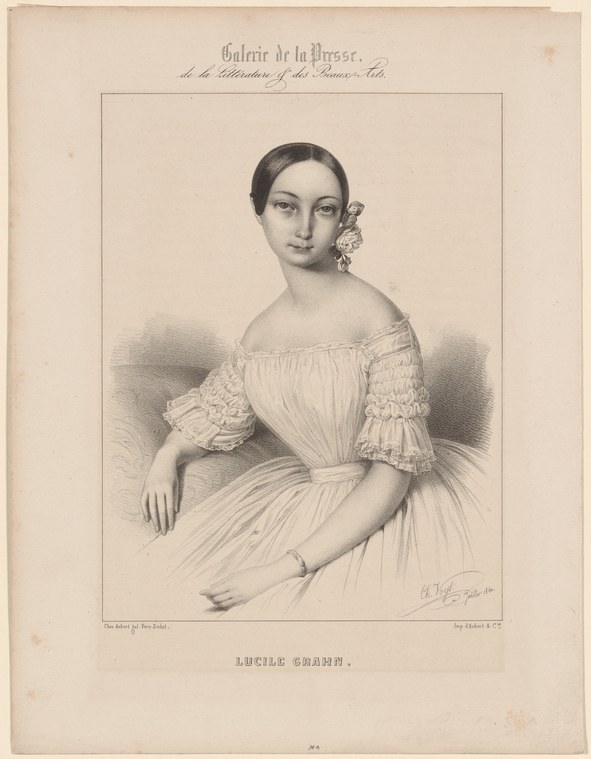
Lucile Grahn
Unknown artist
- Collection:
- Prints depicting dance
- Source:
- New York Public Library
- Rights:
- Public domain — free to use, share and adapt.
- Recorded as:
- Public Domain
Lucile Grahn was an internationally important figure in the establishment of Romantic ballet, and this portrait is a primary-source image of her as she was known to her contemporaries. Such prints are rare visual evidence of how nineteenth-century dancers presented themselves to the public, what they wore offstage, and how the profession was elevated in nineteenth-century visual and popular culture. For dance historians, this is a document of Romantic-era celebrity and the role of visual reproduction in creating and sustaining the cult of the ballerina.
What you are looking at
A three-quarter-length portrait of a young woman seated in an elegant pose against a plain background. She wears a pale, off-shoulder dress with short puffed sleeves edged in delicate pleating or lace, and the bodice is fitted while the skirt falls in soft folds to her ankles. Her dark hair is parted in the center and smoothed close to her head; she wears what appears to be a floral ornament or clip at one ear. Her left arm rests naturally at her side with her hand visible, while her right arm is draped across her lap. Her expression is serene and forward-facing, with a slight turn of the head to her left. The work is executed as a finely detailed lithographic or engraved portrait, rendered primarily in black ink with careful attention to the play of light on fabric and skin. The composition and dress place this firmly in the Romantic era of the 1830s–1840s, and the elegance and restraint of the presentation suggest the subject held some social distinction.
The dancing
A single standing or seated female figure, shown from approximately the knees up, in a relaxed and composed attitude. Her posture is upright but unstudied—the kind of natural carriage expected of a well-trained dancer or woman of social standing. Her shoulders are held back, her neck elongated, and her gaze is direct. The positioning of her arms and the turn of her torso suggest ease and confidence rather than strain. There is no visible footwork or active movement—this is a moment of rest or formal presentation, not a dance in motion.
The dance depicted
The catalogue identifies this as Lucile Grahn, a prominent Romantic-era ballerina. Although the portrait shows her at rest rather than dancing, the image is of a historical figure central to theatrical ballet of the 1830s–1840s. Grahn was a Danish ballet dancer of the Romantic period who performed in major European centers and was known for her roles in works of the era. The portrait documents her as a public figure of the Romantic ballet world, and her appearance—the refined dress, the fashionable styling, the professional presentation—reflects the status of a celebrated dancer of that period.
How it was made
This is a lithographic print, likely hand-colored or deliberately executed in tonal lithography to achieve the soft modeling of form visible in the fabric and flesh. The technique allows for the fine linear rendering of the dress details and the subtle gradation of light and shadow across the face and figure. The signature or printing mark is visible at the lower left ('de Radeaux' or similar), and the imprint 'Imp Lahure & C.' indicates a Parisian printing house, suggesting this was a commercially distributed print issued for the market in fine portrait engravings that were popular among the ballet-going public of the era. Such prints served as souvenirs, promotional images, and collectible records of celebrated performers.
About this work
This is a formal portrait of Lucile Grahn, a celebrated Danish ballerina of the Romantic era, rendered as a lithographic print by a Parisian publisher in the mid-nineteenth century. The work documents not a moment of dance but the public image and fashionable appearance of a star performer—the refined costume, the careful grooming, and the composed bearing all signaled to contemporary viewers the elevated status of a prima ballerina. Within the history of dance in art, such prints are crucial records: they preserve the visual identity of historical dancers, the silhouette and styling of the era, and the way the profession was marketed and celebrated. The image belongs in a gallery of dance partly as a historical document of a specific dancer and partly as a record of how Romantic-era ballet was consumed and celebrated through visual culture.
How to look at it
This is a portrait of a person rather than a depiction of dance, so the viewer should attend to what the image tells us about the subject's status, training, and era. Notice the perfect upright posture and the absence of strain—the kind of carriage instilled by years of dance training but here presented in a moment of social presentation rather than performance. The careful attention to the texture and drape of the fabric, and the soft, flattering light on the face, indicate that this is an image designed to celebrate and immortalize the subject. The inscription and printer's mark place this within a specific moment of media and celebrity culture—the print was a commodity, made to be collected and displayed, and it documents how dancers of the era were marketed and celebrated.
The artist
The print is attributed to a designer and engraver associated with a Parisian publishing house (Lahure & Co.), one of several mid-nineteenth-century firms specializing in theatrical and celebrity portraiture. The signature or mark on the print ('de Radeaux' or similar) may indicate the artist, though such attributions are often uncertain for commercial lithographs of this period. These workshops produced large quantities of theatrical and portrait prints for public consumption, and the quality of execution here—the careful draftsmanship, the refined handling of tone—suggests a practiced hand in the genre of celebrity portraiture.
The period
This portrait dates to the height of the Romantic ballet era, approximately 1835–1850, when Romantic aesthetics—the emphasis on grace, ethereality, delicate femininity, and the poetic rather than technical—dominated European ballet. The costume reflects Romantic-era fashion: the off-shoulder neckline, the short puffed sleeves, and the pale, flowing skirt were fashionable in the 1830s and 1840s and were also the standard dress for Romantic ballet heroines. The period saw an explosion of photographic and lithographic portraiture in response to growing celebrity culture and the rise of a ticket-buying public hungry for images of famous performers. Grahn was performing during the era of works like *La Sylphide* and *Giselle*, which established the vocabulary and aesthetic of Romantic ballet that would define the form for decades.
Where it lives
The work is held in the Library's collection of prints depicting dance and performers. It is a commercial lithographic print issued by a Parisian publisher (Lahure & Co.), one of many such portraits produced for the print market of the mid-nineteenth century. Such prints were distributed and collected as souvenirs of celebrated performers and as fashionable objects for the homes of the theatre-going public.
Dance in this work
Questions about this work
Was Lucile Grahn a famous dancer?
Yes. Grahn was a leading ballerina of the Romantic era, born in Denmark and trained in the Bournonville method. She performed in major European centers including Copenhagen, Paris, and London, and was celebrated for her roles in the canonical works of Romantic ballet. She was one of the few dancers of her time to achieve international fame and to be documented in portraiture and print culture as a public figure.
Why would a portrait of a dancer be made and sold as a print?
In the nineteenth century, successful theatre performers became celebrities, and prints of famous dancers were sold as souvenirs to the public, similar to modern celebrity photographs or merchandise. They were collected, displayed in homes, and served as mementos of performances or as fashionable objects. Publishers competed to issue portraits of celebrated performers, particularly female ballet dancers, whose image was tied to glamour and refinement.
What does the dress tell us about the work or the era?
The pale off-shoulder dress with short puffed sleeves is characteristic of Romantic-era fashion and also of the costumes worn by ballet heroines in works of the 1830s–1840s. The silhouette—fitted bodice, bare shoulders, short sleeves, full skirt—became the standard look for the Romantic ballerina. Whether this is her stage costume or her fashionable day dress (or a hybrid designed for the portrait), it signals to viewers her identity as a dancer and her alignment with the aesthetic and elegance of the Romantic period.
More dance artwork





