49 works in this view — arrow keys or swipe to move between them.
Dance in Art
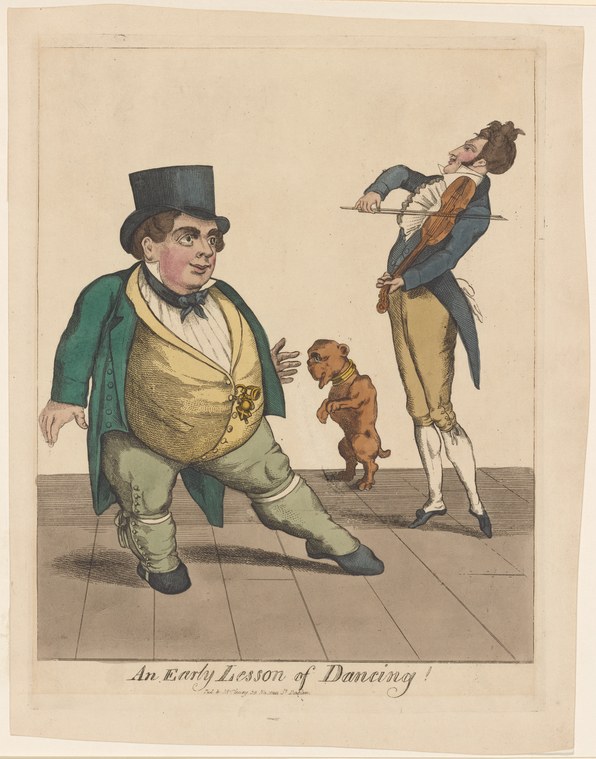
An early lesson of dancing
Unknown artist
- Collection:
- Prints depicting dance
- Source:
- New York Public Library
- Rights:
- Public domain — free to use, share and adapt.
- Recorded as:
- Public Domain
This print documents the social anxieties surrounding dance instruction and bodily deportment in the Regency period, when dancing was a crucial marker of gentility and class. It shows that dance—and the teaching of dance—was visible enough and consequential enough to be worth mocking in widely circulated satirical prints, revealing the stakes of learning "proper" movement. For a historian of dance or social practice, it is evidence of how dance instruction was perceived, negotiated, and often ridiculed by those outside or skeptical of ballroom culture.
What you are looking at
A portly gentleman in regency-era dress—green coat, yellow waistcoat, tall hat, and pale breeches—stands center-left in an exaggerated dancing posture, his body tilted sharply backward with one arm extended. His posture is comical and ungainly, suggesting he is an inept or ridiculous dancer. To his right stands a younger, slimmer man in a blue coat and pale breeches, holding a flute or pipe to his mouth, his own body arched backward in an affected theatrical pose. Between them stands a small dog or similar animal, contributing to the scene's satire. The composition is set indoors on a simple wooden floor, rendered in a hand-colored print with pale background. The title at the bottom reads "An early lesson of Dancing!" with an exclamation mark that signals the satire. The entire scene is pitched as comedic commentary on dancing instruction or pretension.
The dancing
Neither figure displays competent dance technique. The older man's frame is collapsed backward in an inverted posture that suggests either parody or complete loss of control; his weight appears uncentered and his arm position is flailing rather than controlled. The younger musician leans back equally exaggeratedly, his body an S-curve that mimics affectation rather than proper frame. The spatial relationship between them suggests pupil and teacher, but the mutual awkwardness undermines any sense of authority or instruction. The small animal in the center acts as a visual joke—a third "participant" in this absurd lesson.
The dance depicted
This is almost certainly a social dance of the Regency period (roughly 1811–1820), most likely a minuet, cotillion, or quadrille, rendered as satirical commentary on dancing master pretension or incompetent pupils. The exaggerated backward arch and theatrical posturing mock the formal movement vocabulary of these courtly dances, which required precise frame, erect posture, and deliberate carriage. The print satirizes the very notion of "dancing lessons"—suggesting either that the teacher is ridiculous or that certain pupils were hopeless students. The presence of the musician confirms this is a ballroom or assembly context, not a street or theater. The satire is directed at social dancing and its pretensions.
How it was made
This is a hand-colored engraving or etching, likely early 19th century, in which line work establishes the composition and selective watercolor tint is applied to the figures and background. The technique allows sharp detail in the clothing folds and facial expressions, while the pale background and simple floor emphasize the figures. Hand-coloring was the standard method for circulating popular satirical prints in this period, making this affordable for middle-class audiences. The precision of the line suggests this was a commercial print made for distribution, not a unique or wealthy collector's object.
About this work
This is a satirical engraving of a Regency-era dancing lesson, rendered as broadside social commentary. The print mocks either the pretensions of dancing masters or the ineptitude of students attempting to master the formal social dances of the period. The exaggerated postures, ridiculous framing, and inclusion of a bewildered animal transform what should be an orderly instruction into farce. Such prints were widely distributed as popular entertainments in early 19th-century Britain, targeting the anxieties and vanities of an expanding middle class keen on acquiring genteel accomplishments. The work belongs in a dance history collection as evidence of how contemporary society understood, satirized, and made jokes about the body's relation to social status and learning.
How to look at it
Attend to the posture: both figures are arched backward in a posture that is the inverse of good Regency dancing form, which demanded an upright, collected carriage. The distortion is deliberate and visual—the artist is teaching the viewer to recognize incompetence or affectation by exaggeration. Notice the musician's equally absurd posture: he is not merely playing, but performing his own ridiculous arch, suggesting the print mocks not the dance alone but the entire apparatus of musical accompaniment and formal instruction. The small animal in the center is the punchline—a creature innocent of pretension, witness to human folly.
The period
The Regency period (1811–1820, though the style persisted into the 1830s) saw an explosion of satirical prints lampooning social pretension, fashion, and genteel accomplishment. Dancing masters were stock figures of ridicule in caricature and satire—often portrayed as affected foreigners, charlatans, or dupes of their own vanity. The formal social dances of the period (minuet, cotillion, quadrille, country dance) were essential to the ritual of balls and assemblies, and therefore became targets for satirists who questioned whether the rigmarole was worth the effort. This print sits within a tradition of Regency visual satire that includes works by Rowlandson, Gillray, and others, all targeting the behavior and appearance of a society obsessed with etiquette and social climbing.
Where it lives
This work is held in the Prints collection of the New York Public Library. It is a commercial satirical print of the type distributed widely in early 19th-century Britain, likely as a broadside or included in periodicals and collections of humorous engravings. Its presence in an institutional collection reflects the value placed on such prints as historical documents of social behavior and visual culture.
Dance in this work
Questions about this work
What dance is being taught in this print?
The specific dance is not labeled, but the formal dress, indoor setting, and musical accompaniment suggest one of the social dances of the Regency ballroom: minuet, cotillion, quadrille, or country dance. The point of the satire is not the dance itself but the ridiculousness of the instruction and the postures assumed by the participants.
Why is the older man's posture so exaggerated and backward?
The backward arch is the satire's visual joke: it is the opposite of correct ballroom posture for the Regency period, which required an upright, dignified carriage. By inverting the proper form, the artist signals incompetence, loss of control, or deliberate mockery of the dancing master's pretensions.
Who was the intended audience for this print?
Satirical prints were made for middle-class and upper-middle-class audiences with enough education and leisure to attend balls and hire dancing masters. The print mocks both the teachers (for their affected manner) and the pupils (for their effort to learn), appealing to a broad audience skeptical of genteel pretension.
Why is there a dog in the scene?
The small animal functions as a visual joke and observer. Its presence underscores the absurdity of the lesson—a creature innocent of all social pretension witnesses the ridiculous contortions of humans trying to learn deportment and grace.
More dance artwork





