49 works in this view — arrow keys or swipe to move between them.
Dance in Art
A Parisian salon
Unknown artist
- Collection:
- Prints depicting dance
- Source:
- New York Public Library
- Rights:
- Public domain — free to use, share and adapt.
- Recorded as:
- Public Domain
This print shows ballroom dance not as isolated choreography but as embedded social practice—the moment of negotiation, courtship, and hierarchy that preceded and framed the actual dancing. For historians of dance and social history, it reveals how dance was experienced as a total social performance rather than as steps alone.
What you are looking at
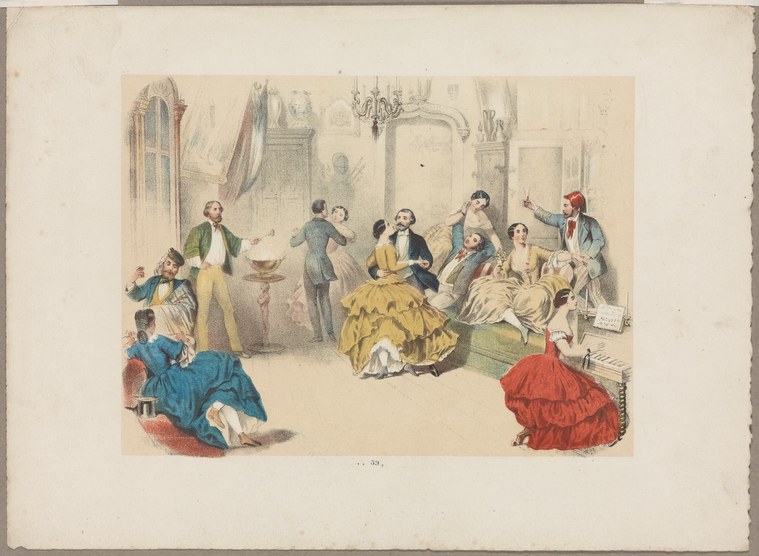
A fashionable Parisian salon of the mid-19th century, furnished with ornate mirrors, candelabras, and draped fabrics. A mixed group of elegantly dressed figures gathers in a formal interior space. At the centre, a woman in a brilliant yellow dress with full skirts sits surrounded by standing and seated companions in contrasting hues—deep blues, reds, pale silks, and earth tones. The composition suggests a moment of social interaction: some figures gesture animatedly, others observe, and the arrangement suggests music or dancing is taking place or about to commence. The scene is lit with the even, warm glow typical of indoor social gatherings, with attention to the play of light on silk and satin fabrics. The mood is one of refined leisure and courtship ritual.
The dancing
The figures are arranged in loose groupings rather than in a formal line or set. Several stand upright in conversational poses with animated arm gestures. The woman in yellow sits in a prominent position, her voluminous skirt dominating the composition. Other seated and standing figures show varied postures—some leaning forward, others relaxed—suggesting a moment of anticipation or transition between dances rather than active movement. The artist has captured a pause in the social choreography rather than the dance itself in full motion.
The dance depicted
This is a representation of salon dancing or ballroom socialising during the romantic era, likely from the 1850s–1860s. The gathering depicts the formal social practice of dance in aristocratic and upper-middle-class drawing rooms, where dance functioned as courtship ritual and entertainment. The composition suggests the moment before or between dances—the social negotiation and conversation that framed the formal dances themselves (waltzes, quadrilles, or polkas would have been the dances of the period). The image documents the practice of salon dance more than it depicts a specific choreographed movement.
How it was made
This is a hand-coloured engraving or lithograph, evident from the fine linear work defining the architectural details and fabric textures, combined with watercolour or hand-applied tint in the clothing and furnishings. The technique allowed mass reproduction of such scenes for a middle-class audience interested in fashion, manners, and social customs. The careful colouring distinguishes each figure and emphasises the fabrics and fashions on display, making this a document of contemporary dress as much as social practice.
About this work
This print depicts a defining ritual of 19th-century Parisian society: the salon dance. Rather than freezing a moment of choreographed movement, it captures the social performance of the drawing room—the conversation, anticipation, and courtship that surrounded the formal dances of the period. The work is a valuable document of how ballroom dance functioned as both aesthetic practice and social negotiation in the romantic era, showing the gendered arrangements, fashionable dress, and interior settings that shaped the experience of dance for the urban elite.
How to look at it
Notice the careful attention to dress: each figure's outfit is distinct in colour and cut, suggesting the importance of fashion to the social event. Observe the arrangement of the figures—not in a dance hold or formation, but in the loose groupings of conversation—which tells us we are witnessing the social choreography that frames the dance rather than the dance itself. The woman in yellow is positioned as the focal point, perhaps the object of courtship or admiration, which was typical of salon culture.
The period
The 1850s–1860s were the height of the Romantic ballroom in Paris, when the waltz and quadrille dominated social dancing and the drawing room was the primary venue for fashionable dance outside the theatre. Prints depicting salon scenes proliferated during this period as consumer goods for the aspiring middle class, documenting both the dances themselves and the fashions, furnishings, and social manners that attended them. This print sits within a well-established tradition of genre scenes depicting Parisian leisure life.
Where it lives
Part of the New York Public Library's collection of prints depicting dance, this hand-coloured print originated as a commercial popular print, likely issued in Paris during the mid-19th century for a broad audience interested in contemporary fashion and manners.
Dance in this work
Questions about this work
What dance is being shown?
The image shows a pause in salon dancing rather than active choreography. The figures are gathered in conversation before or between dances—likely waltzes, quadrilles, or polkas, the fashionable ballroom dances of the 1850s–1860s. The print documents the social practice of ballroom dance in its full context rather than isolating the steps alone.
Why is the woman in yellow positioned so prominently?
In 19th-century salon culture, women were the focal points of the social dance event, and their dress and comportment were central to the performance. The bright yellow gown makes her the visual anchor of the composition, suggesting her role as object of male attention and courtship during the evening.
What does this image tell us about how people danced in Paris?
It reveals that salon dance was as much social negotiation and courtship as choreography. The formal dress, the interior setting, the mixed groupings of men and women, and the moment of pause all show that dancing functioned within a strict code of behaviour and etiquette. Dance was a tool for flirtation, social climbing, and the display of refinement.
More dance artwork





