49 works in this view — arrow keys or swipe to move between them.
Dance in Art
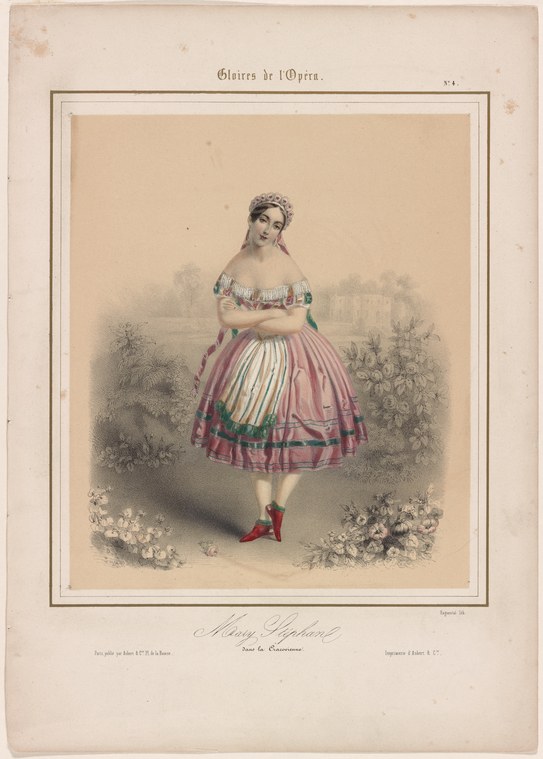
Mary Stéphan. Dans la Cracovienne
Unknown artist
- Collection:
- Prints depicting dance
- Source:
- New York Public Library
- Rights:
- Public domain — free to use, share and adapt.
- Recorded as:
- Public Domain
This print is a primary source for understanding how 19th-century dancers performed, promoted, and were remembered. The Cracovienne and other character dances were central to the theatrical repertoire, yet few records survive of individual performers or their interpretations. For costume historians, the hand-coloring provides rare documentation of actual dye colors, fabric choices, and the decorative conventions of the period.
What you are looking at
A young female dancer stands alone in a naturalistic garden setting, framed by flowering shrubs and foliage rendered in soft greyscale. She wears a white off-shoulder bodice with colorful ribbon trim at the neckline, paired with a voluminous skirt of pale pink silk with deep green and purple ribbon bands at the hem. Her dark hair is crowned with a decorative circlet or wreath. She stands in a pose of relaxed readiness, one leg slightly bent, wearing red heeled slippers. The composition is intimate and theatrical—a portrait of a named performer rather than a narrative scene. The soft botanical surround creates an idealized, romanticized frame for the figure. The hand-coloring of the print emphasizes the brightness of the ribbons and the delicacy of the costume.
The dancing
The dancer's weight is centered, with a subtle contrapposto that suggests momentary repose rather than active movement. Her arms hang at her sides in a natural, unforced manner. The posture is upright but not rigid, conveying ease and poise. No partner or ensemble is present; the focus is entirely on the solo female dancer and the grace of her carriage. The pose suggests the moment just before or after a sequence of movement rather than mid-phrase.
The dance depicted
This is a theatrical solo, most likely a character dance or divertissement from a mid-19th-century ballet or opera. The title refers to the Cracovienne (or Krakowiak), a Polish folk dance in duple meter known for its vigorous stamping and rhythmic drive. However, this print shows the moment of stillness—the dancer's repose—rather than the vigorous action the dance itself demands. The hand-colored engraving documents a specific performer, Mary Stéphan, in a role associated with this dance. Without seeing the dance in motion, we cannot confirm the actual choreography or technique from the image alone; but the costume—the off-shoulder cut, the colorful ribbons, the red heels—is consistent with Romantic-era ballet and with character dances that drew on European regional dress for theatrical effect.
How it was made
This is a hand-colored engraving or possibly colored lithograph, from a series titled Gloires de l'Opéra (Glories of the Opera). The technique of hand-coloring allowed for delicate tonal gradation and accent color—the deep pink of the skirt, the jewel tones of the ribbons, and the naturalistic foliage are applied with restraint and sensitivity. The engraving line is fine and controlled, creating intricate detail in the costume and botanical setting. Such prints were mass-produced for a theatre-going public, circulated as souvenirs or collectibles featuring celebrated performers. The format—a bust or full-length portrait of a named dancer in character costume, posed against a decorative surround—was a standard format for documenting and promoting theatrical talent in the 19th century.
About this work
This is a souvenir portrait engraving of Mary Stéphan, a 19th-century dancer, in the character role of a Cracovienne dancer. Part of the series Gloires de l'Opéra, it documents both the performer and the theatrical costume associated with this Polish folk-derived character dance. The image captures the aesthetic ideals of Romantic-era dance: the young female dancer as the center of theatrical spectacle, dressed in a stylized folk costume, posed with grace and stillness for the viewer's contemplation.
The work is significant not as a document of actual movement but as a record of how character dances were imagined, packaged, and consumed by 19th-century audiences. The Cracovienne was one of many European folk dances adapted for the theatrical stage during this period. Stéphan's portrait preserves the name and face of a performer who would otherwise be lost to history, and the costume detail offers evidence of how such dances were staged and costumed in their era.
How to look at it
The pose of stillness is the key to reading this image. The artist has chosen not the moment of vigorous action (which the Cracovienne demands) but the moment of composed readiness—the dancer's presentation to the audience. This convention reflects the aesthetics of the period: the dancer as an object of beauty and grace to be admired in repose. Notice the costume details—the off-shoulder cut reveals the dancer's neck and shoulders in the Romantic manner, while the colorful ribbons signal a folk or national identity. The red heels are the only hint of the energy and footwork that would characterize the actual dance. The naturalistic garden setting, with its soft botanical detail, elevates and romanticizes the figure, placing her in an idealized realm rather than a stage.
The artist
The artist is not recorded. The print is part of a published series, Gloires de l'Opéra, suggesting it was produced by a commercial printmaking house in Paris or another major opera center. Such series employed staff engravers and colorists; individual works were often unsigned or credited only to the publisher. The series itself indicates a thriving market for theatrical celebrity portraiture in hand-colored engraving during the mid-19th century.
The period
This print dates to the Romantic era of ballet and theatrical dance (approximately 1830–1870), when the female dancer in pointe work and classical tutus dominated the stage, but when character dances—theatrical adaptations of European folk and national dances—remained a major part of the repertoire. Dances like the Cracovienne, the Tarantella, the Cachucha, and the Polka were featured as solo or ensemble numbers within larger ballets and operas, often performed by leading dancers as showpieces. The hand-colored engraving was the primary medium for circulating images of celebrated performers to a broad, theatre-going public before photography became standard. Such prints served as both advertisement and souvenir, fueling the cult of the dancer celebrity.
Where it lives
The work is held in the New York Public Library's collection of prints depicting dance. It is part of the series Gloires de l'Opéra, a commercial publication of theatrical celebrity portraiture from the mid-19th century. The series format and the hand-coloring technique indicate wide distribution and popular consumption.
Dance in this work
Questions about this work
What is a Cracovienne?
The Cracovienne (or Krakowiak) is a Polish folk dance in duple meter, characterized by stamping footwork and rhythmic vitality. In the 19th century, it was adapted for the theatrical stage as a character dance—a solo or ensemble number that drew on European folk traditions for choreographic interest and local color. Theatre audiences enjoyed seeing their favorite dancers perform these folk-derived dances in stylized costumes as part of ballets and operas.
Why is the dancer posed so still if this dance is vigorous?
This print documents the performer, not the dance in action. Portrait engravings of dancers from this era typically show the moment of composed repose—the dancer's presentation to the viewer—rather than mid-movement. The stillness is part of the convention of theatrical celebrity portraiture. The costume and title tell us what dance Stéphan performed; the pose shows us how she presented herself to her public.
How do we know who Mary Stéphan was?
We know only what this print tells us: she was a dancer celebrated enough to be included in a published series of theatrical portraits, and she performed the Cracovienne as a signature role. Beyond this image, her career and biographical details are not established in readily available sources. The print is a primary historical document, valuable precisely because it preserves her name and likeness at a moment when most dancers were not so commemorated.
What makes this an engraving rather than a lithograph?
The fine, consistent line quality and the delicate cross-hatching used to create tonal gradation in the botanical surround are characteristic of engraving rather than lithography. The technique involved incising lines into a metal plate, which allowed for precise control and detail. The hand-coloring was applied afterward, a common practice for making prints more attractive and commercially appealing to buyers.
More dance artwork





