49 works in this view — arrow keys or swipe to move between them.
Dance in Art
Turlupin
Unknown artist
- Collection:
- Prints depicting dance
- Source:
- New York Public Library
- Rights:
- Public domain — free to use, share and adapt.
- Recorded as:
- Public Domain
Commedia dell'arte bodies moved differently than ballet bodies, yet both systems competed for attention in early modern European theaters. This image preserves the physical language of one tradition that is otherwise lost to time. For dance historians, it demonstrates that 'dance' in the period encompassed far more than the structured forms we often prioritize—comedy, acrobatics, and gestural display were central to performance.
What you are looking at
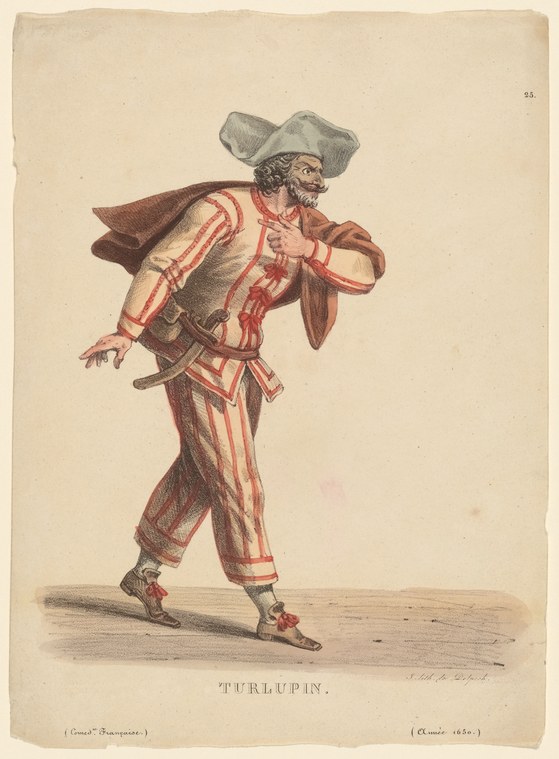
A single male figure dominates the composition, shown in a dynamic contrapposto pose against a plain background. He wears a striking costume of red and white striped breeches and jacket, with a brown cloak or cape flowing dramatically from his shoulders. A large gray-blue hat, somewhat shapeless and oversized, sits atop his head. His face is sharp-featured and animated, turned three-quarter toward the viewer with an expression of theatrical intensity. His body curves in an exaggerated S-bend, with his weight shifting onto one leg, the other extended behind him. One arm gestures expressively outward while the other appears to hold or adjust fabric—possibly a handkerchief or piece of his costume. The figure stands on a thin ground line, suggesting a stage floor or performance space. The hand-coloring is delicate, with greens and earth tones establishing form and shadow, while the red stripes of the costume command visual attention.
The dancing
The single dancer demonstrates an acrobatic, almost contorted posture. His spine arches in a pronounced curve, with the torso tilted sharply back and hips thrust forward. The weight-bearing leg is planted while the other leg extends as a counterbalance, creating an unstable, exaggerated silhouette that emphasizes display over stability. The arms are spread asymmetrically—one extended for balance or gesture, the other occupied with costume or prop. This posture suggests neither ballet nor courtly dance, but rather physical comedy and exaggeration.
The dance depicted
This is an image of Turlupin, a stock character from commedia dell'arte tradition. Turlupin was a comic servant or valet figure—known for acrobatic antics, slapstick humor, and exaggerated physical comedy rather than formal dance. The costume, pose, and theatrical intensity all align with sixteenth- and seventeenth-century commedia performance traditions. The figure is not executing a structured dance step but rather a display of physical virtuosity and comedic grotesquerie characteristic of commedia performance. The performer's body is used as an instrument of humor and spectacle—contorted, unbalanced, and deliberately ungainly in ways that would have delighted period audiences.
How it was made
This is a hand-colored engraving on paper, characteristic of sixteenth- or seventeenth-century theatrical documentation. The engraving technique allowed for precise linear definition of costume details—the striped pattern, the hat, the cloak's folds—while the hand-coloring was applied afterward, likely in a workshop. This combination of media suggests wide circulation: the engraved plate could produce multiple impressions, each then colored individually or in series. The style and circulation method indicate this was a popular image documenting a known performance character, likely for collectors, theater practitioners, or the curious public rather than as fine art.
About this work
Turlupin is a hand-colored engraving documenting a stock comic character from commedia dell'arte tradition. The image captures the physical vocabulary of comedic performance in the early modern period—a vocabulary of exaggeration, bodily distortion, and theatrical display that operated outside the courtly and balletic conventions of the same era. The work belongs in a gallery of dance imagery precisely because commedia performance, despite its lack of formal dance structure, was a primary vehicle for bodily display and movement innovation on stage. It shows how bodies were mobilized for entertainment and how a single figure could generate comedy through posture and costume alone.
This engraving also documents the international circulation of commedia dell'arte; Turlupin was a French adaptation of Italian commedia types, and images like this traveled across Europe in print form. It represents a visual archive of performance—one of the only ways we can now see how these characters moved, posed, and presented themselves on stage.
How to look at it
Attend first to the posture: this is not a balanced, beautiful line but an impossible, contorted exaggeration. The artist has frozen a moment of maximum physical distortion and gestural energy, likely mimicking a specific comedic moment or signature pose of the performer or character. The costume—especially the bold red stripes and oversized hat—amplifies the body's distortion through visual contrast. Notice how the asymmetry of the pose and the theatrical expression in the face work together: this is a character performing for an audience, aware of being watched, deliberately playing to that gaze.
The artist
The artist is not recorded. The engraving carries what appears to be a signature or mark in the lower right, but it is not legible in this reproduction. Hand-colored engravings of commedia dell'arte characters were produced and circulated across Europe throughout the sixteenth and seventeenth centuries, often by printmakers working in urban centers with active theater scenes. These prints served as both documentation and marketing for traveling performance companies and may have been sold as souvenirs or collected as records of notable performers.
The period
In the sixteenth and seventeenth centuries, commedia dell'arte represented a vital alternative to courtly spectacle and emerging ballet traditions. While courts refined balletic movement according to geometric principles and courtly decorum, commedia troupes developed a physical vocabulary rooted in acrobatics, mime, comic timing, and the grotesque. Commedia spread rapidly across Europe from Italy, adapting to local tastes—Turlupin was the French-language adaptation of characters like Truffaldino or Arlecchino. Meanwhile, printed images of performers became a new medium for celebrity and for documenting performance practice. This engraving sits at the intersection of theater, print culture, and the documentation of performance for an emerging consumer market.
Where it lives
This engraving is held in the New York Public Library's collection of prints depicting dance. It appears in their research collections as a document of theatrical performance and dance history. The image was scanned and made available as part of the library's digital collections.
Dance in this work
Questions about this work
Was Turlupin a real person or a character?
Turlupin was a stock character in commedia dell'arte, a traditional character type that could be performed by different actors over time. Like Harlequin or Pantaloon, Turlupin had established traits, costumes, and comedic routines. It is possible that a particular famous performer popularized the role, and this image may document that performer's interpretation, but Turlupin survived as a character type beyond any single performer's lifetime.
Is this really a dance?
In the modern sense, no—Turlupin is not executing a formal dance step. But in the period's terms, commedia dell'arte was entertainment involving movement, physical display, and choreographed gesture on stage. The distinction between dance, theater, acrobatics, and mime was much more fluid then. This image documents what bodies could do on stage and what audiences found entertaining.
Why does he look so awkward?
That awkwardness is the point. The exaggerated, distorted posture was comedic—it signaled the character as ridiculous, foolish, or physically incompetent. The extreme arch of the back, the impossible balance, the grotesque expression all worked together to generate laughter and delight in the audience.
How was this image made?
An artist engraved the design into a metal plate using a burrin or other tool. The plate was then inked and printed onto paper, creating multiple identical impressions. Each print was then hand-colored afterward, likely in a workshop where assistants applied watercolor or similar media following a model or system.
More dance artwork





