49 works in this view — arrow keys or swipe to move between them.
Dance in Art
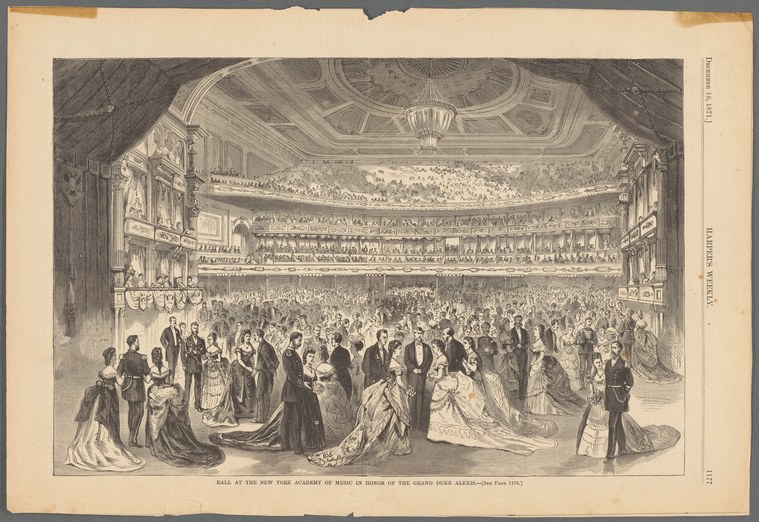
Ball at the New York Academy of Music in honor of the Grand Duke Alexis
Unknown artist
- Collection:
- Prints depicting dance
- Source:
- New York Public Library
- Rights:
- Public domain — free to use, share and adapt.
- Recorded as:
- Public Domain
This engraving documents the public ceremonial life of the ballroom at the moment when American high society was consolidating its identity through European-derived social forms. It is evidence of who danced, in what frame, in what setting—and how ballroom dance functioned not as personal expression but as collective social performance and hierarchy.
What you are looking at
A grand ballroom at the New York Academy of Music during the height of an evening gala, crowded with formally dressed guests in the gilded-age style. The space is rendered in careful linear perspective, the massive auditorium receding toward an ornate proscenium arch, its ceiling coffered and decorated with a large central medallion. The floor is packed with dancers and observers: in the foreground, women in full-skirted gowns with long trains move through the space in couples and small groups with men in black evening dress and some in military uniforms. The lighting is bright and even, characteristic of gaslit interiors of the era, illuminating both the main floor and the galleries above, which are lined with spectators. The composition emphasizes the scale and formality of the occasion—this is a state event, not a private assembly.
The dancing
The dancers move in closed couples and processional lines typical of formal ballroom society. Men stand tall with upright posture, supporting partners whose arms are raised or held at the shoulder. Women's skirts are voluminous, trailing behind them or caught in mid-motion, their bodies held in the erect, corseted frame of the period. The movement is restrained and architectonic: no violent gestures, no improvisation, but a coordinated flow of bodies through prescribed patterns. Groups align themselves in linear formations or concentric circles, suggesting the quadrille or cotillion rather than the waltz.
The dance depicted
The work depicts a formal cotillion or quadrille—the dominant social dances of high society in the 1870s when this ball took place. The Grand Duke Alexis of Russia visited New York in 1871, and this ball in his honor at the Academy of Music was a major social event, extensively reported in the press. The engraving captures the ceremonial, structured nature of these dances, which were performed as organized suites with specific figures and strict etiquette. The presence of military uniforms and the theatrical scale of the setting confirm this as elite ballroom practice, not vernacular dance.
How it was made
This is an engraving, likely produced for reproduction in a contemporary newspaper or illustrated journal. The fine parallel lines (hatching and cross-hatching) build tone and shadow, particularly visible in the architectural elements and the darkened galleries above. The technique allowed rapid reproduction and wide circulation—this image reached thousands of readers in the periodical press, making it a historical record of how Americans understood and represented their social life. The precision of the engraving emphasized the formality and order of the occasion.
About this work
This is a documentary engraving of the ball given in honor of the Russian Grand Duke Alexis at the New York Academy of Music, likely in 1871. It is a record of one of the major social events of the Gilded Age, capturing the scale, dress, and movement vocabulary of elite American ballroom dance at a specific historical moment. The work belongs in a dance archive because it documents not just that people danced, but how they danced—the hold, the frame, the formal procession, the strict adherence to prescribed figures that defined ballroom society in the late 19th century.
How to look at it
Attend first to the architecture and scale: the engraver chose to show the full depth of the ballroom, emphasizing the grandeur of the space and the crowd. Then look at the figures: the formal hold between partners, the upright posture, the way groups align themselves in orderly formations. The artist has rendered individual faces and expressions, suggesting the social nature of the event—this is not an abstract ballet scene but a record of a specific, named occasion. Notice too the dress: the women's long skirts and trains, the men's uniforms and formal coats, the careful attention to surface texture and fabric, all rendered through the precise parallel lines of engraving technique.
The artist
The catalogue record does not identify the artist. The engraving bears no visible signature. The work was likely produced by a staff engraver at an illustrated newspaper or journal such as Harper's Weekly or Frank Leslie's Illustrated Newspaper, both of which employed teams of engravers to convert sketches of newsworthy events into publishable images within days of the event. Attribution of such works is often lost.
The period
The Grand Duke Alexis's visit to America in 1871–72 was a major diplomatic event, extensively covered in the American press. The ball took place during the height of the Gilded Age, when the American wealthy were increasingly formalizing their social life along European lines. The quadrille and cotillion, imported from France and England, were the prestige dances of the period. At the same time, the engraving industry was at its peak as a technology for mass reproduction of images before the advent of photomechanical printing. This image is both a social document and a technological one.
Where it lives
The work is held in the Prints collection at the New York Public Library, part of their holdings of prints depicting dance. It was produced for and distributed through the periodical press, making it a mass-produced historical document rather than a unique work of art.
Dance in this work
Questions about this work
Was this a real event?
Yes. The Grand Duke Alexis Romanoff of Russia visited the United States in 1871–72 as a goodwill ambassador. A major ball in his honor was held at the Academy of Music in New York. The event was extensively reported in the contemporary press and was one of the most significant social occasions of the era.
What dances were being performed?
The dominant dances of American high society at this period were the quadrille and the cotillion—both imported European forms consisting of prescribed figures performed by couples in formation. These were orchestrated, ceremonial dances quite different from the waltz, which was less formal. The engraving shows the formal alignment and posture characteristic of these dances.
How do we know what this was used for?
The technique—wood or steel engraving—and the style of presentation indicate this was made for reproduction in an illustrated newspaper or journal. Such images were produced rapidly from sketches made at the event, engraved, and printed within days for mass circulation. This is documentary journalism rendered in the visual medium of the moment.
Why is everyone so formal?
Because this was ballroom dance as elite society understood and practiced it: a formal, codified system of steps and figures performed in mixed company as a display of refinement and adherence to protocol. The rigidity and formality were the entire point—they signaled membership in a cultivated class.
More dance artwork





