49 works in this view — arrow keys or swipe to move between them.
Dance in Art
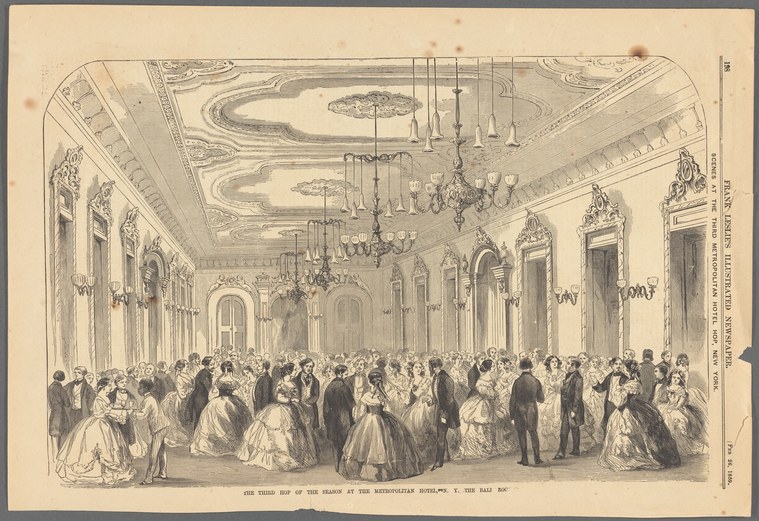
Scenes at the third Metropolitan Hotel hop, New York: the third hop of the season at the Metropolitan Hotel, N.Y., the ball room
Unknown artist
- Collection:
- Prints depicting dance
- Source:
- New York Public Library
- Rights:
- Public domain — free to use, share and adapt.
- Recorded as:
- Public Domain
The image reveals how dancing was integrated into Gilded Age society—not as a focused artistic or athletic pursuit, but as one component of a larger fashionable gathering where the display of dress, architectural magnificence, and social position were equally or more important than the movement itself. For historians of social dance and leisure, it documents the scale, gender dynamics, and commercial infrastructure of subscription balls in major American cities. The engraving's treatment of the dancers' bodies—obscured by and subordinate to the visual drama of crinoline skirts—also reveals period attitudes toward women's dress and bodily visibility in public dance.
What you are looking at
A grand ballroom reception in full swing, rendered in engraved lines. The vast rectangular space is framed by tall columns down both sides and opens to an elaborate coffered and decorated ceiling. A monumental crystal chandelier hangs centrally, casting light across the crowd. Hundreds of figures fill the floor—men in dark coats and women in voluminous crinoline gowns with full skirts. Most figures are arranged in standing clusters, conversing and observing; others are actively dancing. The dancers occupy the open central floor space in small groups, mostly in pairs or facing formation. The women's skirts dominate the visual field: elaborately gathered, flounced, and balloooned, they create a sea of pale fabric contrasted against the dark suits. The engraving is dense with detail, capturing both the architecture and the crush of fashionable society. The composition emphasizes scale and grandeur—this is an event of consequence, captured in its full social moment rather than as a movement sequence.
The dancing
The dancers visible are mostly in closed pair position or standing face-to-face in formation, typical of mid-19th-century ballroom protocol. Women's arms are largely concealed by their voluminous sleeves and bodies; men's postures are upright and formal. The weight distribution suggests measured, controlled movement rather than vigorous or energetic gesture. Most visible dancing couples show minimal arm extension and an overall vertical alignment. The overwhelming visual dominance of the women's crinoline skirts obscures legwork almost entirely—the artist's focus is on the silhouette and the spectacle of fabric rather than on footwork or dynamic momentum.
The dance depicted
This is a formal mid-19th-century ballroom event, most likely featuring quadrilles, waltzes, and cotillions—the standard social dances of the Gilded Age metropolitan ballroom. The 'hop' designation in the title (a colloquial term for a ball or dance event) and the Metropolitan Hotel setting suggest this is a commercially promoted public or semi-public subscription dance, not a private aristocratic event. The image documents the *social occasion* of dancing rather than a specific choreography; the moment is one of promenade, observation, and the orchestrated display of fashionable dress. Actual dance movement is subordinate to the spectacle of the crowd and the architecture.
How it was made
This is a wood engraving or steel engraving, executed in fine parallel lines and crosshatching to create tone and form. The technique's capacity for fine detail and its reproducibility in mass-circulation newspapers or illustrated periodicals is evident in the dense encoding of architectural ornament, fabric texture, and crowd detail. The medium's monochromatic nature and linear logic shape how the artist renders the scene: emphasis on silhouette, outline, and tonal contrast rather than color or atmospheric perspective. This is a work designed for rapid reproduction and wide viewing—it is journalism in visual form, documenting a newsworthy social event for a metropolitan audience.
About this work
This engraving documents a metropolitan ballroom reception at the Metropolitan Hotel in New York during the Gilded Age, capturing the scale, dress, and social choreography of a fashionable public dance event. The composition prioritizes the architectural setting and the massed crowd of fashionably dressed figures over individual choreography or dance technique. It is both a record of a specific occasion and a document of mid-19th-century urban leisure culture, in which dancing was one element of a larger visual spectacle of social display. The work belongs in a dance collection not because it emphasizes dance movement, but because it contextualizes where and how dancing occurred as a social institution in metropolitan American life.
How to look at it
Attend first to the architectural framing—the columns, ceiling, and chandelier establish the social *venue* as much as the crowd does. Then follow the distribution of the crowd: notice how dancers occupy the open floor while clusters of standing figures frame them. Examine the women's skirts: the artist has used the crinoline silhouettes as a formal compositional element, creating rhythm and pattern through repetition of shape. The level of detail in the engraving means individual faces and gestures are small; read the crowd as a mass phenomenon rather than focusing on individual couples. The artist has chosen to freeze a moment of mingled promenade, conversation, and movement—the ballroom in its social fullness, not a moment of peak choreographic drama.
The period
This engraving dates to the era of the crinolined ballgown, roughly 1855–1880. During this period, the Metropolitan Hotel in New York was a fashionable venue for subscription dances and balls, which were commercial events open to those who could afford admission—not restricted to inherited aristocracy. The quadrille and waltz dominated the ballroom repertoire. The engraving's appearance in mass-circulation periodicals (such as *Harper's Weekly* or *Frank Leslie's Illustrated Newspaper*, which pioneered illustrated news coverage in the 1850s–60s) suggests this was one of many such balls documented for a metropolitan reading public interested in fashion, society, and urban leisure. The period was marked by rapid industrialization, urban growth, and the emergence of a commercial leisure and fashion industry that the ballroom represented.
Where it lives
The work is held in the Library of Congress Prints collection (NYPL designation indicates a holding in New York Public Library's print collection, though the work may have been catalogued from a copy). It is a mass-produced engraving, likely from a contemporary illustrated newspaper, and represents the kind of visual documentation of metropolitan social life that circulated widely in the 1860s–70s. The print's survival in institutional collections is typical; thousands of such society engravings were produced and filed.
Dance in this work
Questions about this work
What is a 'hop' in the context of 19th-century dance?
A 'hop' was colloquial slang for a ball or dance event, used especially for subscription dances or commercial events open to paying attendees. It was less formal and more accessible than an exclusive aristocratic ball. The term persists in American English as 'sock hop' and 'prom.' The Metropolitan Hotel 'hops' mentioned in this title were fashionable public events in New York.
Why are the women's legs invisible?
Women wore full-skirted crinolines in this era, which extended from waist to floor and created a bell or dome shape. The crinoline was held out by a framework of hoops or steel stays beneath the skirt, making the garment itself the dominant visual element. Legwork and footwork were entirely obscured and, from a fashion perspective, of little consequence—the silhouette was the point. This also reflected period attitudes about feminine modesty and bodily display.
What dances would have been danced at this event?
The quadrille (a four-couple formation dance), the waltz, and cotillions (a type of group dance with changing formations) were the standard ballroom dances of the 1860s–70s. All three allowed for the promenade, standing, and observation captured in the engraving. The specific dances performed are not documented by this image alone.
Is this a historical record of an actual event or an imagined scene?
The title specifies 'the third hop of the season at the Metropolitan Hotel,' suggesting it documents or reports on an actual event that occurred. The engraving likely appeared in a contemporary illustrated newspaper and served as news coverage of metropolitan fashionable society. However, like all journalistic engravings of the period, it is a compressed, idealized, and composed representation rather than a literal record.
More dance artwork





