49 works in this view — arrow keys or swipe to move between them.
Dance in Art
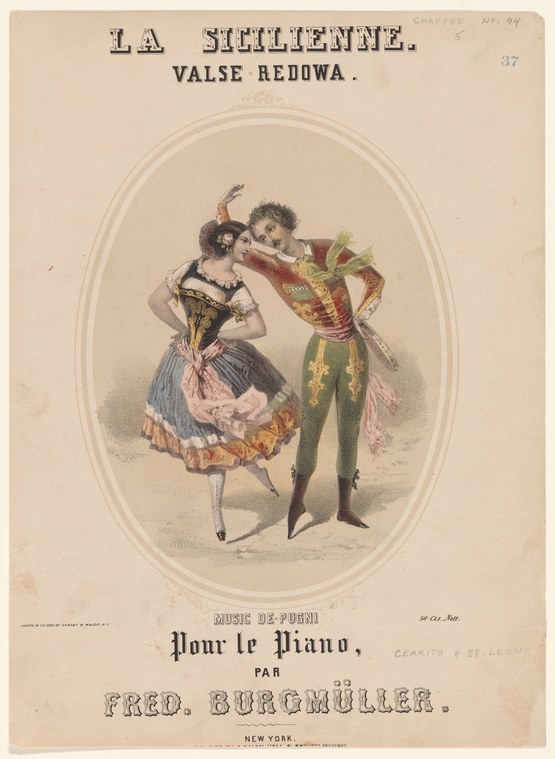
La sicilienne. Valse redowa.: Music de Pugni. Pour le piano, par Fred. Burgmüller
Unknown artist
- Collection:
- Prints depicting dance
- Source:
- New York Public Library
- Rights:
- Public domain — free to use, share and adapt.
- Recorded as:
- Public Domain
This print documents the visual and narrative conventions through which mid-19th-century audiences understood couple dances: not as technical feats but as moments of flirtation, seduction, and social performance. For historians of ballroom, operetta, and theatrical dance, it shows how the Redowa was marketed and imagined in popular culture, and how the boundaries between concert, theater, and salon were permeable and commercially productive.
What you are looking at
A hand-colored lithograph presents a couple in an intimate moment of dance or flirtation, enclosed within an oval frame typical of mid-19th-century theatrical prints. The woman, in the left foreground, wears a pale blue or grey skirt with deep yellow-gold underskirt visible beneath, corseted at the waist with a dark bodice and light chemise. A dark feathered plume crowns her head. The man stands behind and beside her in military or formal dress: a green coat with gold embroidery and pink or mauve silk trim, tight white breeches, and what appears to be formal military insignia. His posture is playful and proprietary; his face is close to hers, and his left arm is raised in a gesture of courtship or command. The woman tilts her head back and away in a pose that reads as coy retreat. The background is plain and neutral, allowing the figures and their interaction to dominate. The hand-coloring is delicate, with careful attention to the richness of the fabrics and the contrast between the military formal wear and the woman's theatrical corseted silhouette.
The dancing
The two figures are in no formal ballroom hold. Instead, the man's posture is assertive and loose—standing nearly upright with one arm extended, not holding the woman in any closed or open frame recognizable from standard couple dances of the period. The woman's body is angled away from him, her spine arched, head tilted back in a gesture of playful evasion rather than partnership. Their proximity suggests intimacy, but the lack of a structured hold and the theatrical exaggeration of her retreat suggest this is not a representation of actual dance technique but rather a flirtation scene set to music—a moment of courtship rather than ballroom pedagogy.
The dance depicted
The title identifies this as *La Sicilienne: Valse Redowa*, and the catalogue attributes the music to Cesare Pugni with piano arrangement by Fred. Burgmüller. The Redowa (or Redowak) was a Bohemian couple dance in triple time, popular in mid-19th-century ballrooms and theaters, often associated with a lively spinning motion and close partnering. However, the image does not depict the actual footwork or hold of the Redowa; instead, it captures a moment of theatrical seduction framed as a dance. The figures suggest operatic or ballet-adjacent theater rather than ballroom instruction or documentation. The Sicilienne reference may indicate a regional or character variant, and the ornate dress and military uniform suggest this is a scene from a narrative work—operetta, vaudeville, or ballet—rather than a concert or social dance manual.
How it was made
This is a hand-colored lithograph, a technique that allowed rapid production and wide circulation of theatrical imagery in the mid-19th century. The delicate hand-coloring over the lithographic line work indicates a commercial print intended for a broad audience, likely sold as sheet music cover art or as a theatrical souvenir. Lithography's capacity for fine tonal gradation and ease of hand-finishing made it ideal for the fashion and theater industries. The presence of publisher and composer credits on the print, along with the New York imprint, suggests circulation both in the United States and likely in Europe, where both the Redowa and Burgmüller's salon music were fashionable.
About this work
This is a mid-19th-century theatrical dance print—a hand-colored lithograph that frames a scene of courtship set to music rather than a record of actual ballroom technique. It advertises a commercial musical composition, *La Sicilienne: Valse Redowa*, with words and dress drawn from operetta and salon culture. The image belongs to a vast archive of theatrical and commercial prints that mediated between concert stage, ballroom, and home piano. These prints shaped how dance was imagined and remembered by audiences who never performed the dances themselves but purchased them as sheet music, collected them as souvenirs, or saw them satirized on the stage. The work reveals the overlap between theatrical ballet, operetta, salon music, and ballroom dance in the mid-19th century—a moment when the same compositions and choreographic ideas moved freely between contexts, and when visual spectacle, military romance, and musical fashion merged in popular entertainment.
How to look at it
Attend to the absence of ballroom hold and the theatrical exaggeration of the woman's retreat. The artist has frozen not a step but a moment of courtship—a narrative or emotional instant rather than a technical demonstration. Notice the precision of the costuming: the military dress, the plumed headdress, and the corseted silhouette all signal that this is a scene from a named character or genre (operetta, fairy-tale ballet) rather than an abstract representation of the dance itself. The oval frame and the neutral ground emphasize that we are watching a theatrical vignette, not a ballroom floor. The visual language is closer to fashion plates and operatic prints than to contemporary ballroom instruction manuals, which would have been far more schematic and didactic in their depiction of the hold and footwork.
The artist
The print is attributed to the publisher and composer credited on the sheet, Fred. Burgmüller (piano arranger). The artist of the lithographic design is not recorded in the catalogue. Burgmüller (1806–1874) was a prolific German pianist and composer of salon music and dance music, widely published in Europe and America. His arrangements and compositions were marketed to amateur pianists and dancing masters, and his name on a title page suggested both musical authority and commercial respectability. The visual design of the print—likely commissioned from a theater or music publisher in New York—follows standard conventions of mid-century theatrical and music-commerce lithography.
The period
The Redowa emerged in the 1830s in Prague and Bohemia and became a ballroom craze across Europe and America in the 1840s–1860s. It arrived in New York during the height of the waltz boom and competed with polka, galop, and other couple dances for fashionable attention. In the same decades, operetta and theatrical pantomime-ballet were consolidating as forms: composers like Offenbach and Herve were refining the musical and choreographic languages that would define the genre. Burgmüller's salon music occupied a middle ground—concert-hall respectability combined with ballroom utility and home-piano accessibility. The military costume visible in this print reflects the romanticization of soldiery in operetta and theatrical dance, a convention inherited from early 19th-century Romantic ballet and operatic tradition.
Where it lives
The print is held by the New York Public Library in its collection of prints depicting dance. It is a commercial music-cover print, one of thousands of similar lithographs produced in the mid-19th century for the music-publishing and entertainment industries. The New York imprint indicates it was either printed in or distributed through New York, a major hub for American music publishing and theatrical commerce.
Dance in this work
Questions about this work
What is a Redowa?
A Bohemian couple dance in triple time (3/4), popular in ballrooms from the 1840s onward. It was characterized by a lively, spinning motion and close partnering, often danced at the same speeds and in the same social contexts as the waltz and polka. Composers including Burgmüller, Strauss, and many others wrote Redowas for ballroom and salon use.
Why doesn't this image show an actual ballroom dance hold?
This is a theatrical or operatic scene, not a ballroom instruction or documentation. It prioritizes narrative, seduction, and costume over technical accuracy. The print was sold as sheet music cover art—a marketing image meant to evoke mood and charm rather than teach steps.
Who was Fred. Burgmüller?
A German-born pianist and composer (1806–1874) specializing in salon music and dance music for amateur performers. His arrangements and compositions were widely published and sold across Europe and America, making his name a marker of commercial and musical respectability in the home-music market.
What does 'La Sicilienne' mean in the title?
Sicilienne usually refers to a dance or musical style associated with Sicily or southern Italy, often characterized by a particular rhythm or melodic flavor. In this context, it may indicate a regional variant or character piece, suggesting that the Redowa was being adapted or flavored with Italianate or operatic associations for commercial appeal.
More dance artwork





