49 works in this view — arrow keys or swipe to move between them.
Dance in Art
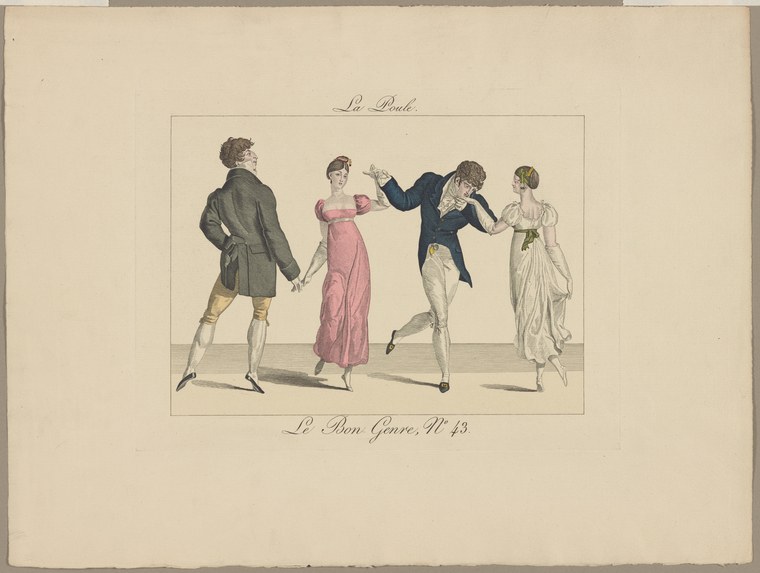
La poule
Unknown artist
- Collection:
- Prints depicting dance
- Source:
- New York Public Library
- Rights:
- Public domain — free to use, share and adapt.
- Recorded as:
- Public Domain
This print documents a named early 19th-century social dance at the exact moment of its fashionable performance, showing posture, partnership, and dress. It also reveals that dance was a subject of satire and social commentary—dance scenes were used to critique genteel pretension and bodily excess, making dance a lens through which the era examined its own manners.
What you are looking at
A hand-colored engraving depicts four fashionably dressed figures in an interior space, arranged as if demonstrating or performing a social dance. On the left stands a man in a dark coat and breeches, weight on his back leg, one arm extended toward a woman in a rose-pink Empire-waist gown who faces him with arm raised. To their right, a second man in dark dress leans forward with exaggerated posture, his arm extended upward in a theatrical gesture, while a fourth figure—a woman in a pale yellow-green gown—stands at the right edge with arms at her sides. The composition is sparse: a simple floor line, plain background, and no furniture or setting details beyond the framing rectangle. The title inscribed below reads "La poule" (The Hen), with a secondary caption "Le Bon Genre, No 43," indicating this is part of a numbered satirical series.
The dancing
The dancers are arranged in two adjacent pairs without physical contact. The woman in pink maintains an upright posture with one arm raised, while her male partner leans away from her with arms akimbo. The second man's pose is emphatically comedic—torso pitched forward, arm extended upward in an exaggerated flourish that suggests mimicry or parody of fashionable movement. The woman at right appears to be a spectator or waiting participant. The poses emphasize social hierarchy and gender display rather than the technical coordination expected of ballroom couples, with particular attention to the woman's raised arm and the men's asymmetrical, theatrical positioning.
The dance depicted
La poule (the hen) was a popular early 19th-century social dance, likely a quadrille variant or cotillion figure known for its playful, sometimes mock-serious character. The title and the exaggerated posturing suggest this is satirical—perhaps mocking the pretensions of dancers attempting fashionable steps, or the peculiar affectations that genteel society considered elegant. The lack of a closed ballroom hold and the emphasis on individual gesture rather than partnership indicates a figure-based group dance characteristic of Regency-era ballroom entertainment. The theatrical posing of the second man, in particular, implies the dance had comic or parodic elements baked into its performance.
How it was made
This is a hand-colored engraving, characteristic of the early 19th century. The print shows fine line work typical of engraving—the detailed rendering of fabric textures, the crisp definition of facial features, and the precise floor line. Hand coloring (visible in the pink gown, yellow-green dress, and flesh tones) was applied after printing, which explains the soft, translucent quality and occasional imperfect registration at edges. As part of the numbered series "Le Bon Genre," this was a commercial product—accessible, reproducible, and designed for a broad genteel readership. Engraving allowed for both satirical commentary and documentation of fashionable dress and manners in a format suitable for framing or binding in albums.
About this work
This hand-colored engraving documents La Poule, a social dance popular in Regency ballrooms, likely dating to the 1820s–1830s. It is one of a numbered satirical series called "Le Bon Genre" (Good Style/Good Taste), which used dance scenes to mock or comment on fashionable society. The work belongs to a rich tradition of dance-scene prints that recorded both the steps and the social comedy of European ballroom culture—showing not just what was danced, but how it was performed, and how artists understood the performative absurdities of genteel life.
The piece is valuable for historians of both dance and material culture: it captures the posture, dress, and spatial arrangement of an early 19th-century social dance in its moment of popularity, while its satirical framing reveals contemporary attitudes toward fashion, propriety, and bodily display. The print's circulation as a purchasable, hand-colored object suggests it had real influence in shaping or reflecting public taste.
How to look at it
Notice the exaggerated forward lean and upraised arm of the second man: this is not elegant technique but rather a caricature of it, inviting the viewer to laugh at affected posturing. The woman in pink's raised arm and upright bearing contrast with the men's asymmetrical poses, suggesting the gender dynamics of the dance—women displayed, men gestured. The sparse setting and two-dimensionality of the print emphasize the figures themselves over any realistic ballroom space, directing attention to body positions and costume. The print's satirical intent becomes clear when you observe that no one is smiling or relaxed; the formality and exaggeration of gesture are the point—this is how fashionable society looked to a critical eye.
The period
The 1820s–1830s were the height of the Regency and early Victorian ballroom era in Britain and France. Quadrilles and cotillions had recently arrived from France and were displacing country dances and cotillions as the dominant social dances of polite society. The "Le Bon Genre" series was a Paris-based satirical publication aimed at the middle and upper classes, using fashion and manners—including dance—as its subject. Dance was not merely recreation but a site of intense anxiety about propriety, social rank, bodily control, and gender display. Prints like this one documented and gently mocked the pretensions of social climbing through the body—showing how fashion and dancing went hand in hand as markers of taste and status.
Where it lives
This engraving is part of the New York Public Library's collection of dance-related prints. It is catalogued as part of "Le Bon Genre," a numbered satirical series, with this print numbered 43. The series was a commercial print publication, likely sold in individual sheets or bound in volumes, and examples survive in multiple collections.
Dance in this work
Questions about this work
What is a poule dance?
La poule (the hen) was a popular figure dance of the early 19th century, likely a variant of the quadrille or cotillion performed in ballrooms across Europe. It was known for playful or comic elements and was often depicted in satirical prints like this one. The exact steps are not fully documented in surviving dance manuals, but prints and written references suggest it involved groups of dancers moving through a sequence of figures with pronounced arm gestures and theatrical posturing.
Why is this a 'satire'?
The title of the series—"Le Bon Genre" (Good Style)—was ironic. The series used exaggerated postures, affected gestures, and awkward spatial arrangements to mock the pretensions of fashionable society. The second man's absurdly pitched torso and extended arm are visual jokes at the expense of dancers who took themselves too seriously or who failed to execute fashionable steps with grace. Satire allowed the print to document real dances while entertaining viewers through critique.
How do we know what people actually danced?
Prints like this one are primary evidence for historical dance, particularly social dance. Combined with surviving dance manuals, music, written descriptions, and other prints, they show us posture, spacing, clothing, and partnership patterns. However, a print captures one moment; it cannot show the full sequence of steps or how weight transferred. Historians read prints alongside written sources and reconstruct dance from multiple kinds of evidence.
More dance artwork





