49 works in this view — arrow keys or swipe to move between them.
Dance in Art
Dance prints from L'Illustration
Unknown artist
- Collection:
- Prints depicting dance
- Source:
- New York Public Library
- Rights:
- Public domain — free to use, share and adapt.
- Recorded as:
- Public Domain
For dance historians, this page documents the visual culture of ballroom dance in the early 19th century—showing how contemporary artists understood and depicted the formal geometries of quadrilles and cotillions, how dancers dressed and held themselves, and how dance functioned as a social institution across different venues and classes. For art historians, it exemplifies the documentary ambition of illustrated journalism in this period: using engraving to bring contemporary manners into the home of the reader, making social dance a subject worthy of detailed observation and recording.
What you are looking at
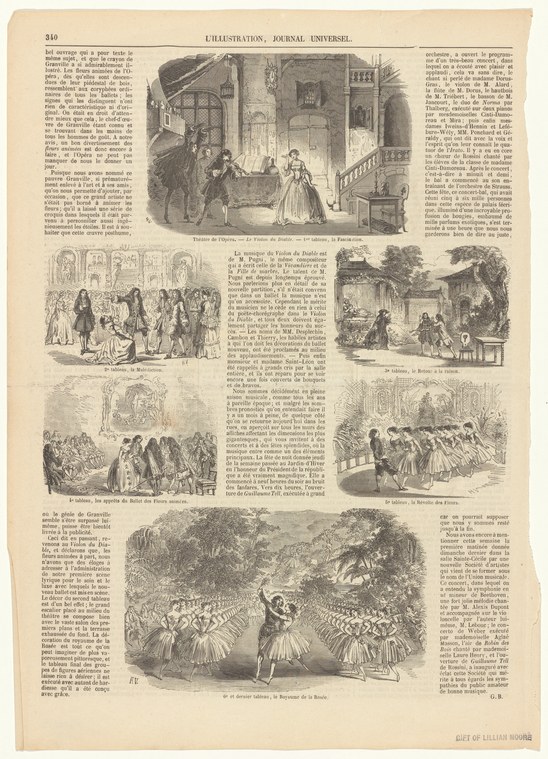
This page from L'Illustration presents six separate vignettes of social dance scenes, each occupying its own framed space on the page. The largest scene at top depicts an interior salon where a couple dances while musicians play and onlookers observe from the periphery; the woman wears a full-skirted dress and the man is in formal coat and trousers. Below this are five smaller scenes: a crowded interior gathering with multiple figures in conversation and small groups; an outdoor garden or terrace scene with dancers and spectators beneath trees; another indoor assembly with figures in formal dress arranged in conversational clusters; a formal ballroom scene with a large group of dancers arranged in what appears to be a cotillion or quadrille formation; and at the bottom, a substantial outdoor gathering with numerous figures in elaborate dress participating in or observing a dance. The page is dense with engraved line work creating texture and shadow throughout. The overall effect is ethnographic documentation—a systematic survey of how different social ranks and settings conducted dance in what appears to be early 19th-century France.
The dancing
Across these scenes, the dancers hold themselves in the upright, formal posture of the period: men in rigid torso alignment, women with weight centered and skirts flowing. In the top scene, the couple maintains a closed social hold typical of the era, the man's arm at the woman's back, her hand resting on his shoulder. The formations vary: some scenes show couples in individual units across a room; others show lines or circles of dancers, suggesting set dances. The spectators—who may outnumber the dancers—are posed with studied attention, their bodies angled toward the action. Children and servants appear in several scenes at smaller scale. The weight distribution and arm carriage throughout suggest controlled, measured movement rather than improvisation.
The dance depicted
These are social dances of the Regency or early Restoration period—most likely quadrilles, cotillions, and country dances as performed in French drawing rooms and public assemblies. The formal dress and interior settings, combined with the presence of musicians and the rigid geometry of the formations, all point to the ballroom repertoire of roughly 1820–1850. The vignettes appear designed to show variations in scale and venue: private salon dancing for the gentry, larger public balls, and garden entertainments. The print documents not the dance itself in motion but the social choreography of how dancing was staged—the relationship between dancers, musicians, and audience, and how different social spaces accommodated the practice.
How it was made
This is an engraving—a line-based print technique allowing fine detail and tonal variation through close parallel lines (hatching and cross-hatching). The technique is ideal for architectural and spatial detail and for the rendering of fabric texture; the women's gowns are articulated through directional line work that suggests both volume and movement. Engraving was the standard medium for illustration in the early-to-mid 19th century and allowed for mass distribution in periodicals like L'Illustration (founded 1843). The fact that this appears as a page within a journal, with text in columns flanking the images, tells us this was meant for a broad educated readership—not a luxury fine-art print but a documentary image for the middle-class reader interested in manners, society, and taste.
About this work
This is a page of social documentation from L'Illustration, a major French illustrated periodical of the 19th century, presenting six distinct vignettes of ballroom and assembly dancing as practiced in polite French society. The image functions as both artistic record and sociological evidence: it shows us not how individual dancers moved but how dance was staged as a social ritual—the geometry of the room, the dress codes, the role of musicians and observers, and the variations in scale from intimate salon to formal public ball. The engraving technique allows the artist to render architectural space, fabric, and crowd convincingly enough that these scenes read as reportage rather than pure imagination.
How to look at it
Notice how the page uses scale and composition to establish hierarchy: the largest scene is the most formal, centrally placed, and most detailed; the smaller scenes at the margins are less distinct and more crowded. The artist has chosen to freeze moments of relative stasis rather than peak movement—the dancers are recognizable as such, but the image emphasizes the architectural and social context of dance rather than the kinetic drama. Observe the ratio of dancers to spectators, which is consistent across scenes: spectating was as important as dancing, and the ability to stand apart and observe was itself a marker of status.
The period
The early 19th century saw the rise of the quadrille and cotillion as the dominant forms of ballroom dancing across Europe. These were highly structured set dances—geometric, social, and non-improvisatory—that required no particular physical virtuosity but demanded adherence to strict protocols of dress, comportment, and formation. L'Illustration, founded in Paris in 1843, was among the first mass-circulation illustrated journals and played a major role in establishing the image of 'society' and 'manners' as legitimate subjects for artistic documentation. Engraved illustrations of contemporary social life appeared regularly in its pages, allowing middle-class readers to see (and measure themselves against) the visual codes of upper-class behavior.
Where it lives
This page derives from L'Illustration, the major French illustrated periodical of the 19th century. The source record identifies it as a print from the New York Public Library's collection of dance-related prints, catalogued under the holding 'Prints depicting dance.' The page is representative of the journal's regular documentation of contemporary French social life.
Dance in this work
Questions about this work
What kind of dancing is shown in these scenes?
These are social ballroom dances of the Regency and early Victorian era—primarily quadrilles, cotillions, and country dances. All are set dances with fixed figures and formations, performed in formal dress in ballrooms and assemblies. No improvisation or virtuosity is implied; the emphasis is on decorum and geometry.
Is this a single event or multiple occasions?
These appear to be six variations on a theme: different venues and scales of social dancing as it occurred in French society of this period. They may be based on actual events observed by the artist or illustrator, but the page is organized to show typological variety—salon, garden, public ball—rather than narrative sequence.
What was L'Illustration and why did it publish dance images?
L'Illustration was a mass-circulation French illustrated journal founded in 1843, aimed at educated middle-class readers. It published engravings of contemporary French life, manners, and society—including fashion, social rituals, and entertainment. Dance, as a marker of taste and social status, was a natural subject.
Can you tell who these people are?
No. The figures are types rather than portraits: they are identified by their dress (indicating wealth and status), their position in the room (dancer, musician, spectator), and their gender. The engraving technique does not permit individual characterization; these are representatives of social roles.
More dance artwork





