49 works in this view — arrow keys or swipe to move between them.
Dance in Art
Dance prints from L'Illustration
Unknown artist
- Collection:
- Prints depicting dance
- Source:
- New York Public Library
- Rights:
- Public domain — free to use, share and adapt.
- Recorded as:
- Public Domain
This image is primary source material for understanding how ballroom dance was actually performed, taught, and observed in the nineteenth century. The specificity of the dancers' hold, the arrangement of spectators, and the garden setting all convey information about social dance practice that written descriptions often omit. As a mass-produced illustration in one of Europe's most influential periodicals, it also documents which dances were considered worthy of public attention and how they were aestheticized for a broad audience.
What you are looking at
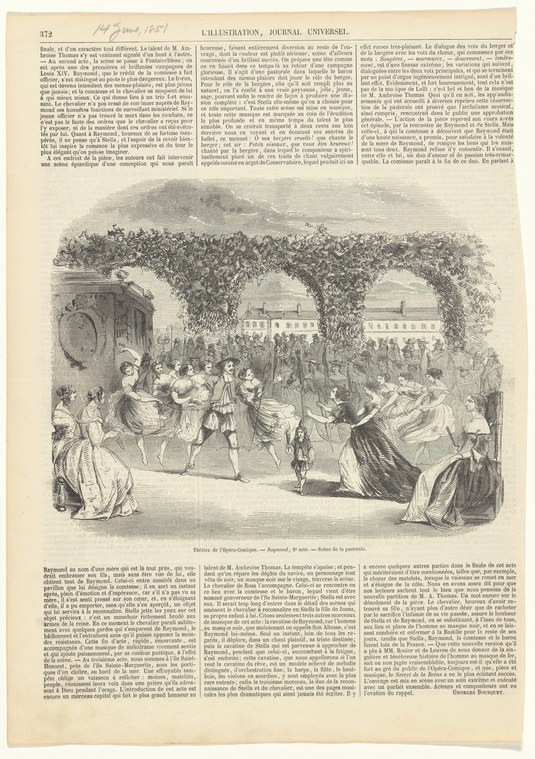
A garden party unfolds beneath a vine-covered pergola in what appears to be a formal European setting, with classical buildings visible in the background. Multiple figures in mid-nineteenth-century dress—women in voluminous skirts, men in formal coats—are engaged in social dancing and conversation. The composition centers on a dancing couple in the middle distance, with additional dancers scattered throughout the space: one couple actively dancing to the left, another pair on the right side of the pergola, and numerous spectators seated or standing. The lighting is soft and even, suggesting afternoon; the ivy-draped arbor creates pools of dappled shade. The overall mood is one of genteel leisure and courtship ritual, with the garden providing both an intimate and public stage for the performance of social dancing.
The dancing
The primary dancing couple in the center maintains what appears to be a closed ballroom hold, with the man's arm around the woman's waist and their bodies positioned at a formal distance—characteristic of mid-nineteenth-century ballroom propriety. The woman's skirt is caught mid-swirl, indicating rotational movement. Other dancers visible on the left also show closed positions with similar spatial relationships. The standing and seated figures around the dancers are arranged as observers, their postures attentive and their dress formal. Arms are held at varied heights appropriate to the social dance etiquette of the period—neither abandoned nor constrained, but controlled and dignified.
The dance depicted
This depicts the formal social dances of the mid-nineteenth-century salon or garden party, most likely waltzes, quadrilles, or polkas—the standard repertoire of Regency and Victorian ballroom culture. The closed hold, the rotational movement of the woman's skirt, and the formal pairing indicate the waltz or a similar turning dance. The setting and the multiple simultaneous couples suggest a formal ballroom or garden venue where dancing was a central social activity, performed for both the dancers' pleasure and the observation of seated guests. The image documents the visual grammar of courtship and social standing encoded in ballroom dance of this era.
How it was made
This is a wood engraving or steel engraving, characteristic of the illustration technique used by *L'Illustration*, a major French weekly periodical founded in 1843. The fine linear hatching, the precision of the architectural details, and the tonal gradations achieved through parallel lines are typical of mid-nineteenth-century wood or steel engraving. The technique allowed for mass reproduction in a periodical format, making such images available to a broad, educated readership across Europe. The relatively small scale and the narrative clarity indicate this was designed for a magazine page, not as a standalone fine art print.
About this work
This is a page from *L'Illustration*, the pioneering French pictorial newspaper, showing a scene of ballroom dancing in a garden setting, circa 1850s. The engraving documents the formal social dances—waltz, quadrille, or polka—that structured courtship and socializing among the European middle and upper classes in the nineteenth century. The image is both a record of choreographic practice and a window into the social rituals of the period: how couples held one another, how observers positioned themselves, how the garden was transformed into a ballroom. As one of thousands of such illustrations published by *L'Illustration*, it represents a major channel through which visual knowledge of dance—its etiquette, its aesthetic, its social meaning—was disseminated to the reading public.
How to look at it
Notice the moment of the woman's skirt in motion—the engraver has caught it mid-swirl, giving the image a sense of movement despite the static medium. Observe the closed hold between the primary dancing couple: this formal, restrained embrace was the standard of the period and would have been immediately recognizable to contemporary viewers as proper and refined. Look at how the seated and standing figures create a frame around the dancers, establishing the social structure of the ballroom: dancers at the center, observers at the periphery, all arranged in a choreographed social space. The architecture and the pergola locate this as a space of leisure and cultivation, not labor.
The artist
The engraver's name is not recorded in the catalogue, which is typical for periodical illustrators of this era. *L'Illustration* employed teams of engravers and illustrators, many of them highly skilled but working anonymously. The journal itself was founded in 1843 by Édouard de la Touche and was known for employing the finest wood and steel engravers of the period. The quality of the line work and the compositional clarity here suggest an experienced hand, trained in the conventions of journalistic illustration.
The period
This engraving dates to the era when ballroom dance—particularly the waltz—had become the dominant social dance form across Europe, having largely displaced earlier court dances. The 1840s–1860s saw the waltz, polka, and quadrille firmly established as the standard repertoire of respectable society. *L'Illustration* began publication in 1843 and rapidly became the model for illustrated periodicals across Europe, including the British *Illustrated London News*. The magazine's visual documentation of social life, fashion, and leisure activities made it a primary source of information about contemporary manners. Garden parties and outdoor social events were increasingly fashionable among the European bourgeoisie, combining the pleasures of nature with the formalities of ballroom culture.
Where it lives
This is a page from *L'Illustration*, a French weekly periodical held by the New York Public Library. As a page from a periodical, it was part of a mass-circulation illustrated journal intended for middle-class readers; the image was not created as a unique artwork but as one of many illustrations documenting contemporary social life.
Dance in this work
Questions about this work
What dance are they doing?
The closed hold and the rotational motion visible in the woman's skirt indicate this is most likely a waltz, the dominant ballroom dance of the nineteenth century. It could also be a polka or a turning figure from a quadrille, all of which used similar holds and footwork. The setting—a garden party with multiple couples dancing simultaneously—confirms this is a social ballroom context where these dances were standard.
Why are there so many people standing and sitting?
In nineteenth-century ballroom culture, not everyone danced at once. Social convention required that some guests remain seated as spectators, observing the dancers and engaging in conversation. This arrangement also enforced the formality and visibility of the dance—it was a display, not merely a private pleasure. Seated guests would wait for the next set or dance only if invited or if a partner became available.
Why is this published in a magazine?
*L'Illustration* was one of the first successful illustrated periodicals, and it documented contemporary social life for a broad readership. Images of ballroom dancing and social occasions were popular because they showed readers the fashions, the etiquette, and the leisure activities of polite society. Such illustrations also served an educational function, communicating to readers what was considered refined and proper behavior.
How do I know this is from the 1850s?
The women's skirts are voluminous but not extremely crinoline-structured as they would become later in the 1860s; the men's coats are cut in the style of the 1840s–50s. *L'Illustration* began publication in 1843, and the engraving style and the fashions depicted both point to the mid-nineteenth century. The garden setting and the formality of the scene are also consistent with the culture of the 1850s.
More dance artwork





