49 works in this view — arrow keys or swipe to move between them.
Dance in Art
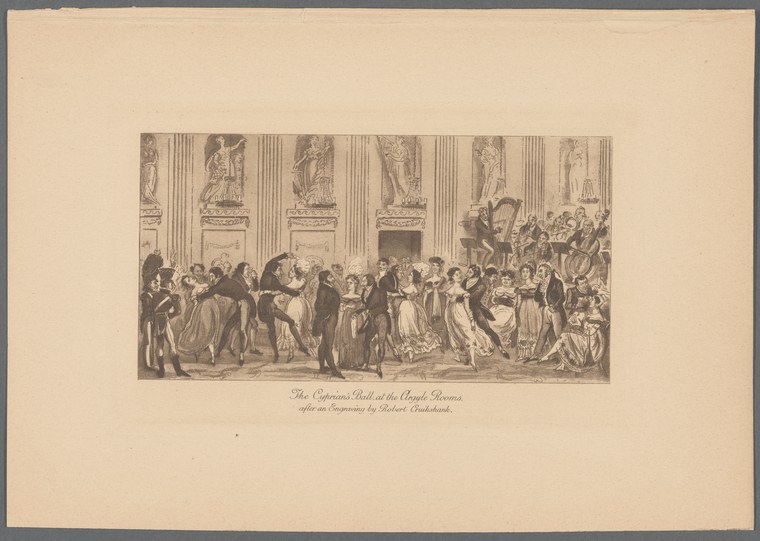
The Cyprian's ball at the Argyle Rooms
Unknown artist
- Collection:
- Prints depicting dance
- Source:
- New York Public Library
- Rights:
- Public domain — free to use, share and adapt.
- Recorded as:
- Public Domain
This engraving is essential evidence for understanding Regency ballroom dance: it shows the actual holds, frames, and formations of quadrille and cotillion as they were danced in fashionable London, and it documents the Argyle Rooms, one of the most important assembly venues of the period. For historians and dancers, it is a rare contemporaneous visual record that reveals the social structure, dress codes, and spatial organization of the ballroom alongside the dance itself.
What you are looking at
A formal ball set in a neoclassical interior with tall fluted columns and sculptural niches. The Argyle Rooms, a fashionable London venue, is crowded with well-dressed figures in Regency-era costume—men in dark coats and breeches, women in high-waisted empire-silhouette gowns. The composition centers on a formal dance in progress, with couples arranged in lines characteristic of quadrille or cotillion formation. The engraving captures the social spectacle of the event: some figures dance while others cluster in conversation or observe from the periphery. The interior architecture, with its neoclassical detail and warm tonality created by the engraving technique, emphasizes the grandeur and exclusivity of the venue. Light falls evenly across the scene, allowing the viewer to read individual figures and relationships across the crowded space.
The dancing
Couples are positioned in the formal closed holds and frames required by Regency-era ballroom dance: partners face each other or stand side by side in structured positions rather than the tight embrace of later centuries. The women's high-waisted empire gowns allow visible ankle and active leg movement; their posture is upright and composed. Men stand in formal stance, their arms positioned to guide and frame their partners. The density of figures and the variety of poses—some mid-step, others stationary in conversation—suggests the stop-and-start rhythm of a set dance rather than continuous movement. No figures show the extreme extension or turnout that would signal ballet; all movement reads as social dance.
The dance depicted
This depicts a formal ball at the Argyle Rooms, a celebrated London assembly venue, most likely during the Regency period (approximately 1811–1820) based on the costume and interior style. The dance shown is almost certainly a quadrille or cotillion, the dominant set dances of Regency ballrooms. The image captures not the height of movement but the social choreography of the event—the structured formations, the pairing of partners, the mingling of dancers and observers that defined Regency ballroom culture. The 'Cyprian's Ball' in the title suggests a themed or satirical event, possibly depicting a gathering of questionable social standing, which may explain the particular energy and density of the composition.
How it was made
This is an engraving, identifiable by the fine parallel lines (hatching and cross-hatching) that build tone and shadow, the precise linear definition of architectural detail, and the characteristic warm cream tone of the paper. The technique allowed for mass reproduction and wide circulation, suggesting this was a popular or satirical print intended for public consumption and commentary. The level of architectural detail and figure work indicates skilled engraving, likely after a drawing or painting. The format and technique place it within the tradition of social satire prints common in British popular culture of the early 19th century.
About this work
This is a Regency-era engraved print documenting a formal ball at the Argyle Rooms, a fashionable London assembly venue. The work captures the social spectacle of a quadrille or cotillion in progress, showing couples in formal ballroom dress and position within a neoclassical interior. It belongs in a gallery of dance in art because it is a primary historical document of how Regency ballroom dance was actually practiced, framed, and understood—not as isolated individual movement but as social choreography, ceremony, and spectacle. The work is also a record of a specific venue and event that shaped dance history in early 19th-century Britain.
How to look at it
Observe the spatial arrangement of the dancers: they are not scattered randomly but organized in parallel lines or sets, typical of quadrille formation. Notice the posture—upright, controlled, and formal—and the precise positioning of arms and hands, which were central to the vocabulary of Regency ballroom dance. The engraver has chosen to freeze a moment during the dance rather than at its climax, allowing the viewer to read both the active figures and the social context around them. Look also at the architecture: the columns and niches frame the dancers and emphasize the formality and grandeur of the setting, which was itself part of the social significance of dancing at a venue like the Argyle Rooms.
The artist
The artist is not recorded in the catalogue. The level of architectural precision and social detail suggests a professional engraver working in the tradition of satirical or documentary social prints, possibly after a drawing by another artist. The technique and style are consistent with London print production of the 1810s–1820s, a period of flourishing social satire and ballroom culture documentation.
The period
The Regency period (1811–1820) saw the quadrille and cotillion reach peak popularity in British ballrooms. These structured set dances, originating in France, had become the standard social dance form in fashionable London assemblies. The Argyle Rooms, located in Soho, were among the most exclusive and celebrated public dance venues of the era, host to fashionable balls, masquerades, and assemblies. Engraved prints documenting ballroom scenes were popular commodities, circulating as both documentary records and vehicles for social commentary and satire. The formality and neoclassical interior design visible here reflect the aesthetic values of the Regency period—the fashion for high empire-waist gowns and the geometric precision of ballroom dance as social art.
Where it lives
This work is held in the New York Public Library's Prints collection, catalogued under 'Prints depicting dance.' The catalogue record is minimal, providing only the title, subject area, and holding institution. The work is a satirical or documentary social print, likely published independently or as part of a series of Regency ballroom scenes.
Dance in this work
Questions about this work
What is a quadrille?
A quadrille is a set dance for four couples arranged in a square, popular in European ballrooms from the late 18th century through the 19th century. It consists of five figures, each with prescribed steps and formations. The dancers move in synchronization within their set, and the dance has a stop-and-start rhythm—moments of active movement followed by pauses, as shown in this image.
What were the Argyle Rooms?
The Argyle Rooms were a fashionable public assembly venue in Soho, London, famous during the Regency era for hosting balls, masquerades, and concerts. They were one of the most prestigious dance venues in London and attracted a mix of genteel and demi-monde society, which may explain the 'Cyprian's Ball' reference in the title.
How do I know this is Regency-era dance?
The costume—women's high-waisted empire gowns and men's dark coats and breeches—dates the image to approximately 1810–1820. The formal closed holds, upright posture, and geometric set-dance formation are characteristic of Regency quadrilles and cotillions. The neoclassical interior design is also consistent with Regency aesthetics.
Why is this called the 'Cyprian's Ball'?
'Cyprian' was a Regency slang term for a woman of questionable virtue or a courtesan. The title suggests this print may be satirizing a particular ball or event, or commenting on the mixing of social classes at fashionable assemblies—a common theme in Regency social prints.
More dance artwork





