49 works in this view — arrow keys or swipe to move between them.
Dance in Art
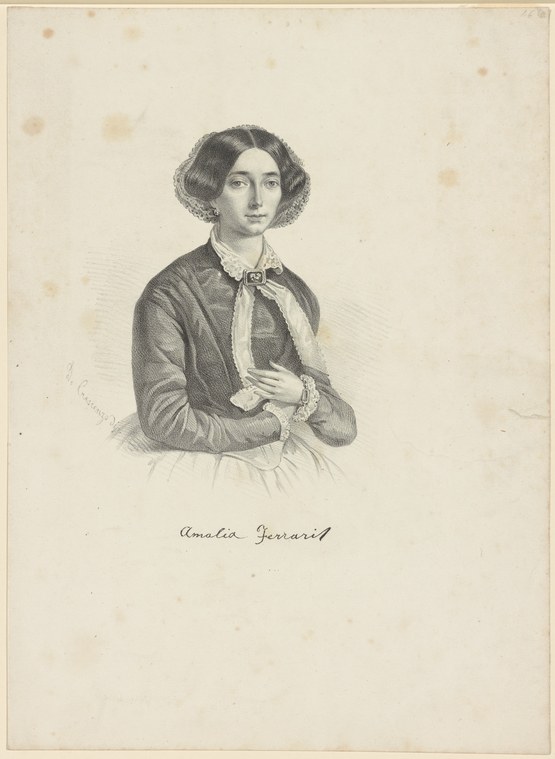
Amalia Ferraris [facsimile signature]
Unknown artist
- Collection:
- Prints depicting dance
- Source:
- New York Public Library
- Rights:
- Public domain — free to use, share and adapt.
- Recorded as:
- Public Domain
Ferraris was instrumental in bringing Italian ballet to prominence in the mid-19th century at a moment when French and Danish companies dominated European dance. This portrait documents her celebrity status and shows how dancers of her stature were marketed and remembered—through fine prints that allowed her image to reach audiences far beyond those who could afford opera tickets. For dance historians, it is material evidence of the star system and the machinery of theatrical celebrity in the Romantic era.
What you are looking at
A three-quarter-length portrait of a young woman, identified by inscription as Amalia Ferraris, shown against a plain cream background. She wears a dark jacket or bodice with long sleeves, fitted at the waist, paired with a full skirt of lighter material—the silhouette typical of mid-19th-century dress. A decorative brooch or clasp fastens a ribbon or shawl at her neck. Her dark hair is parted in the center and arranged in the elaborate side curls fashionable in the 1850s. Her posture is upright and composed, with her arms held at rest before her body, one hand crossed over the other. The technique is that of a delicate engraving or lithograph, rendered in fine grayscale tones with careful attention to the fabric's texture and the soft modeling of her face. The facsimile signature beneath confirms her identity.
The dancing
A single figure at rest, posed formally and frontally. The dancer stands with weight evenly distributed, shoulders back, in the dignified carriage expected of a professional performer in formal portraiture. Her arms are not in a dance position but held naturally before her body—a convention of portraiture rather than a moment captured mid-performance. Her upright posture and composed frame suggest the classical training and deportment required of a professional ballet dancer of her era.
The dance depicted
Amalia Ferraris was one of the most celebrated European ballet dancers of the 1850s, a prima ballerina known for her technique and her role in promoting Italian ballet internationally. This portrait does not capture a dance movement; rather, it presents her as a public figure and celebrity. Her fame rested on her virtuosity in the Romantic ballet repertoire—works like *Giselle* and *La Traviata* (the ballet adaptation)—though this image shows her in street dress or reception attire, not in costume. The portrait serves as a celebrity image, similar to modern theatrical lobby cards, announcing her prominence to audiences who would recognize her name.
How it was made
This is a fine engraving or possibly a lithograph, a reproductive print medium that allowed multiple copies to circulate widely among the theater-going public and collectors of theatrical memorabilia. The delicate grayscale tones and fine linear work are characteristic of mid-19th-century engraving technique. Such prints were affordable and distributed through print shops and theater venues, reaching a broad audience beyond those who could attend performances. The technique implies this is a celebrity portrait produced for public sale and circulation—a precursor to modern promotional photography.
About this work
This is a celebrity portrait of Amalia Ferraris, one of Europe's most celebrated ballet dancers of the Romantic era, rendered as an engraved or lithographed print. The work does not document a dance or a moment in performance but rather presents the dancer herself as a public figure in formal dress. It belongs in a dance history collection as evidence of how 19th-century dancers were promoted and remembered—through printed likenesses that circulated among audiences and became part of the material culture of the theater. The portrait format and the care taken with her appearance reflect the status of the prima ballerina as a celebrity subject worthy of fine printmaking and public commemoration.
How to look at it
Observe the careful rendering of her costume and the attention to her composed, dignified posture—this is not a candid or narrative moment but a formal announcement of status. Notice the high quality of the printmaking, especially the subtle tonal gradations in her jacket and face: such fine work was costly to produce and reserved for celebrated performers. The inscription of her name below is essential—this is a named portrait, a celebrity image for a public that knew who she was. The absence of any dance costume or theatrical setting emphasizes that this is a portrait of the person, not a document of performance.
The artist
The artist is not recorded. The work is a reproductive print—an engraving or lithograph after a drawing or painting—and may have been produced by a printmaker working from a studio photograph or portrait sketch. Such prints were often unsigned or attributed only to the printing house. Mid-19th-century theatrical portraiture was a commercial enterprise, and the quality of this work suggests it was produced by a skilled professional printmaker, possibly for a major printing publisher in Paris, Milan, or another major theatrical center.
The period
The 1850s were the height of the Romantic ballet era in Europe, when dancers like Ferraris, Marie Taglioni, and Carlotta Grisi were international celebrities. Dancers traveled extensively, performing the great Romantic classics—*Giselle*, *La Sylphide*, *Swan Lake* (premiered 1895, but the aesthetic was forming)—and lithographed celebrity portraits were a standard form of theatrical promotion. Print technology allowed dancers' images to be mass-produced and sold to admirers, creating a modern star system decades before photography became the dominant medium. Ferraris's prominence reflects both her technical gifts and the growing internationalism of ballet, which was increasingly centered in Italy and Russia by mid-century, in contrast to the French domination of earlier decades.
Where it lives
The work is held in the NYPL Prints depicting dance collection. It is a reproductive print, not a unique artwork, and likely one of many impressions distributed during or shortly after Ferraris's active career. The collection designation indicates that it has been catalogued as part of a systematic effort to preserve theatrical and dance imagery in print form.
Dance in this work
Questions about this work
Was Amalia Ferraris a real dancer?
Yes. Ferraris (1828–1904) was an Italian prima ballerina celebrated across Europe in the 1850s and 1860s. She was known for her technique and her performances in Romantic ballet classics, and she was a major figure in establishing Italian ballet as a significant force in European dance. She performed in Paris, London, and other major cities, and was regarded as a technical rival to the famous French and Danish dancers of her day.
Why is she shown in street dress, not a ballet costume?
This is a formal celebrity portrait, not a document of a specific performance or character. Theater-goers of the era purchased prints of their favorite dancers in both costume and street dress; the street dress portrait asserted the dancer's identity as a celebrated public figure, not just a character on stage. Such portraits were sold through print shops and at theater venues, functioning as modern fan photographs or promotional images.
Is this a lithograph or an engraving?
The record does not specify. From the image, it appears to be a fine reproductive print, most likely a lithograph or steel engraving. The delicate tonal modeling and linear technique are consistent with mid-19th-century printmaking. Without technical examination or archival documentation, the exact process cannot be confirmed.
Who made this print?
The artist is not recorded. This is a reproductive print, likely produced by a professional printmaker or print publisher, possibly working from a photograph or studio portrait. Such commercial theatrical prints were often unsigned or credited only to the publishing house.
More dance artwork





