49 works in this view — arrow keys or swipe to move between them.
Dance in Art
Theatrical portraits
Unknown artist
- Collection:
- Prints depicting dance
- Source:
- New York Public Library
- Rights:
- Public domain — free to use, share and adapt.
- Recorded as:
- Public Domain
This print is a historical record of how female performers were marketed and seen in mid-nineteenth-century theatre, at a moment when theatrical dancing was shifting from formal ballet toward the lighter, more commercial forms that would dominate the music hall. The costume and pose show the visual language that audiences expected from a comedic or operatic actress, and the lithographic technique demonstrates how theatrical celebrity was mass-produced and circulated. For dance historians, it documents the training, presentation, and social position of women who danced on the commercial stage outside the formal ballet academy.
What you are looking at
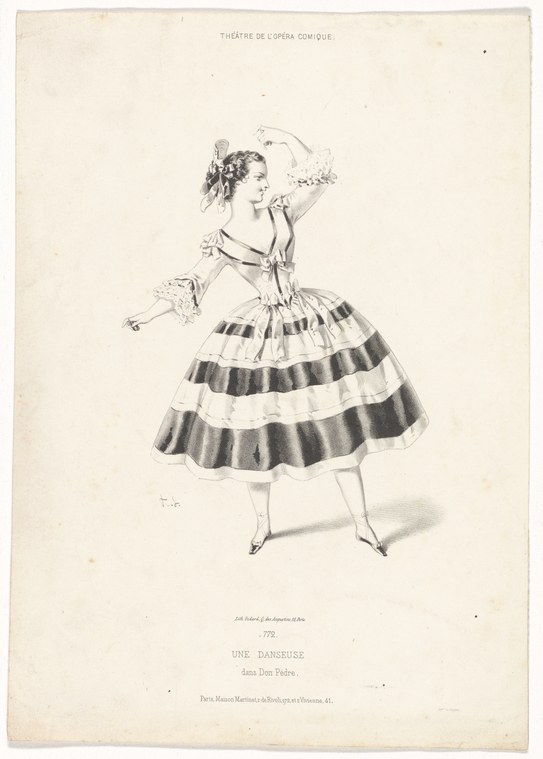
A young woman in theatrical costume stands in an elegant contrapposto pose against a plain background. She wears an elaborate dress with a fitted bodice trimmed in lace, and a full skirt composed of horizontal bands of dark and light fabric—a construction that creates strong visual rhythm and suggests considerable volume and movement. Her hair is arranged in a fashionable style with flowers or ornaments, and she holds a fan in her raised right hand, struck in the attitude of a coquettish glance toward it. The pose is restrained and studiedly graceful; her left leg bears her weight while the right is bent slightly, echoing the conventions of theatrical portraiture. The image presents her as a performer in a comedic or light theatrical role, the kind of actress who would have been prominent in mid-nineteenth-century stage entertainment.
The dancing
A single standing figure, evidently female, posed in a refined three-quarter view with weight on the back leg and the front leg relaxed. The arms are arranged for display rather than function—the right arm raised to shoulder height with the fan held up in a gesture of affected interest or flirtation, the left arm lowering naturally. The posture is that of the trained performer: upright, elongated in the torso, the face turned to maintain a flattering line. There is no suggestion of vigorous movement; rather, the body is arranged as a stationary presentation, which was standard in theatrical portraiture of the period.
The dance depicted
This is a theatrical portrait rather than a record of a specific dance. The costume and pose are consistent with the comedic opera or vaudeville performances of mid-nineteenth-century France, and the woman may well have been a dancer as well as an actress—many performers of this era trained in both disciplines. The skirt's construction, with its bold stripes and considerable width, suggests costumes designed for silhouette and visual spectacle rather than technical footwork. The overall presentation is of a performer at rest, composed for the viewer's gaze, rather than captured mid-movement. No specific dance style or choreography is evident, though the theatrical context and the woman's trained posture suggest she was a professional dancer-actress.
How it was made
This is a lithographic print, as established by the characteristic handling of tone and line in the figure and the simplified background. Lithography allowed the rapid production and affordable distribution of theatrical portraits, which were popular consumer items in nineteenth-century Europe—fans, collectors, and theatregoers would purchase prints of celebrated performers. The technique permitted fine detail in dress and physiognomy while keeping the background spare, focusing the viewer's attention entirely on the performer. The print appears to be from a numbered series, as suggested by the notation at the bottom of the sheet.
About this work
This is a mid-nineteenth-century theatrical portrait of a female performer in comedic or light operatic dress, likely French in origin. The lithographic print documents both a specific performer and a genre of popular entertainment—the kind of stage comedy and musical theatre that dominated European playhouses in the 1840s–1860s. The image preserves the visual conventions of theatrical celebrity in the period: the carefully composed pose, the emphasis on costume and coiffure, the confrontation with the viewer's gaze. It belongs in a gallery of dance in art because theatrical performers of this era were trained dancers as well as actors and singers, and because the image documents the aesthetics and costume conventions that shaped how movement was presented and consumed on the commercial stage.
How to look at it
Attend to the construction of the skirt: the bold horizontal bands are not merely decorative but functional—they create visual movement and volume that would have read clearly from the theatre audience, and they suggest a costume designed for spectacle and silhouette. Note the careful arrangement of the pose, particularly the relation of the weight to the raised arm: this is not natural repose but a calculated presentation of the body as an object of view. The fan is not a functional accessory but a prop that extends the gesture of coquetry; the gaze toward it, rather than toward the viewer, was a common device in theatrical portraiture to suggest personality and playfulness. The plain background emphasizes that this is a portrait of a performer in costume, not a narrative scene.
The period
This portrait belongs to the mid-nineteenth-century vogue for theatrical prints, particularly in France and England. The 1840s–1860s saw an enormous expansion in commercial theatre and music hall entertainment, and performers became celebrities whose likenesses were sought after as affordable prints. At this same moment, Romantic ballet was at its height (the work of Marie Taglioni and her contemporaries), but commercial theatre and opera-comique employed a broader class of performers—singers, comedians, dancers—in mixed-media entertainments. The aesthetic of the portrait reflects the values of this entertainment world: elegance without severity, movement frozen into statuary pose, costume as the primary marker of character and appeal.
Where it lives
This print is held in the New York Public Library's collection of dance-related prints and is catalogued under the series title 'Théâtre de l'Opéra Comique.' The print appears to be part of a numbered series of performer portraits, consistent with the commercial theatrical print industry of mid-nineteenth-century France.
Dance in this work
Questions about this work
Was this woman a dancer or an actress?
She was almost certainly both. In mid-nineteenth-century commercial theatre and opera-comique, performers trained in multiple disciplines—singing, acting, and dancing—and a single performer might be called upon to do all three in a single production. The costume and trained posture suggest theatrical training; the title specifies she was a performer in comedic opera. The image does not show her dancing, but records her professional identity and how she was marketed to audiences.
What is the dance depicted here?
No specific dance is being performed; this is a posed portrait. However, the costume and presentation document the visual conventions of mid-nineteenth-century theatrical performance, and the woman's trained posture and the costume's design for silhouette are both relevant to how dancing was understood and presented in this era.
Why is the skirt made of horizontal stripes?
The bold stripes serve both aesthetic and practical functions. Visually, they emphasize the volume and movement of the skirt and create a striking silhouette readable from a theatre audience. Practically, the construction allows the skirt to hold its shape while permitting movement; the bands of alternating weight and volume would flutter and catch the light during performance, enhancing the visual effect of motion even during static poses.
What does this tell us about how women performers were presented?
The print shows that female theatrical performers were marketed primarily through their appearance, costume, and graceful deportment. The pose is carefully composed for visual effect rather than naturalism; the gaze is directed away from the viewer in a gesture of playful coquetry; the costume is the dominant visual element. This was standard in theatrical celebrity portraiture and reflects both the commercial entertainment industry and the social conventions governing how female performers' bodies were displayed.
More dance artwork





