49 works in this view — arrow keys or swipe to move between them.
Dance in Art
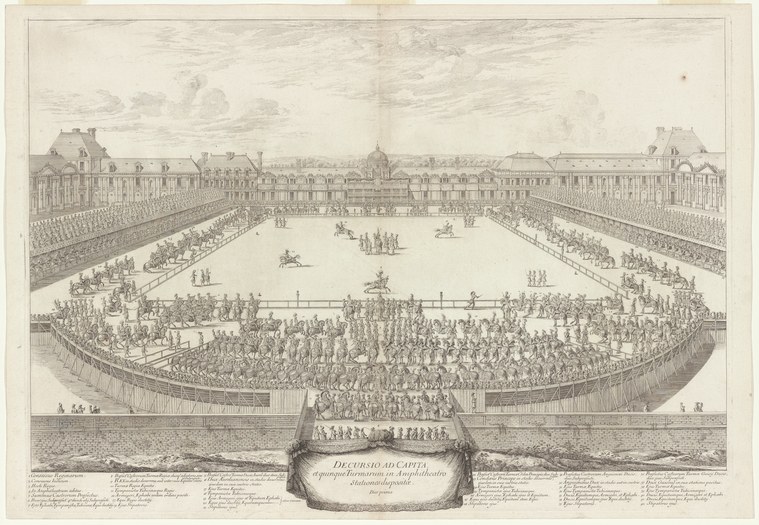
Decurso ad Capita et quinque Turmarum in Amphitheatro stationes dispositæ. Dies prima
Unknown artist
- Collection:
- Prints depicting dance
- Source:
- New York Public Library
- Rights:
- Public domain — free to use, share and adapt.
- Recorded as:
- Public Domain
This work is crucial for understanding pre-classical court performance: it shows that elaborate choreographed spectacle existed in the early modern period, organized not by steps but by formation, rank, and symbolic positioning. The print's precision and circulation reveal how such events were documented, preserved, and propagandized across European courts, influencing the development of court ceremony and theatrical pageantry.
What you are looking at
This is an engraved bird's-eye view of a grand equestrian spectacle in an amphitheater, rendered in the classical architectural style typical of 17th-century court festivals. The composition shows a vast oval arena with tiered seating packed with spectators on all sides. The central performance space is divided into multiple zones: the upper portion displays military formations and riders in elaborate patterns, while the lower sections show dense crowds of standing figures arranged in precise geometric formations. The surrounding buildings form a complete enclosure with classical facades and mansard roofs, suggesting a purpose-built or specially arranged venue. The ground plane is rendered with linear perspective to emphasize the gathering's scale, and the title cartouche at the bottom is supported by decorative scrollwork typical of early modern prints.
The dancing
The mounted figures in the upper arena are rendered small but distinct, shown in rigid formation and processional order rather than in dynamic movement. The standing crowds in the lower arena are represented schematically—heads and bodies compressed into dense blocks of humanity rather than individuated. Where any gesture is discernible, riders sit upright and formal, their posture emphasizing rank and control rather than physical expressiveness. No closed dance holds are visible; the organization is fundamentally military and processional.
The dance depicted
This is not a depiction of dance in the modern sense, but rather a court spectacle—specifically a cavalry display or "turma" (military squadron) review. The Latin title indicates five squadrons (turmarum) arranged in precise positions (dispositæ) in an amphitheater on day one of a multi-day event. Such spectacles were part of 17th-century court culture, blending pageantry, horsemanship, and civic display. The riders and pedestrians are performing a choreography of rank, order, and military precision rather than steps and movements; the dance here is in formation and procession.
How it was made
This is an engraving, most likely from the 17th century, created with the fine line work and tonal modeling characteristic of that medium. The technique allowed for precise architectural rendering and intricate detail across a large plate, making it ideal for documentation of court spectacles and state events. The existence of the print suggests this was a significant, well-recorded event meant to circulate among European courts and nobility—engravings of this type were both commemorative and propagandistic, establishing the spectacle's grandeur for those who could not attend.
About this work
This engraved record of a five-squadron amphitheater spectacle documents a form of early modern court performance that occupied the boundary between dance, theater, and military display. The work captures not bodily choreography but the choreography of state—the arrangement of bodies in hierarchical order, the pageantry of rank and procession, and the civic performance of power through spectacle. For dance historians, it offers evidence of how movement, ceremony, and the body were organized in court culture before the codification of ballet technique.
How to look at it
Approach this as a document of state ceremony rather than a depiction of bodies in motion. Observe how the artist chose an elevated, architectural viewpoint that prioritizes order, geometry, and crowd dynamics over individual gesture or footwork. The precision of the formations and the density of the spectators are the point—this print was made to demonstrate that vast numbers of people and horses could be orchestrated into perfect order, a propaganda statement about authority and control. The moment captured is not a single movement but an entire organized state.
The artist
The artist is not recorded in the catalogue. The print's style and engraving technique are consistent with professional court printers and documentarians of the 17th century, likely commissioned by or for the court that hosted the event. The care taken in architectural rendering and the complexity of the composition suggest a skilled practitioner with access to court patronage.
The period
This print belongs to the 17th century, when court spectacles reached their baroque apogee across European nobility. Large-scale cavalry displays, civic ceremonies, and architectural pageantry were central to dynastic display and courtly culture. This was the era when ballet de cour was evolving in France, and similar elaborate geometric and processional choreography was being applied to both mounted and pedestrian performance. The print documents the civic and martial dimensions of court culture that preceded and paralleled the development of theatrical dance.
Where it lives
The work is held in the Prints collection at the New York Public Library. It is catalogued as a historical print depicting spectacle and ceremony, part of the broader collection of dance-related prints and visual documents.
Dance in this work
Questions about this work
Is this a dance?
Not in the modern sense. This is a court spectacle or military review—a choreographed arrangement of bodies, horses, and crowds in geometric patterns. Movement is controlled and formal rather than expressive. It belongs to the history of performance and pageantry rather than dance proper, but it shows how the early modern court organized and displayed bodies in structured, repetitive formations that served ceremonial and political purposes.
Why is this a bird's-eye view?
The elevated perspective was essential to the spectacle's meaning: it allowed the viewer (whether the patron, an attendee, or a reader of the print) to see the perfect geometric order that was the whole point. From ground level, individual viewers would see only their immediate surroundings; the bird's-eye engraving made visible the orchestrated totality that demonstrated power and control.
What does 'turmarum' mean?
Turma is a Latin term for a cavalry squadron or military unit. The title indicates this spectacle involved five squadrons, each arranged in prescribed positions within the amphitheater. This suggests the event was organized along military lines, with emphasis on formation, hierarchy, and coordinated group action.
How do we know this engraving is from the 17th century?
The engraving style, the form of the cartouche, the architectural vocabulary, and the typology of court spectacle all point to the 17th century. The style of dress visible in the figures and the format of the print are consistent with that era's court documentation practices.
More dance artwork





