49 works in this view — arrow keys or swipe to move between them.
Dance in Art
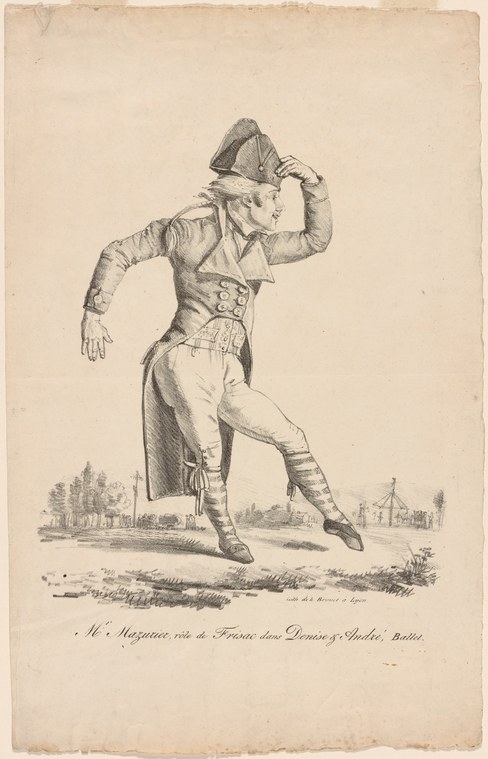
Mr. Mazurier, rôle de Frisac dans Denise & André, ballet
Unknown artist
- Collection:
- Prints depicting dance
- Source:
- New York Public Library
- Rights:
- Public domain — free to use, share and adapt.
- Recorded as:
- Public Domain
This print documents a performer and role that would otherwise be lost to history, and it shows that early 19th-century theatrical dance included acrobatic and comedic physical vocabularies far beyond the romantic ballet aesthetic. For researchers of theatrical history, pantomime, and the evolution of popular entertainment, it is primary evidence of how bodies moved and were shown to audiences in this period.
What you are looking at
A male dancer in early 19th-century theatrical costume strikes a dynamic pose against a landscape background. He wears a fitted jacket with buttons, tight breeches, and wrapped leg coverings or stockings, with a cap or hat held near his head in one hand. His body is captured mid-movement in a striking contrapposto, with one leg extended and his torso twisted, suggesting a moment of exaggerated or comic action. The setting is a sparse countryside with buildings visible in the distance—a pastoral backdrop typical of theatrical prints of the period. The figure dominates the composition, positioned centrally and rendered with fine pen work and careful cross-hatching to suggest volume and fabric texture.
The dancing
A solitary male figure executes a dynamic, off-balance pose with considerable extension of the lower body and upper-body rotation. His weight appears shifted to create an unstable, exaggerated stance—one leg bent, the other stretched, the torso twisted away from the legs in a manner suggesting comedy or burlesque. His raised arm gestures toward his head with the hat or cap; the other hangs loosely. The elongated proportions and acute angles of the limbs suggest a performer trained in acrobatic or pantomimic movement rather than classical ballet line.
The dance depicted
The title identifies the performer as Mazurier in the role of Frisac from the ballet *Denise & André*. This was a pantomime-ballet of the early 19th century, likely performed at the Théâtre de la Porte-Saint-Martin or similar Paris venues specializing in popular melodrama and spectacle. The exaggerated posture and comic distortion of the figure suggest this was a comic or grotesque character role within a narrative ballet. Mazurier was known for acrobatic and pantomimic performance; this pose captures the kind of physical excess and visual surprise that characterized such roles.
How it was made
The work is a line engraving or etching on paper, rendered in fine black ink with careful cross-hatching and tonal gradation to create volume. The technique allowed for mass production and distribution of theatrical imagery to audiences and collectors. The careful draftsmanship and the inclusion of a printed French caption below suggest this was a professional theatrical print—likely issued by a Paris publisher to document and advertise performances or performers of note. The wear and age visible on the paper is consistent with early 19th-century printing.
About this work
This is a theatrical print documenting a named performer—Mazurier—in a specific character role from an early 19th-century French ballet-pantomime. It belongs to a rich tradition of engraved theatrical portraiture that served both as advertisements for performances and as souvenirs for audiences. The image captures not a classical ballet pose but a comic, acrobatic stance—a reminder that early 19th-century dance theater encompassed burlesque, pantomime, and spectacular physical comedy alongside more formal ballet. The work preserves both a moment of theatrical history and the body language of a performer known for turning the body into an instrument of surprise and laughter.
How to look at it
Attend to the exaggeration in the pose: every limb is pushed to an extreme angle, the body is deliberately unbalanced, and the gesture with the hat reads as theatrical and self-aware rather than naturalistic. This was the language of comedy and spectacle in early 19th-century theater—a body pushed beyond the rules of classical ballet into a zone of physical display and surprise. The artist has chosen the peak moment of the distortion, making the performer's virtuosity and daring visible to the viewer.
The period
The early 19th century saw the flourishing of theatrical prints as a major industry in Paris and London. Engraved portraits of celebrated performers were sold to audiences both as memorabilia and as records of celebrated interpretations. This period coincides with the rise of romantic ballet and the cult of the ballerina, but also with the continued popularity of pantomime, melodrama, and acrobatic spectacle on Paris stages. Mazurier was active in this era and known for bringing acrobatic virtuosity and comic invention to theatrical roles. The print's style and execution place it squarely within the professional theatrical print tradition of the 1820s–1830s.
Where it lives
The work is part of the New York Public Library's collection of prints depicting dance. It is a commercial theatrical print, one of many such images that were mass-produced and disseminated in early 19th-century Paris.
Dance in this work
Questions about this work
Who was Mazurier?
Mazurier was a celebrated French theatrical performer of the early 19th century, known for his acrobatic skill, pantomimic ability, and comic roles. He performed at major Paris theaters and was celebrated for roles that required physical virtuosity and expressive movement. He was particularly associated with pantomime-ballet roles that blended dancing, acrobatics, and narrative theater.
What was Denise & André?
This was a ballet-pantomime performed in early 19th-century Paris, part of the popular theater tradition that blended narrative, spectacle, and physical comedy. It is now largely lost to history except for images like this print and scattered references in theatrical records.
Is this classical ballet?
No. While it is from the same era as romantic ballet, this is pantomime-ballet or spectacle theater—a different tradition emphasizing comic and acrobatic virtuosity over the ethereal, narrative-focused aesthetic of works like *La Sylphide*.
How was this image made?
It is an engraving or etching—a printmaking technique that allowed multiple copies to be made from a single plate. This made theatrical prints affordable and popular among theater audiences and collectors of the period.
More dance artwork





