49 works in this view — arrow keys or swipe to move between them.
Dance in Art
Folk and ethnic costumes
Unknown artist
- Collection:
- Prints depicting dance
- Source:
- New York Public Library
- Rights:
- Public domain — free to use, share and adapt.
- Recorded as:
- Public Domain
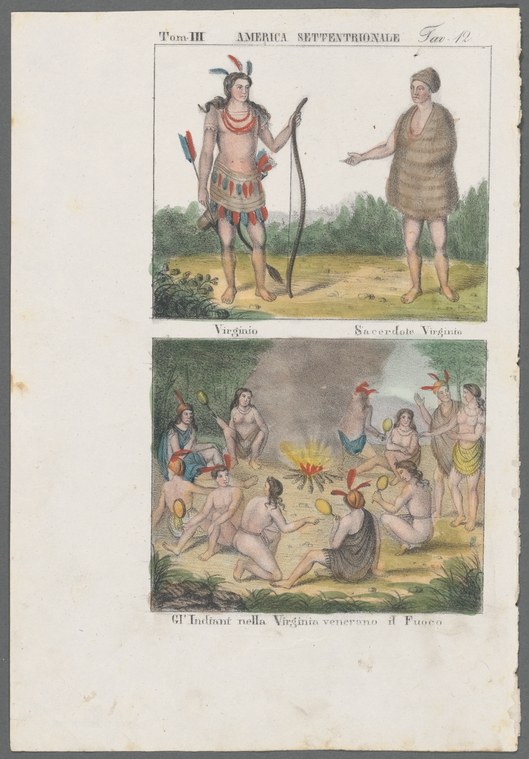
This image documents how Indigenous dance and ceremony entered European visual culture during the colonial period, filtered through engraving technique and European artistic assumptions. For dance historians, it preserves a moment of cross-cultural encounter and shows the challenge of reading movement from works created by artists who did not participate in or deeply understand the practices they depicted.
What you are looking at
This hand-colored engraving depicts two scenes from early colonial Virginia. The upper register shows two Indigenous figures in a landscape with scattered trees and green foreground. The figure on the left wears an elaborate feathered headdress, a beaded or shell-decorated chest ornament, and holds a long bow and arrows; the figure on the right is unclothed except for woven or matted material covering the legs and torso. The lower register shows a larger gathering of approximately fifteen Indigenous figures arranged in a circle around a central fire. Some sit, others stand or crouch; several appear to be in motion or gesturing. The composition suggests a ceremonial or social gathering, with figures facing inward toward the flames. The style and hand-coloring are consistent with late sixteenth- or early seventeenth-century European ethnographic illustration.
The dancing
The figures are depicted with naturalistic anatomy but stylized in the manner of contemporary European prints. In the lower scene, bodies are arranged radially around the fire without formal holds or paired positioning. Several figures gesture with raised arms or bent knees suggesting movement or dance posture, but the artist has not rendered specific footwork or weight distribution. The composition emphasizes gathering and proximity to the central fire rather than choreographed steps or couple formation.
The dance depicted
This appears to document a communal Indigenous ceremonial gathering rather than a specific named dance. The circle formation around fire, the raised-arm gestures, and the mixed standing and crouching postures suggest sacred or social ritual movement common to many Northeastern Woodlands and Mid-Atlantic Indigenous cultures. The upper scene may depict a warrior or hunter; the lower scene suggests a gathering ceremony, possibly related to seasonal or spiritual observance. Without inscription or ethnographic context, the specific dance form cannot be identified, but the image records movement as part of community life and ceremony.
How it was made
This is a hand-colored engraving, recognizable from the parallel line work in the sky and shading, the fine detail of the feathered headdress, and the careful register separation. The coloring—green foliage, flesh tones, the orange-yellow fire, tan earth—is applied over the printed line, a common technique for expensive or prestigious ethnographic prints of the period. The technique allowed wide circulation of images claiming to show the New World to a European audience unfamiliar with Indigenous peoples, making such prints important documents of early colonial visual culture even where accuracy is questionable.
About this work
This engraving is part of a European visual archive of early North American Indigenous peoples, likely from a travel narrative or natural history compilation of the late 1500s or 1600s. It records movement and gathering in a colonial moment, documenting Indigenous ceremonial or social practice through the lens of European artistic convention. The work is significant not for ethnographic accuracy but as evidence of how dance and ceremony were represented to European audiences during the period of contact and early colonization, and how European artists rendered unfamiliar movement vocabularies within the conventions of engraving and anatomy they knew.
How to look at it
Attend to the circle formation in the lower scene, a recurring motif in Indigenous ceremonial practice that the artist has faithfully recorded even while stylizing individual bodies. Notice the raised arms and bent-knee postures: these suggest movement captured mid-motion rather than static display. The contrast between the two figures in the upper register (warrior/hunter versus unclothed figure) and the grouped gathering below suggests a hierarchy or differentiation in roles that the artist is trying to convey. The central fire is the visual and social anchor of the ceremony.
The artist
The artist is not recorded. The print is attributed to a tradition of European engravers (likely English or Flemish, given the style and inscription in Italian) working from descriptions or earlier sketches of the Virginia colony in the late 1500s. These ethnographic prints were often created by artisans who had never traveled to the Americas, working from second-hand accounts or the reports of colonists. The style and technique place the work in the circle of natural history illustration associated with early colonial Virginia documentation.
The period
This engraving dates from the earliest phase of English and European visual documentation of North America, a period when Indigenous movement and ceremony were being recorded—however inaccurately—as exotic spectacle for European consumption. The print predates the development of systematic ethnography and reflects the conventions of Renaissance naturalism applied to unfamiliar bodies and practices. In European art of the period, Indigenous peoples were often depicted in idealized or fantastical settings, with an emphasis on costume and perceived exoticism rather than accurate representation of movement or social structure.
Where it lives
The print is held by the New York Public Library in a collection of historical prints depicting dance. It is part of a larger archive of early colonial visual documentation, likely a page or plate from a published travel narrative or natural history of Virginia from the late 1500s or early 1600s.
Dance in this work
Questions about this work
Is this depicting a specific Indigenous dance?
The engraving does not identify a particular dance or ceremony by name. It appears to document a communal gathering with movement—possibly a seasonal ceremony, social gathering, or ritual related to fire—but the artist has not provided specific context. The image is useful as evidence of movement and gathering in early colonial Virginia but not as documentation of a named tradition.
Who made this print, and when?
The artist is not recorded. The style and inscription (in Italian) suggest a Flemish or English engraver working in the late 1500s or early 1600s, likely from descriptions or sketches by colonists or travelers rather than from direct observation. Such prints were often created in European workshops by artisans without firsthand knowledge of the Americas.
How accurate is the depiction of Indigenous dress and bodies?
The print reflects European artistic conventions of the period applied to unfamiliar subjects. While some details (feathered headdress, woven leg coverings, the gathering around fire) may be based on colonial accounts, the idealized anatomy and the composition follow Renaissance print conventions rather than careful ethnographic observation. The image is more valuable as evidence of European perception and artistic practice than of Indigenous reality.
What is the significance of the fire in the lower scene?
The central fire is the visual and social focus of the gathering, suggesting its importance to the ceremony or gathering. Fire features prominently in Indigenous ceremonial traditions across North America, and the artist has placed it at the compositional center, emphasizing its role in organizing the gathered community.
More dance artwork





