49 works in this view — arrow keys or swipe to move between them.
Dance in Art
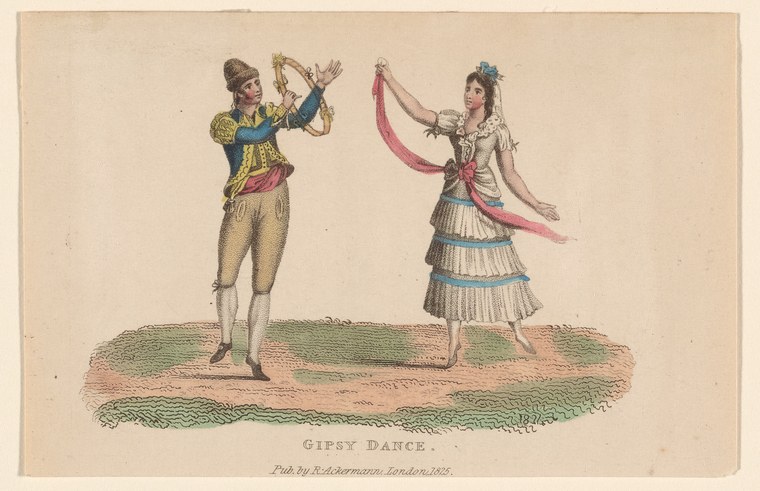
Gipsy dance
Unknown artist
- Collection:
- Prints depicting dance
- Source:
- New York Public Library
- Rights:
- Public domain — free to use, share and adapt.
- Recorded as:
- Public Domain
This print reveals how early 19th-century European theater packaged and exoticized non-European dance for consumption, and how commercial printmaking helped establish and circulate specific choreographic and costume conventions for 'Gipsy' performance. The work is a rare documented example of theatrical 'ethnic' dance as performed in London during the Romantic era, before such representations became more standardized in ballet and music-hall traditions.
What you are looking at
A colored engraving depicting two figures in an open landscape with green grass and brown earth, posed to show a Romani or 'Gipsy' dance as understood by early 19th-century European printmakers. On the left stands a male dancer in a yellow jacket with red trim, tight breeches, and stockings; he holds his arms raised and bent, his hands near his head in a gesture of animation or flourish, his body angled in an energetic contrapposto. On the right, a female dancer wears a tiered, flounced white skirt with blue trim, a white bodice, and a draped pink or red shawl across her torso; her left arm is extended to hold the shawl aloft in an arc, her right arm at her side, her body upright and her gaze directed toward her male partner. Both figures are centered on a shallow stage-like ground, posed rather than caught in motion, in a manner typical of instructional or theatrical dance prints of the period.
The dancing
The two dancers maintain an open, face-to-face relationship with substantial distance between them—no closed hold or partnering contact. The male figure's raised arms and animated hand positions suggest Spanish or Mediterranean influence, with the hands held high and the elbows bent; his legs are straight and his weight appears evenly distributed. The female figure's extended arm carrying the shawl creates a linear, decorative line; her posture is upright and her stance grounded, suggesting a display stance rather than active traveling steps. Both figures are shown in profile or three-quarter view to the viewer, allowing clarity of silhouette and costume.
The dance depicted
The work is titled 'Gipsy Dance' and appears to represent a romanticized, theatrical interpretation of Romani dance as performed or imagined in early 19th-century Europe. The costume details—the male figure's close-fitting jacket and the female's tiered skirt and decorative shawl—reference Mediterranean and Spanish-Romani visual conventions rather than ethnographic accuracy. The open spacing, the emphasis on shawl work, and the animated arm positions suggest an influence from Spanish flamenco or popular European theatrical adaptations of 'exotic' dance, though the term 'Gipsy' indicates it was presented as Romani. The pose and composition suggest this is an instructional or promotional print documenting a specific theatrical choreography rather than a documentary of living practice.
How it was made
This is a hand-colored engraving or etching, evident from the fine line work, cross-hatching, and the careful application of color in distinct areas (yellows, pinks, blues, greens). The technique allowed for precise figural definition and decorative detail in costume, and the hand-coloring extends the cost and indicates circulation among a relatively affluent audience. The publication line 'Pub by R.Ackermann, London, 1825' confirms this as a commercial print produced by the prominent London print publisher and art dealer Rudolf Ackermann, whose shop and publishing house were known for theatrical, fashionable, and instructional prints. Such works circulated widely among the theater-going public, dancers, and those curious about fashionable amusements.
About this work
This is a theatrical dance print from early 19th-century London, commissioned or published by Rudolf Ackermann, depicting a 'Gipsy Dance' in the Romantic period's fascination with exoticized and orientalized subjects. The print documents both a choreographic idea and a visual stereotype—the costume, open spacing, and dramatic gesture reflect how European audiences and artists imagined Romani dance, filtered through Spanish and Mediterranean theatrical conventions. The work belongs in a dance history collection as a primary document of how non-European dance forms were appropriated, performed, and circulated in the European theater and popular imagination of the 1820s. It is also a record of the commercial dance-print market that served both theatrical professionals and amateur enthusiasts.
How to look at it
Attend to the costume details and their sources: the male figure's jacket and the female's tiered skirt and shawl were not ethnographic but theatrical inventions, drawn from Spanish and Mediterranean sources rather than documented Romani clothing. Notice the open spacing and lack of physical contact between the dancers, which suggests this is a display or solo-turn format adapted for the theatrical stage rather than a social dance. The raised arms and animated hand positions of the male figure, and the extended shawl work of the female, indicate the emphasis on decorative, visible movement for audience viewing—characteristic of early 19th-century theatrical dance. The careful, posed composition and the refined engraving technique suggest this was a prestige object, not a cheap broadside, aimed at educated theatergoers and perhaps dancers themselves.
The artist
The work is attributed to publication by Rudolf Ackermann, a Saxon-born London print publisher and entrepreneur (1764–1834) who established himself as a major figure in the London print trade from the 1790s onward. Ackermann's shop on the Strand was famous for theatrical prints, fashion prints, and colored engravings aimed at a broad middle-class market. His output included instructional prints on fashion, manners, and popular entertainments. The artist or engraver is not identified in the catalogue record, which was common for commercial prints of this period; such works were often collaborative productions or attributed to the publisher rather than the maker.
The period
The 1820s saw a peak in the European Romantic interest in exotic and 'Oriental' subjects across visual art, theater, and dance. The London theater world of this period was engaged in staging increasingly elaborate spectacles and character dances, drawing on Spanish, Italian, and imagined 'Gipsy' themes. The hand-colored engraving was at the height of its commercial production in this decade, before lithography began to dominate the market in the 1830s–1840s. The Ackermann print shop was a leader in this market, publishing thousands of theatrical and fashionable prints. The 'Gipsy Dance' print sits within a broader visual culture that treated non-European and marginalized communities as sources of visual spectacle and costume rather than as sources of living cultural practice.
Where it lives
The work is held in the New York Public Library's collection of prints depicting dance. The publication line indicates it was issued by R. Ackermann, London, in 1825, making it a commercial theatrical print with wide potential circulation among the urban middle class of the period.
Dance in this work
Questions about this work
Is this a real Romani dance or a European invention?
This is a Romantic-era theatrical adaptation, not a documentary record of Romani dance practice. The costume and choreography were designed for European audiences and drew from Spanish and Mediterranean theatrical conventions. Early 19th-century Europeans often conflated Romani, Spanish, and 'Oriental' visual markers, and commercial theater capitalized on this imagined exoticism.
What was Rudolf Ackermann's role?
Ackermann was a London print publisher and entrepreneur who ran one of the largest and most successful print shops in early 19th-century London. His business produced thousands of colored engravings aimed at the affluent middle class, including theatrical prints, fashion plates, and instructional works. He was the publisher, not necessarily the artist or engraver.
Why are the dancers so far apart?
The open spacing is typical of theatrical solo or display dances, where the emphasis was on visible, decorative movement and costume rather than partnering. This format allowed each dancer's movements and attire to be clearly seen by the audience and was standard in Romantic-era theater and in instructional prints.
What does the engraving technique tell us?
Hand-colored engravings were expensive and prestigious in the 1820s, indicating this print was made for educated, affluent buyers rather than mass or working-class audiences. The technique allowed fine detail in both line work and color, suitable for documenting costume and theatrical spectacle.
More dance artwork





