49 works in this view — arrow keys or swipe to move between them.
Dance in Art
Melle. Plunkett, dans La mañola de La favorite
Unknown artist
- Collection:
- Prints depicting dance
- Source:
- New York Public Library
- Rights:
- Public domain — free to use, share and adapt.
- Recorded as:
- Public Domain
This print documents a theatrical role and performer name that anchors the history of mid-nineteenth-century European dance and its repertory. For historians, it provides evidence of how Spanish and Spanish-inspired material was costumed and marketed to audiences, and of the international circulation of theatrical talent. The isolation of the single named figure—the focus on the performer rather than the ballet or the company—shows the centrality of the star dancer to theatrical culture and marketing of the era.
What you are looking at
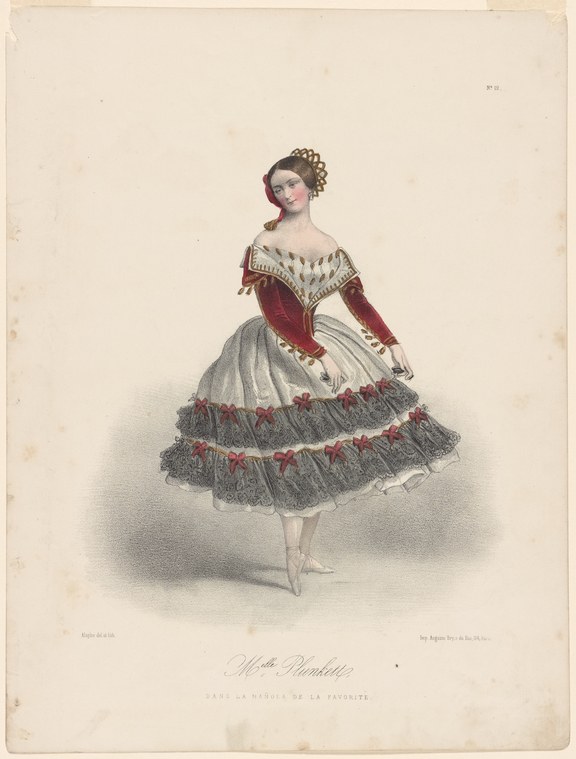
A young woman in theatrical dress stands alone against a plain background in a pose of graceful stillness. She wears a white bodice with red velvet off-shoulder sleeves trimmed in gold, and a full skirt of pale silk with three deep flounces of black tulle ornamented with red bows. A jeweled headdress sits in her upswept blonde hair. Her posture is upright and composed, one leg slightly forward in a stance that suggests either the conclusion of a movement or a moment of repose between phrases. The hand position is relaxed at her sides. The figure is modeled with soft shading that gives her volume and presence against the pale ground, and her gaze is directed toward the viewer with a calm, professional demeanor typical of mid-nineteenth-century theatrical portraiture.
The dancing
The dancer is shown in a standing position with her weight evenly distributed, neither actively engaged in a step nor in a fixed classical pose. The frame is frontal and open, with no partner or ensemble visible. Her bearing is upright and dignified; the arms hang naturally rather than being placed in a codified position. The slight forward placement of one leg suggests the stance might be transitional—the moment between movements—rather than a fixed attitude or arabesque. There is no visible turnout at the hip or elevation of the heels, and the posture reads as resting rather than dancing.
The dance depicted
The costume and title reference *La mañola de la Favorita*, likely a theatrical piece from the Spanish romantic tradition, possibly a divertissement or solo from a larger work. The term 'mañola' refers to a young woman or girl from Madrid of a particular social character, often romanticized in nineteenth-century Spanish popular culture. The print title attributes this role to Melle. Plunkett, suggesting a named performer in a known theatrical production. The costume—the red velvet, the white skirt, the jeweled headdress—is theatrical Spanish or Spanish-inspired rather than folklorically authentic, marking this as a stage interpretation rather than an ethnographic representation. However, without being able to date the print or confirm details of the production, the specific dance form cannot be definitively identified.
How it was made
This is a hand-colored lithograph or engraving, evidenced by the fine line work in the figure and the characteristic softness of the shading, likely from a theatrical print series. The coloring—applied by hand in delicate washes—is typical of mass-produced theatrical souvenir prints from the mid-nineteenth century, designed for circulation among theater patrons. The technique allowed for rapid, relatively affordable reproduction of recent performances and was a standard medium for documenting dancers and their roles. The inscription at the bottom in fine script would have carried the performer's name and the role or production title.
About this work
This is a portrait print of a named performer—Melle. Plunkett—in the role of a mañola, a romanticized figure of Spanish urban culture, in a theatrical work titled *La mañola de la Favorita*. The work belongs to the tradition of theatrical souvenir prints that documented celebrated dancers and their signature roles for a middle-class theater-going public. The costume is theatrical Spanish pastiche rather than folk dress, reflecting the nineteenth-century European taste for exotic and romanticized characterizations. The image preserves the record of a specific performer and role at a moment when such prints were the primary visual evidence of performance practice beyond written reviews.
How to look at it
The artist has chosen a moment of stillness and frontal display rather than a dynamic step or turn. This was a standard convention for theatrical portraiture: the figure is posed to show the costume clearly and to project composed authority toward the viewer. The stance is neither balletic (no turnout, no arabesque) nor folk-derived; it is a theatrical pose designed for recognition and admiration of the performer and her costume. Notice the care taken in rendering the fabric and ornament—the flounces, the trims, the headdress—which would have been what patrons paid to see on stage.
The period
This print dates to the mid-nineteenth century, an era in which theatrical portraiture, especially of celebrated dancers, was a thriving commercial genre across Europe. The 1830s–1850s were the height of Romantic ballet, with its emphasis on ethereal, exotic, and nationally marked roles—the sylph, the Spanish maiden, the peasant girl. French and Italian lithographic print shops produced thousands of such souvenir portraits for export throughout Europe. The costume style and the theatrical Spanish subject matter place this within the era of *La Favorita* (Donizetti's opera premiered 1840), which sparked European fascination with Spanish material and may have influenced theatrical productions and divertissements.
Where it lives
The work is held in the New York Public Library's Prints Depicting Dance collection. It is a lithograph or engraved print, hand-colored, of the type mass-produced and distributed as theatrical souvenirs or publicity in the mid-nineteenth century.
Dance in this work
Questions about this work
Who was Melle. Plunkett?
She is identified only by this print as the performer of the role of the mañola in *La mañola de la Favorita*. No additional biographical information is recorded here. Theater historians or archivists specializing in mid-nineteenth-century European dance may have more detailed records.
What is a mañola and why is this character in a ballet or theatrical work?
A mañola was a young working-class woman from Madrid, characterized by local dress and manners. Nineteenth-century European theater, especially after the success of Romantic opera and ballet, romanticized Spanish and exotic national types as subjects for theatrical divertissements and character dances. This was part of the era's taste for orientalism and theatrical nationalism.
Is this a ballet or a different form of dance?
The costume and the solo presentation suggest a theatrical character role—possibly a solo or a featured divertissement within a larger work—rather than a classical ballet role. The absence of pointe shoes, the lack of balletic pose vocabulary, and the emphasis on costume detail point toward a character dance or Spanish-themed theatrical piece.
More dance artwork





