49 works in this view — arrow keys or swipe to move between them.
Dance in Art
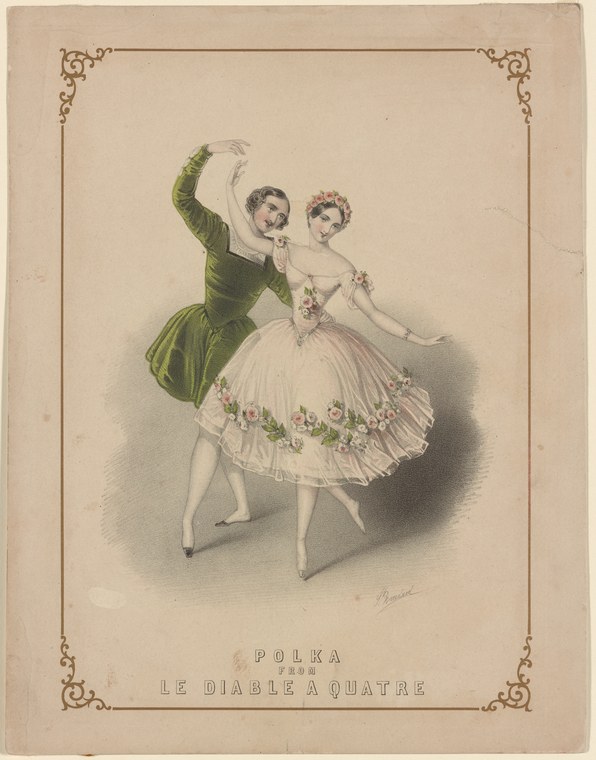
Polka from Le diable à quatre
Unknown artist
- Collection:
- Prints depicting dance
- Source:
- New York Public Library
- Rights:
- Public domain — free to use, share and adapt.
- Recorded as:
- Public Domain
It captures the exact moment European culture was discovering that a social dance could be transformed into spectacle through acrobatic amplification. The polka's trajectory from village to salon to stage theatre, all within 15 years, is one of the most rapid dance assimilations in history, and this print shows the endpoint: a ballet-pantomime incorporating social dance material into classical technique.
What you are looking at
A man in green velvet coat and white breeches lifts a woman in a white tulle skirt trimmed with flowers, suspending her in the air with one arm while his other hand waves a white handkerchief overhead. The woman's body is nearly horizontal, her legs extended and feet pointed, her arms held gracefully. The composition is set against a plain background with a decorative border frame typical of mid-19th-century dance prints. The moment captured is one of theatrical lift and elevation, the woman's skirt billowing softly around her suspended form. The print employs subtle shading to suggest movement and weight, with the figures emerging from the pale background in the cool tonalities of hand-colored lithography.
The dancing
Two dancers in a ballistic lift: the male dancer supports the female with his raised arm in an asymmetrical embrace, his body leaning back to counterbalance her weight, while his free hand gestures skyward with the handkerchief in a flourish. The female dancer's body is nearly prone—legs extended, feet pointed, arms held in gentle curve—in a position requiring both partners' technical control. The composition suggests acrobatic capability from the male dancer and trust from the female, typical of the virtuosic pas de deux format.
The dance depicted
This is a polka, a dance that dominated European ballrooms and theatres from the 1840s onward. The title *Polka from Le diable à quatre* (The Devil's Four, or Four-Part Devil) identifies this as a theatrical version, likely from the ballet-pantomime of that name. The acrobatic lift—far more extreme than the social polka—indicates this is a theatrical showpiece, not a ballroom step. The handkerchief and the woman's elevated, near-horizontal position show the polka's evolution into spectacle on the professional stage, where dancers incorporated lifts and flourishes absent from its social form.
How it was made
This is a hand-colored lithograph, a process that allowed rapid production and wide circulation of dance imagery to both theatre audiences and the broader public. The soft modeling of flesh tones, the delicate shading that suggests musculature and fabric weight, and the even hand-coloring are characteristic of mid-19th-century commercial dance prints. The decorative border in gold-toned ink marks this as a finished, framed print for display or collection rather than a working costume plate.
About this work
A theatrical polka from the 1840s–50s, depicting the acrobatic apotheosis of a dance that began as a peasant step from Bohemia and within a decade had conquered European salons and stages. The image documents the moment when ballroom dance moved into bodily extremes—the lift, the extension, the theatrical flourish—that defined romantic-era ballet and theatrical dance. This is not how people danced the polka socially, but how it appeared in the professional theatres that shaped public imagination about dance.
How to look at it
Notice the exact moment of the lift: the woman is not moving upward but held at apogee, her body nearly horizontal, her weight fully committed to her partner. The handkerchief overhead is not accident but flourish—it signals theatrical performance, not social dancing. The tulle skirt, the pointed feet, the extended line from shoulder to toe, and the male dancer's controlled posture all signal classical ballet training applied to a popular dance. This was how audiences saw the polka transformed: not as a lively hop, but as an aeronautic feat.
The artist
The artist is unrecorded, but the print style and composition are typical of the Parisian and London commercial lithography houses that supplied the theatre-going public with dance imagery in the 1840s–50s. These were unsigned mass-market prints, made to be affordable and collectable, and they remain the primary visual record of how romantic-era dances looked in professional performance.
The period
The 1840s were the polka's decade of conquest. Originating in Bohemia around 1830, it reached Prague in 1835, Vienna in 1839, and Paris by 1840, where it became a sensation overnight. *Le diable à quatre* was a hit ballet-pantomime (choreographed by Joseph Mazilier, music by Adolphe Adam) first performed at the Paris Opéra in 1845. The theatrical polka borrowed the social dance's characteristic rhythm and hop but elevated it through extension, lifts, and the formal technique of the ballet corps and soloists. This period saw the romantic ballet at its height—an era when classical technique and pointe work were deployed to make dancers appear weightless, ethereal, and superhuman. The polka's arrival coincided with the full maturity of Romantic ballet aesthetics, and theatrical polkas became showcases for the virtuosity prized in the era.
Where it lives
This print is held in the New York Public Library's collection of prints depicting dance. It is a commercial lithograph, one of thousands produced for the mid-19th-century theatre-going public, and is representative of how theatrical dance was circulated and consumed as visual commodity.
Dance in this work
Questions about this work
What is the polka, and why was it such a big deal?
The polka was a Bohemian dance that became a European craze in the 1840s, moving from village celebrations to aristocratic salons to professional theatres within a decade. Its arrival coincided with the height of Romantic ballet, and theatres incorporated it as a spectacle featuring classical technique and acrobatic lifts. It represented an unusual moment: a social dance that acquired professional prestige and theatrical elaboration rather than fading from fashion.
Is this what people actually danced at balls?
No. The social polka was a spirited, hopping couple dance with less elevation and no lifts. This is a theatrical version, made spectacular for stage performance. The lift, the extension of the woman's body, the handkerchief flourish, and the sheer technical control all mark this as professional spectacle, not social dancing.
What is 'Le diable à quatre'?
It is a ballet-pantomime choreographed by Joseph Mazilier with music by Adolphe Adam, first performed at the Paris Opéra in 1845. It was a hit and remained in the repertory for decades. The work incorporated contemporary social dances, including the polka, into classical ballet form, making them part of the theatrical spectacle.
Why do dance prints matter?
Before photography and film, prints were the primary way dance was circulated as image and memory. They show us not just what dancers wore, but what the era valued about the body—the line, the weight, the moment of maximum spectacle. This print shows us what Romantic-era audiences paid to see.
More dance artwork





