49 works in this view — arrow keys or swipe to move between them.
Dance in Art
Ballroom dancing on British and American 19th-century music covers
Unknown artist
- Collection:
- Prints depicting dance
- Source:
- New York Public Library
- Rights:
- Public domain — free to use, share and adapt.
- Recorded as:
- Public Domain
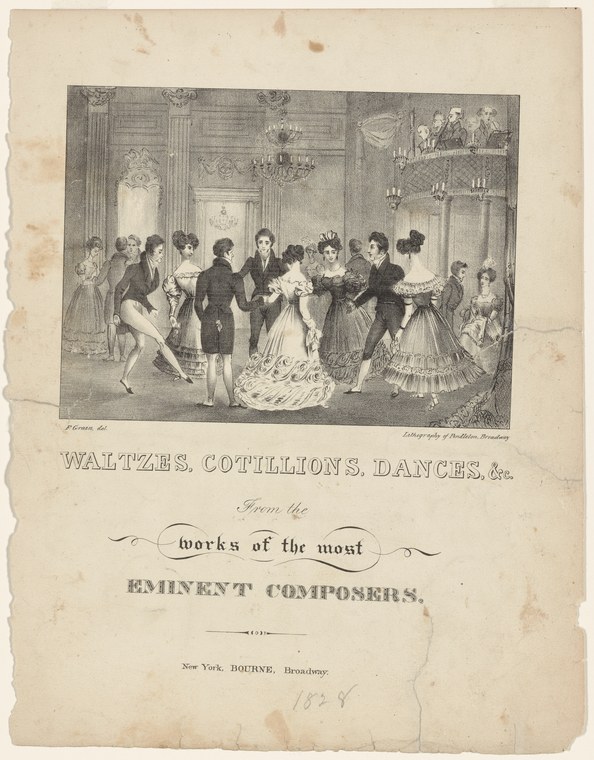
For historians of ballroom culture, this is evidence of how the waltz and cotillion were presented to American audiences in the early 1800s—not as exotic imports but as fashionable repertoire for domestic entertainment. The image also documents the visual conventions of the period: the dress codes, the ballroom architecture, the role of musicians, and the social hierarchy visible in who dances and who watches. For dancers, it shows how the waltz was framed and posed for commercial appeal, offering a window into period aesthetics and the market for dance.
What you are looking at
An engraved ballroom scene depicts well-dressed couples and groups in a grand interior with columns, chandeliers, and a gallery above. The space is crowded with figures in early 19th-century formal dress: men in dark coats and breeches, women in high-waisted Empire silhouettes with full skirts and elaborate hairstyles topped with feathers or ornaments. In the foreground, a couple performs a closed-hold dance—the woman's voluminous skirt is caught mid-swirl, her frame upright, his posture formal and contained. Around them, other couples stand in conversation or prepare to dance, while musicians and spectators occupy the gallery. The composition is lively but orderly, the engraving technique rendering the scene with fine detail and a pale wash that suggests candlelit warmth.
The dancing
The central couple holds in closed ballroom position with the man's right arm at the woman's waist and her left hand resting on his right shoulder—a formal frame consistent with early 19th-century etiquette. Both figures are upright and dignified rather than spiraling; their weight appears centered, not thrown into the traveling action of later waltzes. The woman's skirt, caught in mid-motion, fans outward and upward, showing the fabric's volume rather than the tight control of a later era. Other couples and individuals stand at various distances, some engaged in dance, others in social conversation, creating a scene of ballroom activity rather than a single focused moment.
The dance depicted
This is a waltz or cotillion scene from the Regency or early Romantic era (circa 1810s–1830s), when both dances dominated European ballroom culture. The title page explicitly lists 'Waltzes, Cotillions, Dances' from compositions by eminent composers—this is a music cover illustration, not a documentary record, so the specific dance cannot be determined from the image alone. The closed hold and upright posture are consistent with the waltz as it was danced in England and America in this period, more restrained than Continental versions. The formal dress, the presence of musicians, and the grand interior all confirm this is fashionable urban ballroom dancing of the leisure class.
How it was made
This is a hand-colored engraving, recognizable by the fine parallel line-work (hatching) that defines shadow and form, combined with a pale tinted wash applied after printing. The technique allows both precise architectural detail and the rendering of texture—the sheen of silk, the play of candlelight on faces and fabrics. As a music cover illustration published by Bourgne in Broadway, New York (noted on the plate), it was produced for commercial circulation to a genteel domestic audience—these were sold alongside sheet music and intended for piano drawing rooms. The engraving's refinement and narrative clarity suggest a publisher investing in attractive presentation of dance instruction and repertoire.
About this work
This engraved ballroom scene illustrates the social and musical world of American and British dance in the early 19th century. It is a commercial music cover, designed to sell waltzes, cotillions, and other dances to a wealthy urban audience who purchased sheet music for home performance and dancing. The image shows not just the dance itself but its setting, dress code, and social function—an evening of formal ballroom entertainment in a grand house. The engraving technique and composition suggest that visual representation of dance was becoming a marketing tool, not merely documentation; the publisher is selling an ideal of elegance and courtly pleasure as much as the music itself.
How to look at it
Attend to the posture and distance between the dancers: the man and woman in the foreground are upright and separated by the formality of the hold, not pressed close or yielding to each other. The woman's skirt is the focal point—its volume and the caught moment of its swing suggest the waltz's rotational movement, but the couple's frame is restrained. The background figures in conversation or waiting to dance show that the ballroom is a social stage, not a space of private feeling. The engraving technique itself—with its fine hatching and careful tonal gradation—creates an impression of refinement and order that matches the dance's formal elegance.
The artist
The engraver is not recorded on the surviving catalogue record. The plate inscription credits 'Bourgne, Broadway' as the publisher, a New York commercial house. The technique and style are consistent with early 19th-century commercial reproductive engraving—the work of skilled artisans producing illustrations for sheet music, periodicals, and books for the genteel market. Without further documentation, the engraver's identity remains unknown, though the quality of execution suggests a trained professional.
The period
The waltz was spreading across Europe and America in the 1810s and 1820s, with some moral objection to the close hold but strong uptake among fashionable society. Sheet music with illustrated covers became a standard product of urban music publishing houses, especially in New York and London. This engraving dates from the height of the Romantic era in art and music; the figure drawing and composition reflect Neoclassical restraint rather than dramatic Romantic gesture, placing it in a transitional moment when ballroom scenes were idealized rather than sentimentalized.
Where it lives
This work is held in the New York Public Library's collection of prints depicting dance. It is a commercial music cover illustration, one of many such works produced by American and British publishers in the 19th century to accompany and promote sheet music for amateur musicians.
Dance in this work
Questions about this work
What dances are shown here?
The title page lists waltzes, cotillions, and other dances. The central couple appears to be waltzing or performing a cotillion based on their closed hold and upright frame. Both were fashionable ballroom dances in the early 19th century, and this cover advertises music for all three.
Is this a historical document or an idealized picture?
It is both. As a commercial music cover, it is designed to appeal to buyers and to present dance as elegant and aspiring—an ideal. But it also records real practices: the dress code, the ballroom setting, the presence of musicians, and the formal posture all reflect how ballroom dancing actually happened in wealthy households.
Who published this and where?
Bourgne, a publisher on Broadway in New York, issued this cover. New York was a major center of music publishing in the early 19th century, and covers like this were sold to amateur musicians and dancers who played and danced at home.
Why is the woman's skirt so full?
Empire-waist fashions of the 1810s–1830s featured high-waisted, flowing skirts with minimal structure. The waltz's rotational movement caused the skirt to swing outward, and the engraver has captured this moment to convey both the elegance of the dress and the energy of the dance.
More dance artwork





