49 works in this view — arrow keys or swipe to move between them.
Dance in Art
Rosati
Unknown artist
- Collection:
- Prints depicting dance
- Source:
- New York Public Library
- Rights:
- Public domain — free to use, share and adapt.
- Recorded as:
- Public Domain
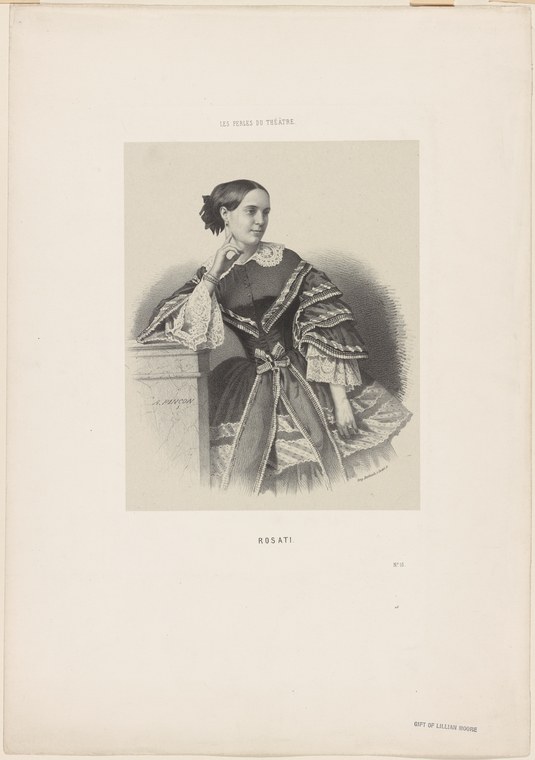
Rosati was a significant international ballerina whose career spanned the height of Romantic ballet, yet her name and likeness have faded from general memory. This engraving is primary documentation of her celebrity and the visual conventions through which 19th-century audiences knew the great dancers of their time—not as captured movement, but as idealized social and artistic figures.
What you are looking at
A three-quarter-length portrait of a woman in mid-19th-century dress, shown in three-quarter pose against a plain background. She wears a dark bodice with voluminous sleeves decorated with contrasting light-colored trim or lace, and a white collar. Her hair is dark and pulled back simply. She holds a small fan in one hand and gazes to her right in a composed, theatrical manner. The figure is rendered in fine engraving technique with careful attention to the texture of fabric and the play of light across her form. The composition is formal and dignified, suggesting a portrait of a notable performer or public figure.
The dancing
The figure stands in a relaxed but composed stance, weight seemingly balanced on both feet, with one arm raised to hold the fan near her shoulder. The pose is stationary and presentational rather than dynamic—there is no evidence of active movement or dance position. The posture is upright and formal, consistent with mid-century portrait convention rather than the captured moment of choreographed motion.
The dance depicted
The title 'Rosati' and the formal theatrical dress suggest this is a portrait of a notable performer, almost certainly the Italian dancer Carlotta Rosati (1826–1905), a principal ballerina of the Romantic era. However, the image itself shows a stationary portrait pose, not a depiction of dancing. Rosati was celebrated for roles in ballets including *La Muette de Portici* and *Le Corsaire*, but this engraving captures her as a social or professional portrait subject rather than in performance.
How it was made
This is a steel or copper engraving, characteristic of mid-19th-century reproductive printmaking. The fine parallel hatching, careful modeling of light and shadow, and the precision of line work are typical of engraving as opposed to etching. Such prints were produced in substantial editions and were affordable to middle-class audiences, making them the primary medium through which the public encountered images of celebrated performers. The technique's formality and technical precision suited the dignified presentation of theatrical celebrities.
About this work
This engraving documents a celebrated dancer of the Romantic ballet era through a formal portrait rather than a performance image. Carlotta Rosati was one of the reigning ballerinas of the 1840s–1860s, a period when Romantic ballet—with its emphasis on ethereal femininity and exotic narratives—dominated European stages. The portrait's elegance and restraint reflect the cultural status of the prima ballerina as both artist and public figure. The image belongs in a dance archive not because it depicts dancing, but because it is material evidence of how Romantic dancers were marketed, remembered, and visualized for the public sphere.
How to look at it
Attend to the deliberate pose and composed gaze: this is not a candid image but a carefully arranged portrait following conventions of social portraiture. The fan, the three-quarter turn, the direct but thoughtful expression—all signal the dancer as a refined public figure. The engraver's technique, visible in the fine parallel lines that model the fabric, demonstrates the technical skill required to reproduce the texture and dignity of the sitter's appearance for a mass audience.
The artist
The engraver is not recorded. The print's style and execution suggest a professional reproductive engraver of the mid-19th century, working in Paris or London where such celebrity portraiture was a commercial enterprise. The signature or initials visible on the engraving (partly legible at lower left) may identify the artist, though this cannot be confirmed from the catalogue record.
The period
This engraving dates to the height of Romantic ballet in Europe (1840s–1860s), when dancers like Rosati, Marie Taglioni, and Fanny Essler were international celebrities. Printmaking was the primary means of circulating their images; photography existed but had not yet displaced engraving for artistic portraiture. The formal dress shown here—the dark bodice and elaborate sleeves—reflects mid-19th-century fashion, though Rosati would have worn classical tutu and pointe shoes on stage. Such portraits recorded dancers in street dress or light formal wear, presenting them as fashionable women of society as much as theatrical performers.
Where it lives
This engraving comes from the New York Public Library's collection of prints depicting dance, where it is catalogued simply as 'Rosati' with no artist, date, or publication information recorded. It is one of many such celebrity portrait prints from the 19th century, often issued singly or as part of theatrical souvenir series.
Dance in this work
Questions about this work
Who was Carlotta Rosati?
Carlotta Rosati (1826–1905) was an Italian prima ballerina of the Romantic era, celebrated for roles in major ballets including *La Muette de Portici* and *Le Corsaire*. She performed across Europe and maintained a prominent international career during the 1840s–1860s, a golden age of Romantic ballet. Like other celebrated dancers of her era, she became a public figure whose image was widely reproduced in prints.
Why is this a portrait rather than a dance scene?
By the mid-19th century, most celebrated dancers were recorded in formal portraiture rather than performance imagery. Engravers captured them in fashionable street dress or light theatrical costume, presenting them as refined artists and social celebrities. Action scenes from stage performances were less common, partly due to the technical difficulty of engraving dynamic poses and partly because portrait conventions dominated the marketing of celebrity.
How were 19th-century dancers known to the public?
Before photography displaced engraving, reproductive prints like this were the primary way audiences encountered images of stage performers. Such portraits circulated widely and affordably, making them important historical documents of theatrical celebrity. Dancers' images appeared on playbills, in souvenir collections, and as standalone prints for collectors of theatrical memorabilia.
More dance artwork





